The Road Home

The Road Home
There is no place like home.

Tuesday, May 5, 2015

Fern's Cheese Making Tips

Now that Frank and I have been making cheese for about four years, we have worked out some kinks, developed a working routine, and figured out how to solve some problems that were
Our first wheel of cheddar
affecting either the ease of the process or the flavor of the cheese. Except for reading my cheese making books, or articles online, I have never met anyone that makes cheese. Much of what we have done, and continue to do, is trial and error. And, as with any new venture, once the basics are somewhat mastered, the time of real learning can begin. It's like gardening. Once you have grown a particular plant for a few seasons, then you really begin to figure out how to increase production through proper soil conditions, moisture requirements, insect pest control and companion planting. I once heard an analogy of comparing learning to an onion. As you peel off a layer, it reveals more of the onion. I think cheese making, gardening, and many other ventures are the same. The more you learn and master, the more is revealed that you can learn.


Making cheese. It takes some time, equipment and good, quality ingredients. All of the cheese we have made comes from our own goats' milk. There have been a few batches of mozzarella along the way that I tried making with milk that I had skimmed the cream from, but it just doesn't taste as good as whole milk, so we don't skim the cream before making cheese. I have already written articles about making several different cheeses, as well as how I wax our cheddar, and will list them here for your convenience. 


There are also several more articles and recipes for using some of these cheeses, like making cheesecake from Chevre, listed under the page, The Things You Can Do With Milk, found at the top right hand corner of the blog under Things To Read.


I included a picture of our first wheel of cheddar for a couple of reasons. One, I was very excited to actually begin making cheddar, and two, because it tasted awful. It was rather disheartening to finally have a dream come true, only to have to wait a couple of months to find out it was very bitter with a strong after taste. After two years, yes two years, we began to wonder if all homemade cheddar was supposed to have this strong, bitter aftertaste. Well, it's not. Most of our cheddar up to that point ended up with a reddish kind of mold inside the wax. It wasn't mold in the normal sense, like that stuff that shows up on your bread or old leftovers in the frig, but it was something that was obviously growing in there. So, I read all of my cheese making books and did many online searches. That was a couple of years ago, so I can't give you the sources of my information, because I don't remember where I found them. But this is what I discovered.


One. Before you wax any cheese for aging, brush the entire surface well with apple cider vinegar, then let it dry for a bit. Do this after you have let it sit and form the rind for a few days, according to the directions for the type of cheese you are making. The vinegar will help kill any surface bacteria on your cheese before you encase it in wax. Two. Keep your wax as hot as you can get it during the entire waxing process. I wax with a brush, not the dipping method, which is much faster that applying layers of wax with a brush. There is a post
listed above about waxing. At first I was melting the wax, then turning off the heat. According to my research, the wax needs to be as hot as possible during the entire process. This also helps to kill any bacteria on the surface of the cheese. The result? No more strong, bitter aftertaste, and a wonderful cheddar flavor. Needless to say, I was very happy after two years of making cheese to finally discover the reason for my much less than desirable cheeses.


And the best way to clean up those wax drips from the stove and cabinet? Paper towels.


Some other tips I found along the way for making cheddar have caused me to adjust a few things. I only ripen the milk and buttermilk for 45 minutes instead of an hour. This will lessen the acidity somewhat. Reasons for too much acidity can vary, with one of them being the animal you milk. I also use just a hair less rennet than the recipe calls for. As we've have gained more experience, and identify certain flaws in the process, research has been very helpful in increasing the success and flavor of the finished product.


Another thing I discovered recently is how to keep the wheels of cheese from being very difficult to remove from the mold after the last 24 hour press. It appears that it is natural for some bacteria to grow between the cheese, cheese cloth and cheese press. This can make it extremely difficult to get the wheel out after is has sat for 24 hours. To alleviate this, wipe down the inside of the mold, the surface of the press and the follower with apple cider vinegar. I did this the other day and it worked great. The only place the cheese stuck was to the base of the press. I put the vinegar on the follower and mold with a cotton cloth, but forgot to do the base. But because I overlooked the base, it showed me just how effective this technique was.


Making buttermilk from a commercial culture is very easy, as I outlined in the article above. About the only thing we do different now, is keep a continual supply by using about 1/8 cup of our existing culture to inoculate the next batch. This limits our need for commercial buttermilk culture to the first batch of the year when we begin renewing our cheese supply. With the double batch of cheddar we started this morning, it was time to culture another quart of buttermilk.


Mozzarella cheese is fairly easy to make and doesn't take the time or attention cheddar does. We can make a quadruple batch of mozzarella in about four hours, while an equal amount of cheddar takes about eight hours and more babysitting, meaning you have to tend to the next step more often, so you can't get really involved in any other projects or chores while making it. The hardest thing to learn about making mozzarella is the stretching process, and it's almost impossible to describe in words. The first batches I made tasted okay, but the consistency was like rubber. Really. Kind of like chewing on one of those rubber balls kids used to play with. But we ate it anyway. Frank is a wonderful man that way. He will usually try to eat anything I make, even if it's like rubber or has a strong, bitter after taste.

There are a couple of things I am doing different this year when making mozzarella. First, I read that you can save the brine and reuse it many times. That was great news. It always bothered me to use 1/2 cup of salt per batch of cheese, only to pour it out. That seemed like such a waste of salt. We tried adding the salt to the curd, like some recipes recommend, but like it much better when the cheese is soaked in a brine. Second, I am using water to stretch the cheese instead of whey. I liked the idea of using whey since it is a natural byproduct of making cheese, but it seemed to be the cause of the cheese souring long before I thought it should. Since I have changed to water, we haven't had that problem.

Chevre. Even though chevre is versatile and can be used in many different recipes, including cheesecake, I have never really liked it much. We have tried seasoning it a number of different ways, from dill, to garlic, to ranch. Frank likes it in a celery stalk, and I will eat it, but I can just as easily do without it. We haven't made any this year because we still have some in the freezer. Chevre is by far the least labor intensive cheese to make. Just remember to roll it back and forth in the cheese cloth before you leave it to hang. It gets a lot of the whey out, and leaves a nice soft cheese.

I'm still experimenting with the pressed herb cheeses. So far the only type I have made is with small green onions and fresh garlic. The flavor is good, but the texture is not. The only thing I can figure out so far is that I press it too hard. It is a little dry, and it squeaks in your teeth, which I don't care for. I haven't tried any more herb cheese yet since we are working on our goal of getting 30 wheels of cheddar waxed and aging before the garden produce starts coming in. We have a number of herbs growing in the herb bed that would make a nice herb cheese, so I will be experimenting more later in the summer.


We have worked out a very good routine for making cheese as well. The equipment we use is well suited for making a large double boiler. It also processes many vegetables for the canner in the summer. Using a double boiler makes it easy to control the temperature of the milk and curd without scorching or overheating the milk on the bottom of the pan. Long thermometers work very well for our 12 quart stock pots. Any type of cheese press will work. We prefer this version because it doesn't take up much room. Our kitchen is small and many times when we are making cheese, cabinet space comes at a premium. 


I have tried to 'hurry' the process along before by trying to put hot instead of cold water into the double boiler. This just doesn't work. Regardless of what type of cheese we're making, the curd ends up separated and kind of stringy instead of a nice, solid mass. I have also tried using milk fresh from the barn before it has been chilled in the refrigerator, but I get the same loose, inconsistent curd. So the lesson I have learned from this is, allow adequate time, use chilled milk with cold water, and follow the directions for whatever recipe you are using.

Temperature of the milk/curd

Temperature of the water in the bottom pot
When you are heating the milk or curd to a specific temperature, let's say 88*, don't heat it all the way to the desired temperature if you are using a double boiler. Does that make sense? Probably not. I got the temperatures too hot, if only by a few degrees, more than once, and ended up taking the cheese pot out of the pot of water, to either maintain the correct temperature or to cool it off. I've learned to turn the fire off when the temperature reaches four to six degrees cooler than the desired temperature. So in the example of 88*, I turn the fire off at 82*, wait about ten more minutes, when the desired temperature is reached. The pot of water is usually warmer than the milk or curd, which is how the correct temperature can be maintained over the 30 to 45 minute time period most curd is allowed to ripen or set up. I occasionally don't keep a close enough eye on things and still have to take the pots out so they don't get too hot, but I was glad to figure out a better process so I could leave the curd in the double boiler for a more consistent temperature.


Making cheese is one of those things that I provides me with tremendous personal satisfaction, not to mention something good to eat. I hope these tips have been useful, and if you have any questions I can answer, please let me know. I am by no means a skilled cheese maker, I think I still fall in the category of a novice, but I will be happy to share whatever I have learned.

Until next time - Fern

Saturday, May 2, 2015

Winter of Our Demise

Hi Everybody, Frank here.

A month or so back, Fern and I were driving down some long, lonesome highway somewhere, going to a place that I can't remember where we went. But while we were traveling, I observed some of the changes that occur during the seasons, and at that same time, it dawned on me that
there are lots of seasonal changes. Plants in the garden for the most part grow one year and are gone. Some come back the next year and some don't, but there are other types of seasonal events that happen. In my neck of the woods, folks grow and harvest pine trees. They just seem to have a longer season, somewhere between 20 and 30 years. There are also people. I'm approaching 66 years. I might have 10 more days or maybe 10 more years, God willing. But see, my season started with conception, and my season will end when I take my last breath. Let's guesstimate and say 70 years. In 70 years, I'm a spring chicken compared to some in the tortoise world. So, you get my idea here. I've read about some insects that only live a couple of days. That's their entire season.

Now, so much for the trip down memory lane. What I'd like to talk about is the season of our demise. You see our country, like all other countries, is controlled by a beginning, a middle and an end. Like some fruit flies that live for two days, and some trees that live for hundreds of years, everything has a beginning and an end. I raise goats. A good, solid, productive goat will produce somewhere around 10 years. I've seen baby goats born, and live 10 years, and I've seen baby goats born that never see another sunrise.

So, in the history of our developed world, our country, the United States of America, is a relatively young, thriving nation. I know some would question that, and in a moment I'm going to explain what I mean. But as nation, we are showing growing pains. Like me, we're starting to show our age and things are starting to slow down. That is part of the process of being mature. One of the things that I have accepted is that someday I am going to die. Sad as it is, someday our great nation will cease to exist as we currently know it. 

Let's step back in history a little bit. Not many of us around today actually remember the Great Depression. There are a few older folks around that still do, but not many. I would venture to say that most folks under 30 know very little about the Great Depression. Like the depression we're in right now, back then there was a debate as to when it started and when it ended. But have no doubt, we are currently in a financial depression. Play any word game you want, or do the semantic shuffle, but we are in a depression, because we have been in a severe recession for over six years.

Let's get back to the Great Depression. What caused it? Who knows? Who knows what's caused the depression we're in right now? Remember, the winners write the history books, and we are only taught what very influential people want us to know. But are you aware that in our great nation we have had multiple severe depressions? Actually it's really no big deal, because most people
back a 100 or so years ago, were extremely poor. This affluent society that we live in today, and you quibble, "We don't live in an affluent society!". You might say, "I only have one SUV in front of my house." Well folks, 100 years ago, let's say 1915, there were no SUVs. If you had a covered type chariot for daily transportation, you were wealthy. Now remember 100 years ago, 1915, few, very few people had electricity. That same few did not have running water and there was no such thing as a Wal-Mart Super Center. Credit was unheard of for the most part. Few, few people owned firearms. You can see the pattern here. By the way, in 1915 we were in one of those severe depressions.

What do you think got us out of that depression? It's the same thing that got us out of the Great Depression. It's called war. But right before we got into World War I, a private group of the very wealthy and influential folks created the Federal Reserve banking system. You hear about it
occasionally on the news now days. Ever heard of quantitative easing? Or liquidity? Have you ever heard that the dollar has been devalued to just about nothing? Some people think this is a direct result of the creation of the Federal Reserve system. Which, by the way, the word Federal is just a name, like Federal Express is just a name. It is convenient, though, that it was started right before World War I. Okay. A depression before World War I, the Great Depression before World War II, and I don't know what history will call the depression we're in right now, we'll have to wait and see on that one. But can you guess what's coming? Good guess. Let's back up one more time.

While Europe was fighting, back in the late 30's and early 40's, the United States became the industrial base for the world. Remember the winners write the history books, and we were the good guys, along with western Europe that we were providing war supplies to, so that they could fight the bad guys. You know, Hitler and the Nazis. During this period before we were involved in World War II, our industrial base was ramped up to full capacity. But the war in Europe didn't go too well. 

A little history here. We had huge convoys of supplies leaving our ports and going to Europe as fast as we could make them, and as fast as the supply ships that we were building could carry them. Well, remember those horrible Hitler Nazis? They took out full page ads in our east coast newspapers advising the American public that they were going to start sinking those supply ships. And they did. But they warned our country multiple times. Remember we were supplying western Europe with bullets, beans and bandages. So they did start sinking some of our ships. Soon the war cry went out and we sent our good, homegrown, American boys to Europe, and we helped defeat Hitler and the Nazis.

Let's skip over to the Pacific now. We all know that the Japanese government bombed Pearl Harbor. Did the American government know that Pearl Harbor was going to be bombed? History now shows that yes, absolutely, they knew. But do you know why the Japanese bombed Pearl Harbor? It's because we put an embargo where the Japanese could not import oil. Japan was a quasi modern, industrial nation and we shut off their oil supply. We know what they did. It's called Pearl Harbor. 

Okay, now we have a war on two fronts. Our industrial base really kicks in now. Everybody is working. My mommy worked in an aircraft plant. All the men, or most of them anyway, went to fight in
the war. My dad and his brother went to Europe, and my mother's two brothers went to the Pacific. Why all this history stuff? Because this is the beginning of the "spring" of our nation. We destroyed, and I believe rightly so, the industrial base of most of Europe. What we didn't destroy, the German's took care of before we got there. The same thing happened in Japan. So, World War II is over, all of our soldiers are coming home, and everybody needs jobs.

Jobs were there. We had passed the Rural Electrification Act, so all those back woods, country, hicks could now get rid of their icebox and get a refrigerator, and every other modern convenience that their citified cousins had. At the same time we're also rebuilding Europe, Japan and England,
which Hitler pretty much took care of destroying. Let's take a look at things now. The British economy along with it's infrastructure and industrial base, was pretty much destroyed. The same with most of industrial Europe and Japan. Britain was the reserve currency, but now their economy was in shambles. The reserve currency now becomes the U.S. dollar. This means that most international trading is done with dollars. At that time the United States had beyond a doubt the strongest economy, the strongest industrial base and the strongest military. You say, "What about China?" China was still closed to outsiders, so at that time, they did not figure into the picture. 

Guys like my daddy are now helping build appliances, or automobiles, or any of the thousand items that our new, blossoming industrial base can
produce. The good folks in Europe and Japan want these products also. People are leaving farms by the droves to go get the citified jobs, so they can live and work in a town, buy a little house, which they're building by the thousands, which means more jobs, so the cities are expanding, infrastructure has to develop, neighborhoods and streets need to be built. Don't forget your rural country cousins that now have electricity, they're in the process of getting water and sewage to every house. Times are great. Times are wonderful. Everybody is working and everybody is happy. We are coming into the "summer" of our content. 

Southern California is growing like a weed, the valleys of California have been turned from desert into the most prolific producers of food the world has ever seen. Highways are being built, along with hydroelectric dams, and now the common man can get credit. You see, everything is growing. Except the farm population, that is. But, no big deal. The farmers now 
have larger pieces of equipment, stronger credit, which means companies like John Deere can produce more jobs. The growth just never seems to stop. The whole world is trading in U.S. dollars. Europe is getting back on their feet. Japan has made some shifts from their Imperial based society to a more democratic based system. Japan is ready to take off on a financial venture that has never been seen or replicated since. But in the modern world, as of today, Japan's financial system is in serious dire straights. They are the fast track of what we are. Their economy will never survive.

But, back to the good Ole' U.S. of A. During all this time, we the happy Americans, are becoming a huge consumer based society. We now have more junk than we will ever need or use in our lives. We bought so much stuff from Japan that they had to outsource their work to the Philippines and then Malaysia. Japan can't produce enough, fast enough for our insatiable desire for consumerism.

Something we haven't talked about yet is that during and after World War II, we are the largest oil exporting nation on the planet. Imagine that. We were the largest oil exporting nation on the planet. It's not that our oil production abilities decreased, it's our oil consumption increased. Even though we're still producing huge amounts of oil, we have now become an oil importing nation. Most of that oil comes from various countries, but primarily Saudi Arabia. Things are still good, things are still happy, but we should start seeing a pattern here. It was about 1957 when we shifted from exporting to importing oil. As mentioned earlier, credit had opened
up for the common man, but things were still not growing fast enough. Our currency was based on the gold standard. The same gold that in 1933, President Roosevelt legally and conveniently stole from the American people. But, in a brilliant financial move, President Nixon removed us from the limitations of the gold standard, and the U.S. dollar was now free to grow as fast as it could. We're looking at the end of our summer season here.


Going off of the gold standard, with the unfettered dollar, the common man, through changes in banking policies, now could comfortably put that piece of plastic in his wallet. We are still a consumer nation. We need more, we need to feed that addiction toconsumerism. Madison Avenue has now
become experts at convincing us that we need more. Don't worry about it, you can pay for it later. Just put it on your credit card. But everything is still LOOKING good. We not only have one SUV in our driveway, we now have two! Suburbs are growing at a phenomenal rate. People are now escaping the cities, that 20 or so years ago, they were leaving the farm to move to. More expansion, more infrastructure, more roads, more electricity, water, and so forth. Don't forget, since 1945 up to the mid 60's we had a huge population growth in this country. Why not? Life is good, we are living in the lap of luxury, and we are the envy of the world. But there is a sickness brewing. We are addicted to consumerism. I want more. Everybody has two cars, and a big, cheap house out in the suburbs. Gasoline is cheap. I can drive anywhere I want to. I have earned that right. Debt just continues to build. 

I can remember in 1978 when economists said that the Dow Jones would never cross 1000. Well, obviously, they were wrong. That phenomena hasn't changed any. For the most part, economists are just talking heads. You see, we're starting to go downhill. Abortions are now legal. Marriage is starting it's decline. Man is rich, he doesn't need God anymore. We start to see financial bubbles coming up and collapsing. We get involved in the
Vietnam War. Remember the Gulf of Tonkin Resolution? Supposedly some of their little bitty boats fired on one of our ships, and Johnson agreed to escalate our involvement in Vietnam. Ten years later, about 79,000 of our soldiers are dead, and who knows how many of the Vietnamese we killed. We find out later that the Gulf of Tonkin never happened. It was a lie. Or as Hillary Clinton would say, somebody misspoke. It never happened. The Vietnam War tore our country apart. Some think that's when the rapid social decay of our nation started. Remember Hanoi Jane? To this day I don't understand why she is not in prison for treason. 79,000 young men and women died for some unknown reason. But we do know historically, that the Gulf of Tonkin never happened.

The military industrial complex made fortunes, and it did provide jobs in this country. The undertones from the Vietnam War left an indelible mark on society. During this time we saw the Civil Rights Amendment, which in theory was probably the right thing to do. But in application, it's the Civil Rights Amendment that is now allowing same sex marriage in our country. 
So, be careful what you wish for, because I expect pretty soon, we will see sisters marrying sisters and fathers marrying daughters. You see, it's their civil right to do so. We got the peace and love movement, the suburbs are still packed, society is decaying at a phenomenal rate. We have a couple of little crashes here and there in the financial sector. A lot of retired folks get their 401k wiped out. But, ironically, the first chance they get, they put their money back into another 401k, because they're going to make a fortune. Now everybody has three SUVs in their driveway. Ten year old girls are wearing $50.00 blue jeans that make their hips look curvy, not to mention their skin tight t-shirts, then people at church sit around and comment about how pretty they look. 

You see, ladies and gentlemen, we have entered the fall of our society. It's been a good ride. My grandfather got to leave the farm, and go to work for an aircraft plant building airplanes. At that time
women earned their place in the workforce, even though there is no one home to raise little Billy now. So we have a new industry pop up called daycare. Everybody after World War II has a good job, if they want one. Everybody works, and we are going to have growth forever. Well, anybody with a half a lick of sense knows that is impossible. Our infrastructure is now decaying. Water lines and sewer systems in every major city need to be completely replaced. That's never going to happen. Our electrical grid system is a fossil just waiting for a collapse. Our schools have become institutions of putrid vile. Our industrial base we have effectively crushed by sending our jobs to other countries. 

And I really hate to say this next item, but if you believe that our government is working for us, The People, then you are delusional. Our elected officials, for the most part, are the most corrupt group of people ever assembled. But most people don't care because things still appear
to be good. Look at the crime in our cities. Look at unemployment. Look at welfare. Turn on that great educator called the television and compare it to 50 years ago. If you can't see the progression of filth and trash, then you are taking way too many psychotropic drugs. Look at the way mother's dress their little girls. Listen to what comes out of little boys' mouths. If you are a decent individual, you are a minority. If a person tries to live a humble life and raise their own food, then they are labeled a terrorist. Can you imagine that? Our government has systematically managed to associate decency with terrorism. 

Let's review. We had a spring. It was a good time after a long-term bad time. We had a lengthy summer. Now we have crept into the fall. We are a mature nation, and some day we are going to
relinquish our world domination to some other country. This is a natural progression. Are we going to do this peacefully? History would say no, we're not. Is our government going to become more tyrannical? Absolutely. We had better learn to accept the fact that martial law is just around the corner, because if you believe that your life is private, then you're both delusional and taking psychotropic drugs. As usual, the future is not here yet. But it's coming. 

Let's take a look at some things that we do know and can forecast with some degree of certainty. Are our schools going to start teaching American values? Well, actually, they are teaching American values, because we have allowed them to teach trash and filth. So the schools are going to continue doing what they're doing. Is our obvious moral decay going to make a turn around? No, it's not. The answer to that one is obvious. Is our economy going to improve? Well, that depends on who you listen to. If you think rising unemployment is an improvement, if you think more people
being serviced by government social programs is an improvement, then yes, it's going to improve. It's been improving for years. Do you think our corrupt government is going to start telling the truth? I don't think that's possible, because if our politicians were to tell the absolute truth about what's coming in the future, then we would have anarchy in the streets. They can't tell the truth. But that doesn't mean that they are still not corrupt. And that is only going to worsen. What about our financial system? How are they going to continue to feed their need for more of our money? You can only tax so much. So why don't they just take our money? You say that will never happen? I would have never thought that a man would let an
airport agent feel up and fondle his wife while standing right beside her. But that happens everyday. They also do the same thing to his teenage boy and daughter, and that's okay too. Because remember, Roosevelt stole gold and silver from the people. If you don't think that our government will not take all of our savings, then you're not paying attention to history at all. All they have to do is issue you a debit card, or an EBT card, or whatever name they want to call it, and try to convince you that your money is now secure with them. 


Okay. So. Now we know a little bit about what to expect in the future. How are we going to get out of this conundrum? War. We've been at war for the
last 20 years. But I'm talking about big war. People fight different than they used to. A fellow sitting in front of a keyboard can shut down a plane in mid flight. I'm talking about a commercial jet liner here. They can shut down our banking system with the punch of a key. They can shut down our power grid with the punch of another key, and it can't be stopped. This next war is going to look a whole lot different than the last few wars. I'm not sure that some of those keys might not be punched by our own people. It wouldn't be the first time they've done it.

Folks, we're getting older, our time is expiring. Hold your grandkids, hug your spouse, keep your powder dry, for winter is at the threshold. It is inevitable.

We'll talk more later, Frank

Friday, May 1, 2015

Picking Wormer....From The Yard

As spring has come on, I've been thinking more and more about being able to grow natural wormer for our goats. For now, we still administer Fenbendazole (Safeguard) and Cydectin, and since it's been an exceptionally wet spring, we have prime conditions for a heavy worm infestation. We allow a five day withdrawal period before we keep any milk for human consumption, but we do continue to milk, then feed it to the cats, dog and chickens. I didn't want to experiment with all natural wormers only to have the goats become ill from worms, so this year we're doing both.


The Complete Herbal Handbook for Farm and Stable by Juliette di Bairacli Levy is an amazing source of information if you want to learn how to treat most farm animal ailments naturally. I have spent much time reading and re-reading about many different herbs and plants, especially pertaining to worms. I would highly recommend this book if you are interested in herbal remedies for farm animals. As I read through this book, I began making lists of plants that are good for goats. 

This little notebook contains the beginnings of my research, with ideas for several categories including: plants for feed, plants for overall health, plants for worms and plants to increase milk production.


Now as I head out in the morning to do the chores, not only do I take a bucket to pick slugs and weeds from the garden for the chickens, I take a bucket for some goat pickings as well. The amount and variety of things I pick has grown since I took this picture, but it gives you an idea. Here is a tour of my morning wanderings as I pick for the goats.


I usually start off with comfrey, with anywhere from three to five leaves per goat each day. I am having to limit how much I pick for now until the plants are really at full production. Because of that, the chickens don't get comfrey very often for now. Comfrey is a highly nutritious fodder plant for animals of all kinds.

 
Once the cabbage plants got big enough, I started picking leaves from the Michilli cabbage for the goats. It's a very good source of sulfur and other vitamins. It turns out cabbage is good for lice, as well. Each time I introduce something new, it may take the goats a day or two to get used to it, cabbage was one of those things, but now they really like it.

I have also started including a few mustard leaves in the last few days, which helps to expel worms. Some of the goats seem to really like them, but some of them don't. It's always interesting to see how they will react.

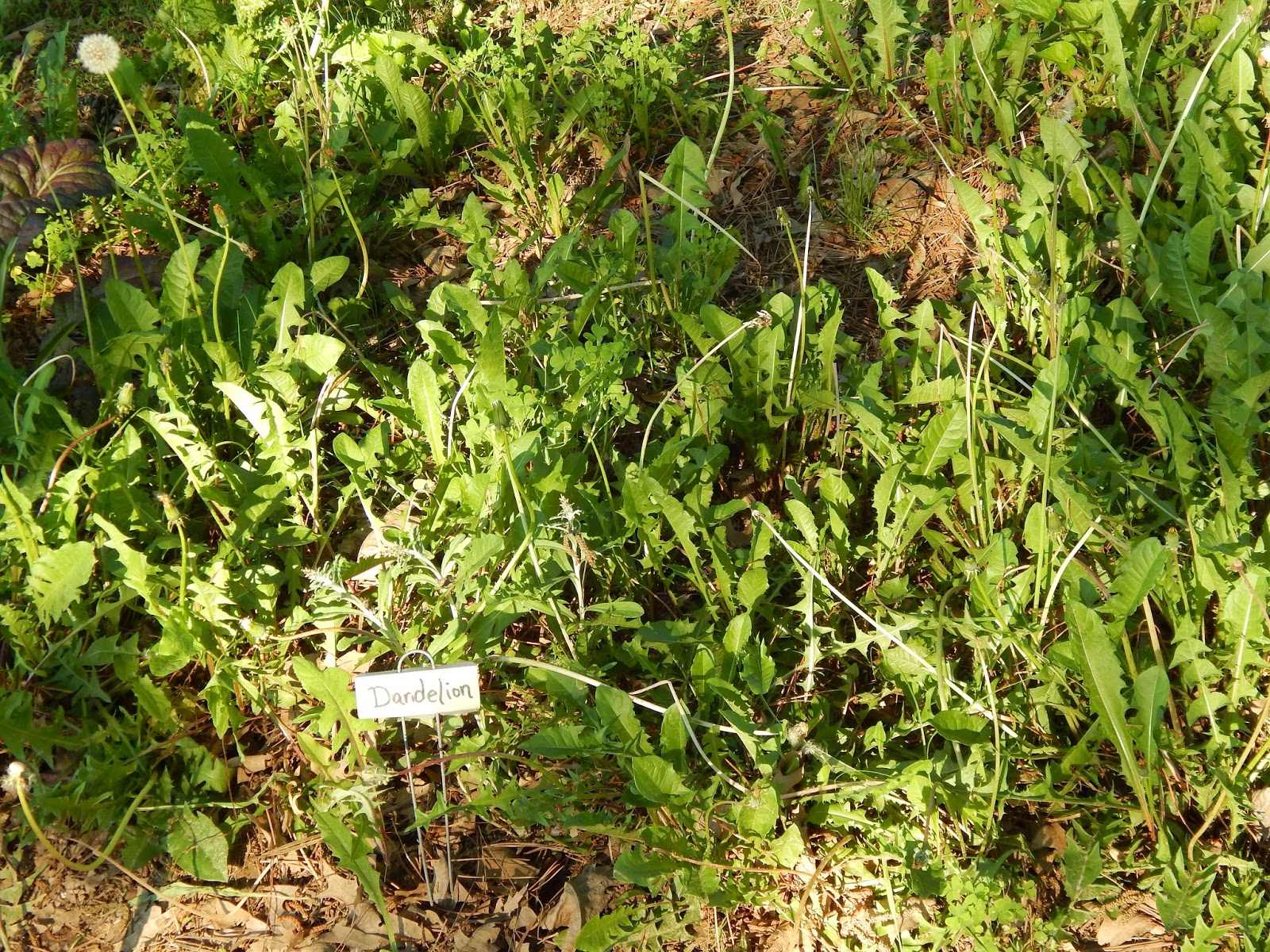
 Next to the mustard is the dandelion patch. I always try to have at least a handful of leaves for each animal. Dandelion leaves are good for overall health as well as expelling worms.


I usually alternate between lemon balm and marjoram, which are both good for overall health. I want the plants to continue developing well for our own use, so the goats only get a few sprigs. They probably wouldn't eat much more than that anyway. It's part of the browsing nature of a goat.

 
Next comes garlic leaves which are high in sulfur and is an effective worm deterent. The goats won't eat much, but they will eat some. I have started to include just a little each day. Behind the garlic is a patch of honeysuckle.


I have a couple of healthy chive plants that I have started picking small handfuls from as well. They are also effective against worms.


Honeysuckle

On Saturdays, I also pick a big handful of honeysuckle along with around four or five wormwood leaves for each goat. These two plants are especially good for expelling worms. One thing I have observed that I find to be very interesting is how the goats choose to consume them, or not. I have found that if I walk out into the barn with a large handful of honeysuckle vines, the does will gather around and heartily begin to strip the leaves from the vines. Until they are finished. Not until the leaves are gone, but until they are finished. My theory is, once a goat has eaten enough of a certain plant, they stop. Too much is not a good thing. And enough for one goat, may not be enough for another. They each stop eating the honeysuckle at their own timing. And the wormwood? Sometimes they will eat it and sometimes they won't. Last week I wormed One Stripe and Copper with the commercial wormers on a Monday. Saturday when I brought up the honeysuckle and wormwood, neither one of them would eat them, even though they always did on the preceding days I had brought them. As I wondered why, I realized that they didn't need the plants because I had just recently wormed them. Interesting, huh? Since tomorrow is Saturday, one week later, it will be interesting to see if they will eat these two plants tomorrow.


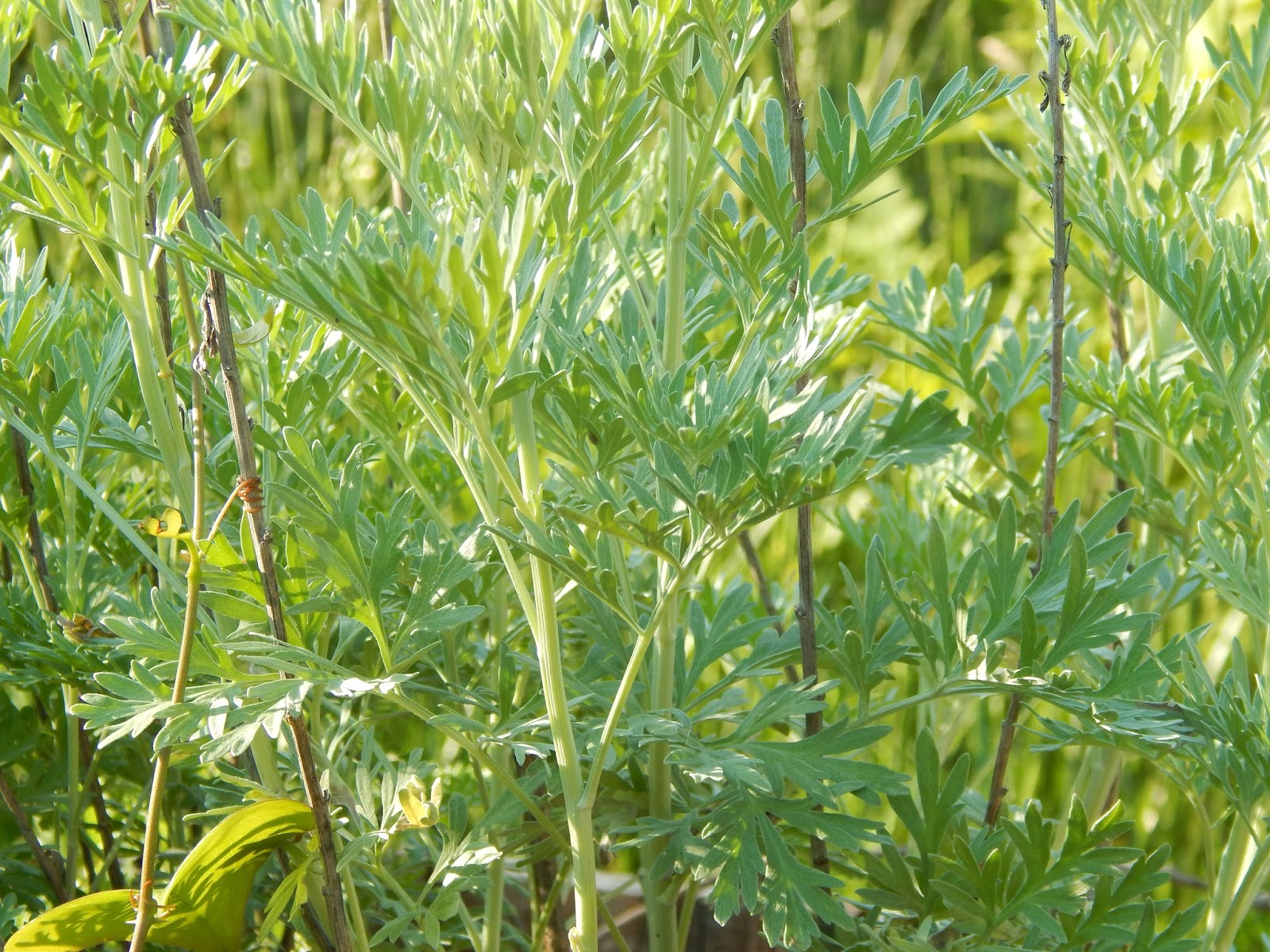
I started this wormwood from seed several years ago in this large wooden barrel. Now that I know it will continue to grow and have started using it, it's time to move it back into the fringes of the herb bed. Many other plants don't get along with wormwood too well, so it will be out on the edge of the bed next to the camphor wormwood I planted last year. It really does smell like camphor, and I haven't quite decided what I would like to make out of it. I don't use the camphor for the goats, though.


Since I recently read that blackberry leaves are good for goat feed, I stop at this patch of wild berries on the way to the barn and add a good handful of leaves to my bucket. 

Last week when the vet came to disbud our youngest baby goats, we found out they had lice. As far as I know, we have never had a lice problem on our goats before. The vet said our extremely wet spring has created prime conditions for lice. I got out my Herbal Handbook again and looked up lice. It turns out that sulfur is a good natural remedy and you can add a teaspoon of sulfur to the goat feed. Well, that wouldn't work for the young babies that needed treating, so we put a little Sevin dust on them, and the teenage goats that are being weaned. But I needed a natural remedy for the does I am milking. It turns out garlic and cabbage contain sulfur. I was already feeding the cabbage leaves, so I increased the amount each doe was getting. That's when I added in the garlic leaves. They ate more of them the first day, but since then, they will only eat a limited amount. But so far, I haven't seen any lice on the does, so I hope this works.

So what do I do with all of these leaves? I dump my bucket on top of the big round bale of hay by the milk stand and sort everything out. I want to make sure each doe gets a portion of the harvest I have brought. And I only do this for the does I am milking, not the babies or the billy and wethers. As each doe comes to the milk stand, I give them their grain ration, then pile all of the leaves I have brought right on top of it. At first they seemed to be a little irritated with me, but now they just dig around the leaves, eat their grain, then usually have the leaves for desert. It's rather comical. But if I took all of these leaves out to the feeder and spread them out for the goats to eat, they would just turn up their noses and go graze in the pasture. I'm not sure why they will eat them from the stand, but not from the feeder. It's like it's a treat or something.


I am hoping that feeding the goats plants that we have growing here will eventually be enough to keep them healthy and somewhat worm free. I don't want to experiment to the detriment of their health, but I do want to try to eliminate the commercial wormers. I know there are companies that sell a natural wormer, but if I am going to change over to natural, I would like to see if growing our own plants will work. Only time will tell. It may take a year or more to really see what the outcome will be. I'll let you know.

For the off season when the plants aren't growing, I plan to dry the herbs. But, with nature, worms generally aren't a problem in the winter months since the worms go dormant, some in the ground, some in the goat. There are other techniques for controlling worms, pasture rotation, short or tall grass and others. 

This brings us to another question. If the time comes when we are dependent upon ourselves, and we get worms, will these remedies work on us as well? Many of these plants are a common part of our diet and I have read that wormwood can be used with humans. But that is a whole different research project. Just food, pun intended, for thought.

Until next time - Fern