The Road Home

The Road Home
There is no place like home.
Showing posts with label garden plan. Show all posts

Thursday, June 18, 2020

What's Growin' In the Garden 4

Well folks, it truly is turning out to be a hot summer, isn't it? Frank has long thought the unraveling of our society would come to pass about this time. The uncertainty of life affects us all in many different ways, even the earth is unsettled and behaving quite different. Gardens and pastures in these parts are not growing anything like they usually do. Some things do okay, not great, but okay. Other standard crops are barely growing or doing anything. I have found ONE squash bug this summer. ONE. By now they are normally here by the hundreds and the plants are dead. Instead, we have had many fewer yellow squash, but the plants are happy.

Today we pulled the beets and planted grocery store red potatoes. Yes, it's very late to plant potatoes and it's a toss up whether they will grow in the heat of the summer here. We weren't going to grow any at all, but feel the need to grow more calories and nutrition.
Old beet patch, one new potato patch


More potatoes between the cabbage & sunflowers

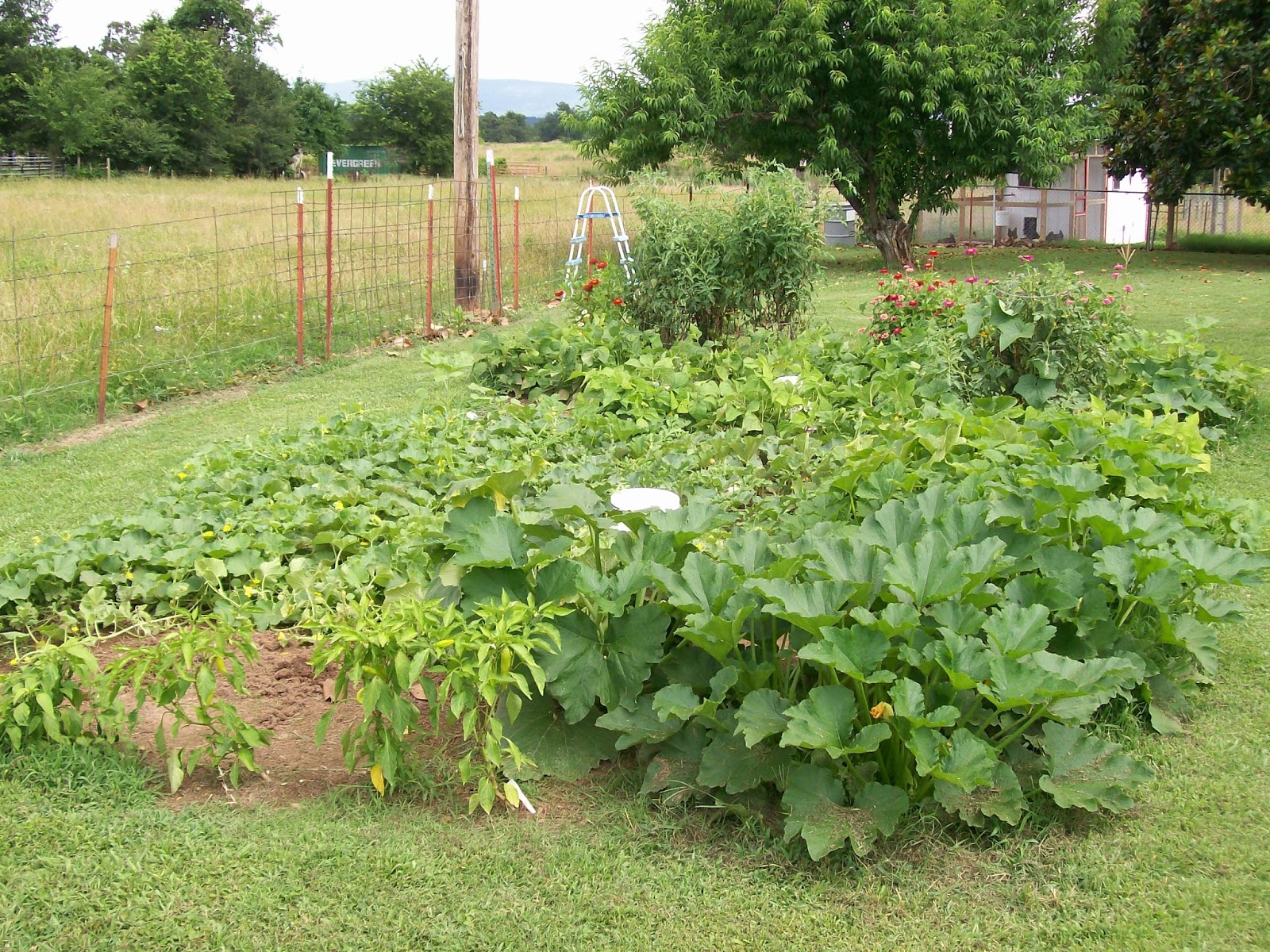
                Here is a look at the rest of the garden.

Parsley in the front, carrots and yellow squash

Sweet potatoes on  stock panels are growing well.

Pinto beans, some are climbing and some are not....

Tomatoes are growing slowly with little production

Purple hull peas after 4 plantings

Okra, barely growing, and it's mid June

Sunflowers for chicken feed

There are a number of cabbages that survived the worms.

Small pepper plants

Planted Thelma Sanders winter squash by wooden stakes today.

Apple with curculio infestation

I was very hopeful of a good fruit crop this year. Our young plums were loaded with fruit, but each had this little brown mark on it. Every plum dropped and now the apples are slowly joining in. I pick up half a dozen or so every other day as they fall and feed them to the chickens. I found a beneficial nematode that is supposed to help control curculio and applied them below the trees a month or so ago. My research indicates curculios may produce up to two generations per year, so I hope the nematodes are established enough to affect the second generation this summer. I don't know if there will be any apples left to harvest or not, only time will tell.

Rather dismal outlook, isn't it? It is definitely a strange growing season. As the COVID19 outbreak grew more serious, we decided to grow more food this year instead of less like we had planned. But the way the garden is performing, we don't know how much food it will produce at all. If we were truly in dire straits and dependent upon this growing season for survival, it would be a very stressful situation indeed. Well. What if this is it? What if our life does depend upon this harvest?


Folks, we are in perilous times. Do everything in your power to have enough food for your family for the long term. It matters not if you grow one morsel, have food for your family. Do everything in your power to provide a safe environment for your loved ones. Between the virus, the economy, the riots, the anger and hatred, our country is a pressure cooker just waiting for the lid to blow. The tentacles of the enemy are long and well camouflaged. Distance is your friend.

Frank has been saying for many months that it is going to be a very hot summer. The summer is upon us with burning and death. There are a couple of videos at the end of this article that may give you pause. If nothing else, I hope they give you something to think about.

Food. You can't have too much & without it you are dead.

Until next time - Fern


Monday, January 11, 2016

What Seeds Have Taught Me

Seeds. I love seeds and the potential nourishment they represent. If the truth were to be told, I have too many seeds, so some of them age past their prime and lose viability before they have the opportunity to grow. A waste? Yes, could be, but like our preparations, I would rather have too many, than wish I had something grow because we were hungry. Frank has heard me say many times that seeds are worth more than gold. The food that seeds provide can keep us alive. If there are no seeds to be had, all the gold in the world is worthless.


I am grateful that we have had the last seven years here to learn the climate, soil conditions, pests and temperature variations. No two years have had the same weather conditions, which has offered even more to learn. Our first two gardens were grown under extreme drought conditions. This past year we lost some of our hard earned topsoil to flooding, and it was so wet that seeds rotted in the ground.

During the first few years we tried growing the same varieties of vegetables we had grown else where, some did well and some did not. We experimented one year with about six or eight types of peppers, tomatoes and winter squashes. That gave us a very good idea of which ones would produce well here. Some of our favorites made the cut and some did not, fortunately we found better producing varieties that have now become our new favorites.

It took me three years to figure out how to grow lima beans only to discover we really didn't like them. Until two years ago, I didn't like fresh tomatoes. We started growing two old heirloom varieties, and surprisingly, I liked them. Frank has always liked tomatoes and he describes them as more acidic than many of the newer varieties. I have also discovered that my back cannot pick a row of bush beans. I just can't do it. This has led to experiments with several types of pole beans until we found one that we really enjoy, that produces well into the fall.

I wish I could figure out how to grow a head of cabbage. I even wrote an article about it. And onions. Those are things I will continue to work on because we eat a lot of both. I also need to be more diligent at saving our seeds. It has always been easier for me to order seeds instead of planning ahead for seed saving. There will come a time when the only seeds we have will be the ones we save, so this is not a skill for me to continue avoiding or neglecting. 


The greenhouse has given us a whole new learning experience in growing food. As would be expected, the cool weather crops are happier than those that like the heat of summer. We have picked one yellow squash and the tomatoes are blooming, but with 38* lows at night, I don't expect much from them. I will soon be planting seedlings in the greenhouse. The window I've used for the past few years has now been replaced by the greenhouse entrance and I find that to be very comforting. I'm excited about the greatly expanded room to grow many more seedlings that won't be leggy and leaning over sideways in an attempt to reach the sunlight. I'll be learning much more about the timing for growing, hardening off and planting these seedlings.


There are many beautiful seed catalogs arriving in the mail now days. They all have something to offer that is new, different or interesting, but I have found a company that has a very wide variety of quality products for a fraction of the cost. With few exceptions, we order our seeds from R.H. Shumway's, which I have no affiliation with, except as a very satisfied customer. Their catalog is not shiny and showy, but it is packed full of seeds and information.  I would highly recommend them.


So, what have the seeds taught me? Patience, diligence, responsibility, the power of observation and learning, conditions for success, hard work usually pays off, and that hope springs eternal in the miracle of germination and growth. In a recent article I said, "Our future will be one of incredibly hard work, grubbing in the dirt for our survival." That's what seeds mean to me. Life. Survival. I am continually fascinated that one tiny little seed can produce so much food. In the coming days if you have a few seeds and a shovel to spare, a man could help feed his family. Do you have enough seeds for this year, and the next, and the next?


If you are new to your area, or plan to go somewhere else when the SHTF, do you know someone that can help you with invaluable information about local growing conditions and varieties that produce? When is the average first and last frost date? What insect pests cause the most destruction? Do you know how to deal with them without running down to the local garden center for a fix? Has the soil been turned and worked? Is it fertile enough to support the production you need? There are so many things to learn and know before those seeds will turn into food. I have read many places that people feel prepared to replenish their food supply because they have a can of survival seeds. Unless these people have figured out, and made accommodations for many of the things I have mentioned, they will starve. Not that these cans of seeds are a bad idea or contain inferior products, but the conditions necessary for adequate food production are dependent upon so many factors that the odds are stacked against them. 
 
Grace's garden

We have a friend, Grace, that gardens just a few miles down the road. She can grow things we cannot. We have pests she doesn't, and she has some we don't. Conditions can change quickly, from location to location, as well as year to year..


What have you learned from your seeds? Please share with us because we are all in this together. Any knowledge we can glean now, before it is a vital means of survival will be of great benefit. As soon as I get back the use of these two hands I will be rolling up a new batch of pot makers and planting them in the greenhouse. I can't wait.

Until next time - Fern
 

Monday, January 26, 2015

Planning the Garden & Changing the Way We Eat

These beautiful, sunny 65* January days only attribute to the spring fever I get every year about this time. Frank and I got out a vegetable list yesterday and started planning the garden for this year. Over the past two months we have made some fairly drastic changes in the way we eat. We're not calling it a diet, because this is the way we plan on eating for the rest of our lives. You see, we are both over weight, and it is way past time to do something about it. Something permanent. Not something that will last a while, help us lose a few pounds, then go back to the way we used to eat and gain it back. This is a permanent change and we are very excited about it. And from another perspective, if we truly believe that our country and world is in for a very serious collapse, which we do believe, then we need to be healthier and better able to deal with the physical challenges that will come when we are in long term survival mode. 

That being said, we have made some fairly significant changes in what we will be growing, not only for ourselves, but for our animals as well. We will not be growing potatoes, sweet potatoes or corn this year. They are very starchy and full of carbohydrates that we really do not need. There are other vegetable choices that will provide us with the energy we need, along with many other nutrients, that don't have the significant carbohydrate load. There are some vegetables that we haven't been very successful at growing, that we are going to get very serious about. Things such as cabbage, broccoli, spinach, lettuce, onions and winter squash. I have looked into buying some green lace wings and lady bugs to try and increase the predatory insect population while at the same time decreasing the cabbage worms and aphids. Since we are both home full-time now, the garden will also get more attention than it did with only few minutes during the evenings on weekdays and weekends. I'm hoping that will make a big difference.


Each year as I start to think about rotating crops in our small garden, I pull out last year's map to make sure I remember what was growing where then. Last year's map is one of the messiest ones yet, but it still contains the data I need for this year.

After Frank and I made the list of vegetables we want to grow, I went back and separated this list into early cool weather plants, and warm weather plants that won't go outside until after the last frost. Most of these will be grown as seedlings, but a few will still be directly seeded into the ground. We have found that growing seedlings, even with beets and carrots, gives them a much better survival rate than direct seeding, which is the traditional way to plant. If we give them a good start as seedlings, they survive the early spring weeds much better and we get more harvest for our efforts.

After we made our list, and lists of lists, I got out last year's map along with this document that contains companion plant data for the vegetables we grow. I have several garden books that cover this information that I was referring to over and over. So, I kept looking up the same information time and again. After a few years I put everything on this document and printed it out for my notebook, which is much quicker to reference.
I use it every year when choosing locations of vegetables. Companion planting really is effective. Before I knew beets were inhibited by pole beans, I planted two rows of beets on either side of my pole bean trellis. They all died and I didn't know why until I started incorporating companion planting into our garden design. This is another example of layers of knowledge. The more I learn, the higher our vegetable yield becomes, and the more I realize I don't know.

Armed with our list of vegetables, last year's map and my companion plant list, I am ready to map out this year's garden. Initially I do it in pencil, because I always have to move something. Either I put it too close to last year's planting, or next door to something it doesn't get along with too well. But after a little jockeying around, everything usually falls into place. I thought I had everything on this map and was satisfied with the results until I realized I had left out the tomatoes, which means I had left out some of the carrots. I have the companion planting book Carrots Love Tomatoes, and they really do. Some of the best carrots we have grown have been on either side of the tomato trellis.

Taking down trellis, end of summer 2013
Speaking of trellises. We use stock panels on t-posts. Each year at the end of the season, we take them down and stack them beside the garden. Then after we have everything tilled up for the last time and ready for planting in the spring, we install the panels and t-posts wherever we want the trellis to be for that year. There are just about as many ways to trellis tomatoes and beans as there are gardeners, and this way works very well for us. It's easy to pick from either side of the panel, and we don't have any trouble even with some of the strong winds and thunderstorms we get here sometimes. One of the trellises will initially be for the sugar snap peas. After our last average frost, which is April 1st, I will plant beans in amongst the peas to take over the trellis when the peas are finished. I did this with peas and tomatoes last year. 

Since we haven't had any luck with fall planted winter squash for the past two years, I will be planting my winter squash in the spring when I plant the yellow summer squash. We would like to get as many winter squash as possible to store for both us and the animals. The same goes for the mangel beets, which are an old time traditional animal feed.

September 2014
We planted a larger than usual patch of cowpeas, purple hull peas, last summer which actually grew pretty well even though the grass overtook most of the patch during Frank's back surgery and recovery. Many, many peas dried and went to seed in this patch, so we expect they will come up again this summer. Because of that, this will be one time that we won't rotate this crop. We make it a standard, rather strict practice not to grow the same crop in the same place two years in a row, but instead of pulling up many volunteer pea plants, this year, we will replant the peas here and let them share space with the expected volunteer plants.

July 2014
We will be growing a fair sized patch of sunflowers again this summer for the chickens, goats and pigs. (The pigs will be joining us in a few months.) The amount of sunflowers we can grow in the garden will not be enough to provide a lot of animal feed, but will be a supplement, and it's good practice. If our plans work out to get a larger area ready to plant in one of the pastures, we will grow many more sunflowers, cowpeas, maybe some field corn, beets, winter squash, turnips and carrots there. All for animal feed. That would be a dream come true. We have had plans for this pasture for many years.

This year I will plant the spinach, lettuce, celery, celeriac, leeks, collards and swiss chard in the herb bed. There is room there to do small successive plantings, and that will leave more space in the main garden for the larger vegetables. I will also work at getting more herbs established in the herb bed again this year. There are many things that are started, and some of the annuals are reseeding themselves, which is the goal. The weeds and grass had a hayday last summer during Frank's recovery as well. But there are many things still growing in amongst the weeds that we hope to give more attention to this summer.

There is much to learn, study and do to provide a good, balanced adequate diet. I continue to try to determine the nutritional content of the vegetables we are growing, to make sure we are getting what we need to be healthy, active people. Because when the time comes that we must depend upon our little patch of dirt for our sustenance, I want to be ready. I want to know how to coax that nutrition out of the ground. I want to be able to put a healthy, satisfying, life sustaining meal on the table in front of my husband. I want to live.

Until next time - Fern

Tuesday, February 18, 2014

Getting the Garden Ready

Yippee!! It's time to get the garden ready to plant. It's great this coincides with cleaning out the barn since not only does it mean we're going to have goat kids, it means fertilizer for the garden. So, now that the fertilizer, AKA goat poop, is spread out it's time to till it in before the next chance of rain comes along. It was 70 degrees today and pretty windy. This helped the garden dry up enough for us to be able to work in it with the tractor, but there were still a few spots that were almost too wet.


First, detach the brush hog.


Then, attach the tiller.


This will be the sixth year we have worked this garden spot. We have added barnyard and wood ashes each year. Most of the soil is in great condition for gardening. There are still some rocky areas that seem to grow more and more rocks every year. There is one patch that has a lot more clay than the rest. I think this is where the septic tank was put in, since this patch is just different.


We have developed a good routine for getting the tilling done pretty quickly. It has it's challenges since Frank has to back the tractor into towards the fence then till as he come back out. With our storage sheds and relatively small space between the house and the fence, we don't have a lot of room to just go back and forth. But Frank has figured out a good routine and makes short order of this chore.


So, now I have my garden plan


I have dug out the seeds I need for my first wave of seedlings. 


I have rolled up about 275 pots for the seedlings that are just waiting for dirt and seeds. That may be the chore for tomorrow.


So, another day's chores are almost complete. Just like any other day. Morning chores; off to work at school while Frank does more daily chores around the house; after I get home we: till the garden; feed the animals and milk One Stripe; cook dinner; write a blog post; make butter while we read a novel together; say our prayers and call it another good day. The Lord is good and we are very blessed. Count your many blessings each and every day. Each day is given to you to use to the best of your ability. Make it count. 


Until next time - Fern

P.S. Even though it was not forecast, we had a nice freeze at 28 degrees last night. That is perfect timing. Freshly tilled ground with all of those nice bugs and eggs exposed to the freezing weather. This increases my hopes for the garden this year even more!