The Road Home

The Road Home
There is no place like home.
Showing posts with label woodstove. Show all posts

Wednesday, October 28, 2015

TEOTWAWKI Cleaning

If things fall apart and your regular routine is greatly compromised, how are you going to keep things clean and sanitary?

We had a great conversation in the last article about different ways to cook our food in a collapse situation, and one comment took the conversation a little farther along the planning process. I really enjoyed this comment because I have been thinking along the same lines. Your comments on the last article has given us more to ponder and learn, and I'm hoping this article will do the same.

The comment I referred to is this:  "Fern, after commenting this morning, I was out picking apples and got to thinking about this some more. Besides cooking itself, what about clean up like washing pots and pans as well as dishes and utensils? Heating water will be a similar challenge. For me, I have a couple of large pots designated for this. One of the many things I learned in Boy Scouts back in the 60's was how to set up a sanitation station by heating water over a wood fire in pretty large quantities.. Just thinking the whole thing through. Carl in the UP" I really appreciate Carl's comment, the added dimension to the discussion, and the fact that he lives in the Upper Peninsula of Michigan where it gets much colder than it does here.

I have given this situation thought many times. When Frank and I lived in Alaska back in 1990, we were in an Inupiat village without running water. There was a washeteria that provided water to the village, people would bring 30 gallon trash cans to fill and haul home. Frank carried two 5 gallon
collapsible water jugs to school and back many days, keeping our 30 gallon trash can supplied with water. Any water we used for washing dishes and such had to be heated on the stove first. The ease of heating water at the time came with an electric stove. Since there are many times throughout the day that something needs to be wiped down, cleaned off or hands washed, we began keeping a bowl of water in the sink that had a little soap in it. Granted, throughout the day, the water would be cold, but it was better than using up the water Frank hauled in. We learned to be very frugal with our water usage during this time. It was a very, very good learning experience for us.

When I think of cleaning, or having water on hand for washing, winter time seems easier than summer. If we have the woodstove in the house fired up for heat, it only seems logical to keep a kettle or large pot of water on it heating. This way it would be available as needed for washing dishes, clothes, or cleaning up after a meal or project. 

Summertime hot water may be a different issue. If I fire up the rocket stove to fix coffee and breakfast, a pot of water can be put on the stove to utilize the remaining heat until the fuel is expended. The size of the pot will be limited by the size of the stove. If more hot water is needed for washing clothes, another heat source will have to be utilized.

Both of the options I've outlined depend upon a source of fuel for the fire. There are other options, like a solar shower bag or water tanks in dark colors meant to harvest the heat of the sun. They may not get as hot, but it is a way to heat water without consuming a fuel source.

What are other ways to provide heated water for cleaning and sanitation? And like Carl said, in large quantities?

While we're at it, what about toileting needs? What will you do when you can no longer flush your toilet? Haul water just for that purpose? That may work for some, but if you're dependent on a city sewage system, it probably won't work then. Where are you going to go to 'use' the bathroom? Or, how are you going to dispose of your waste? What other options do you have plans for that will safely, take care of your needs and not cause unwanted health issues? And while we're talking about it, what happens when you run out of toilet paper?

There are many, many things we take for granted each and every day. I know we sure do. What happens when the power goes off for
a while? You walk in a room and turn on the light switch, even though you know it won't work, you still do it because most of the time it works just fine. What happens when the water goes out? You walk over to the sink and turn the faucet on, because it usually works. Then you go to the bathroom thinking all the time, don't flush it, don't flush it. But then you flush it anyway! These are just a few of the basic things we take for granted that will require more planning and work when we have to depend upon ourselves for everything. Everything.

This discussion didn't even touch on things we've come to depend on for cleaning. Things like soap, Pinesol, Mr. Clean, 409, dish cloths, towels, mops, brooms and 101 other things we use all the time. Doing without, or finding good substitutions will require a change of attitude and more work on our part. Again, this is one of those things it would be easier to practice now, than try to figure out later when the chips are down and many other needed tasks are vying for our attention.


Frank and I think about many different options for a number of situations like food, water, power, communications, or security. Some we keep and some we discard, which is what everyone needs to do. Evaluate information for usefulness in your situation. Some will be good, some will not, but the main thing is evaluate it. Think about it, just like Carl did. That is one of the things that struck me about his comment. He took a conversation farther by thinking about it and applying it to more areas of need along with cooking. Once again, we look forward to your thoughts, experiences and ideas. We're all in this together and the more we can learn now, the better prepared we will be when the time comes.

Until next time - Fern
Monday, October 26, 2015

How Many Different Ways Can You Cook?

Cooking will always be a way of life as long as there is food to cook and people to cook it. With the construction of the outdoor kitchen underway, I have been thinking about different ways to cook. There are many, many ways to choose from, so I thought I would see if we could get a good conversation going. Like Frank says, we're all in this together, and we always learn so much from interaction with the folks that stop by and visit here.


As I pondered this question, I came up with several possibilities. Here they are in no particular order.

We cook with propane in the house, and will be able to continue to do so until the tanks run dry. For now, it's easy to call up a company and have them come and fill the tank. When that is no longer an option, we'll have to come up with other alternatives.

We have our wood stove in the livingroom that has a flat top. It's not ideal and isn't meant to be a cookstove, but we can put a cast iron dutch oven on it and cook beans or soup. I'm not sure how well it would work for making a pot of coffee with a camping percolator, though. Yes, we really like our coffee, and until our supply runs out, we'll be having some everyday, even after the SHTF.


Now we come to the outdoor kitchen. We will have a wood cookstove there along with a grill/smoker.


Another addition for quick cooking and heating will be a Rocket stove. Once we have everything set up out here, I will practice with all three.


An option for baking we have acquired is a Coleman camp stove oven. It folds down flat, so it isn't air tight, and makes me wonder how effective it will be. It is about an internal 10 inch cube, so no 25 lb. turkeys. In one of the reviews Frank read, someone suggested putting bricks in the bottom to help hold the heat. We have firebricks to put in the wood cookstove, and will try some in the oven as well.

Another oven option is a Sun Oven, which we also have, but it hasn't made it's way out of the box yet. I've read about several people using them very successfully, including our friend Grace down the road, so it's time I learn how to use this one.  


Of course there is always a campfire with a metal grate across it, or an open pit fire that you can hang pot over or put a rotisserie on. If you have the right cookware, you can cook all sorts of meals this way.


Another possibility is a small cast iron hibachi type of system. It's small, doesn't take a lot of fuel, and will provide a small, hot fire. Again, with some cast iron cookware, this would be an easy way to cook a quick meal. 

Now that we have different ways to cook, we need to think about fuel for all of those fires. Right now we have an abundance of firewood stored, but that won't last forever, just like the propane. There will come a time when we need more wood, along with a way to cut and haul it.

There will also come a time when it may not be safe to cook because of the smell. If you are trying to keep a low profile for security reasons, the odor of cooking food would be a dead give away, especially to someone, or a bunch of someones, that are hungry. Then what do you do? Even the smell of a fire would draw attention.

On the other hand, if your retreat is your homestead then there are all sorts of noises that come with the territory. Your chickens make all kinds of noises, from crowing to singing the egg song. Your goats will holler good morning when they see you. The pigs will excitedly greet you asking for breakfast. Your dog will bark. Your radio will come to life with a greeting or message from down the road. Not to mention everyday conversation that comes with the activity of the day.

These are some of the things I think about as I go through my days. The sounds and smells of life are a rich addition to all we do. There may come a day when some of these things have to be curtailed for a while for our safety. If that happens, and you can't cook, how will you provide adequate nourishment? Let's face it, if a collapse happens in winter, it will be easy to see where the people are. There will be fires for warmth, and where there is fire, there is smoke.

So, what do you think? How many different ways can you cook, and will you be able to cook when the SHTF? Will it make a difference if it is winter or summer? Will it make a difference if safety is a concern? I have thought many times recently that two is one, and one is none. I've applied that to many things, including cooking, canning, gardening, clothing, animals, tools, radios, just about everything. That's what brought me to this article about cooking. I want to make sure I have enough options to be able to put good, nourishing food on the table when we need it the most. I'd love to hear your ideas and thoughts.

Until next time - Fern

Thursday, October 15, 2015

Homestead News, Volume 14

Well, let's see, what have we been up to lately? Bunches. Last week we got a comment that accused us of putting the youngsters to shame with all of the work we've been doing. It struck me as kind of funny at the time, and I've thought about it a couple of times since then. Because of that comment, I thought I'd let you know that the two men that are doing most of the hard work around here, Frank and Henry, are 65 and 60 years old, respectively. This little tid bit of information may motivate someone out there, so I thought I would share. As for the woman here? I'm 56.


The ditch we showed you last week looks exactly the same as it did then, except we ran a soaker hose across the yard where the rest of the ditch is to be dug. Emmet has been back since this ditch was
started, but during that visit he dug a different ditch, the one between these two buildings, and about half of it was done in the dark by lantern light. The one picture I tried to take showed too much of Emmet's face, so I didn't keep it. After the ditch was dug, Frank and Emmet ran 12/2 in conduit connecting the two buildings. And then there was light. Inside that is. Frank did his first night time tractor driving and covered up
the ditch with the bucket. He didn't like it much, he prefers the visibility daylight provides instead. So now we have temporary power to these two buildings. Temporary because the solar panel installation will provide the power to these buildings in the long run.


Today Frank and Henry finished installing the braces and brackets for the new antenna towers. There is one on the garage, one on the garden shed and one on the house by the current antenna pole. Frank has been determining the angle of attachment because these towers will fold over at the bottom so they can be laid down to install or work on antennas. This has taken a lot of planning, plus acquiring some needed equipment and accessories. We will continue to give you updates on how this project is progressing.


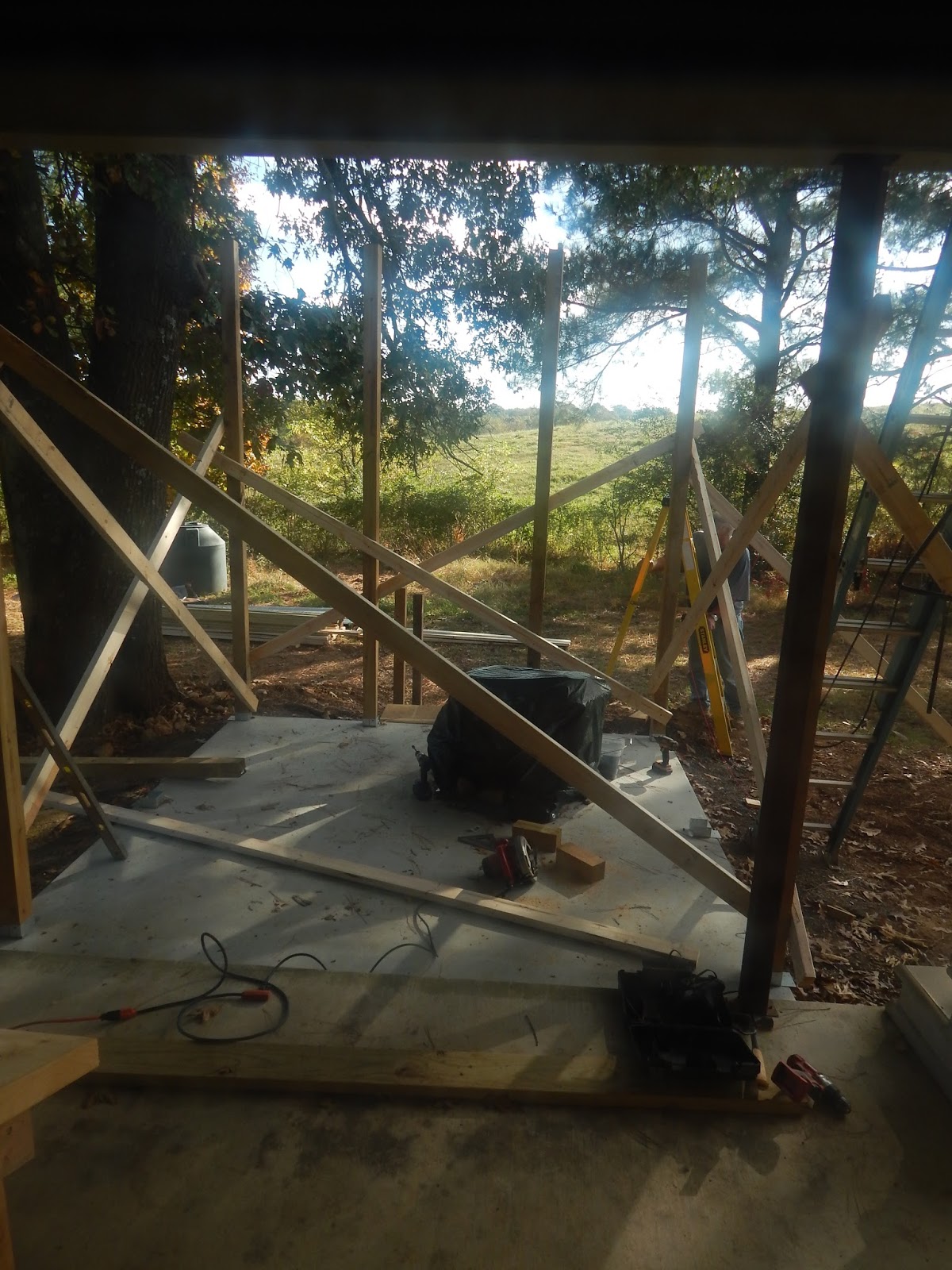
As you can tell from the picture on the header, the concrete for the outdoor kitchen was installed last week. I have to tell you, watching Henry mix the concrete bag after bag made me tired. That was a lot of work, but it went quickly and smoothly. Frank brought the bags of concrete over in the bucket of the tractor so no one had to lift them. We kept water in a five gallon bucket for Henry to pour into the wheelbarrow, which saved time and effort as well.


Here is the first appliance for the outdoor kitchen. Neat, huh? It is neat and exciting to think about completing this project and having a functional, no-grid, rather primitive kitchen right off the back porch. But when I really stop and think about using it out of necessity in a survival scenario, the neat factor drops like a rock. This kitchen has not been conceived, nor created to invite friends over to enjoy tea and crumpets. I picture processing vegetables and meat out here, washing clothes and fixing breakfast before a hard days work. It's rather daunting, actually.


Last week our friend Grace let me know there were some local pears ripe and available. There are folks that have pear trees, but aren't using the pears. One gentleman's tree is loaded and they are falling by the dozens to the ground. Yesterday instead of butchering and canning chickens, I went and got pears, five 5 gallon buckets full of pears. Guess what I
Washed pears in the sunrise that's peeking in the backdoor.
did today? Yep, but I only got started. So far we have 21 quarts of canned pears. We did it a little different this time, no sugar (just like the peaches), and no peeling. When we had finished canning peaches a month or so ago, one person commented that they don't peel their fruit before they can it. I thought that sounded great and read about other folks doing the same thing, so that's what I did. Aren't they beautiful? And there are lots left to put way. I hope to have them finished by the weekend.


We have had some cold nights this week, into the 40's. This was the first 'cold' test for the greenhouse and the water barrels we are using for the thermal mass. The first night it got down to 47*, the greenhouse against the wall was 59*. Yea! That is where the tomatoes, peppers, ginger, potatoes and turmeric are living. The temperature on the thermometers along the outside wall read 54*. Another yea! That's when I discovered that I hadn't thought to close the screen at the top of the storm door on the greenhouse. That may have kept it even warmer in there. The plants are happy, even when it gets over 100* most afternoons. It is supposed to cool off, even for the highs later in the week. Today it got up to 97*, it was a hot day.

Beets
Carrots

Cabbage
Brocolli

Brussel sprouts
Muskmelon

Squash

Onions!

Spinach


Since I have been watering the plants in the greenhouse almost everyday, I thought it would be good to use the water well that is right next door. This water well has a Simple Pump installed that works very well, it's just that we haven't been using it at all. When I pumped some water out of it the other day it smelled awful, so today I put about half a gallon of bleach in it. We'll let it sit for a couple of days then pump water out of it until the bleach smell is gone. It will be an easy walk with my watering can back and forth to the well. I figure it is a good time to get the well into good working condition since we may be using it regularly before long. I wiped down the main rod to remove any dust and grime. Before I use it again I will clean and lubricate the rod again with olive oil.


For now, I am filling the watering can with the hose and rural water supply. I have also been 'watering' the clothesline poles for several days. It is really dry here and it hasn't rained since we put the poles in the ground with the dry concrete. I have watered each pole a number of times, several days apart. I'm ready to use it, it just isn't ready to be used yet.


I almost forgot to tell you. Monday when Frank and Henry were finishing up shelving and braces in preparation for working on the antenna towers, I tore the carpet out of the bedroom. This
house has old, old, about 35 year old shag carpet in the bedroom, hallway and living room. Did I tell you it's old? Well, last weekend Frank took up a small piece of the bedroom carpet, just to see what was underneath. That showed me what to do. I thought it would take quite a while and be difficult. It took less than an hour and was a breeze. The hardest part was moving the mattress out into the
hallway and back, and that wasn't difficult. Now we have a somewhat uneven, paint splotched and stained in some places, plywood bedroom floor. It's great! We haven't decided what we're going to do with it next, but there's no hurry. We're just glad to have the carpet and everything that was living in it out of our bedroom.


After I finished with the carpet, I snapped a few green beans I had picked over the weekend and thawed out the gallon bag of cowpeas I had put in the freezer over the summer. Out came the canner and they all went in together even though the green beans only require 25 minutes to can and the cowpeas require 40 minutes. I ended up with three pints of green beans and 10 pints of cowpeas. It sure is nice to have a few more jars of food on the shelf.

There is an interesting article on The Economic Collapse today that Frank ran across, The Numbers Say That a Major Global Recession Has Already Begun. We know that not everybody follows the markets, but we're all invested heavily, one way or another. Please pay attention. And if you can or would, please pray for the Middle East. Things are not looking good there. Do you think the world economy and the Middle East problems might be connected? Certainly food for thought. A couple of extra cans of green beans might come in handy some day. You just never know when the stores might not be there.


Life continues to rush by at break neck speed. It's amazing how much we are getting done and how much is yet to be completed. We have never worked this hard and accomplished so much in such a short amount of time. Ever. It's quite fascinating. This afternoon after Frank and Henry had quit for the day and we were waiting for the last batch of pears to be finished, Frank and I talked about how hard we have been working. I told him we are practicing for what is to come, when there won't be a choice of working hard all day or not. It's hard work, it's good practice and it's providing us with many things that will make life a little easier. There is nothing like experience for learning. It's your turn, do, learn, and experience. It will get you one step closer to being as ready as you can.

Until next time - Fern