The Road Home

The Road Home
There is no place like home.
Showing posts with label coax cable. Show all posts

Monday, March 18, 2019

Radio - Let's Get Started

Hello Everybody, Frank here.

I recently received this comment under a non-radio article. I'm going to share the comment with you, I'll answer this man. He had some very good questions, valid points and is seeking information. The comment will be edited, by removing what part of the country he is from, otherwise it is mostly intact. 

Following the answer to his comment, I have included an older article that is a beginning step for understanding radio. Some of the information in here is dated, in other words, out dated. I'll talk about that before you get to the article.
 
Hi Frank, Thanks for offering additional help! I'm interested, like you, in "survival communications". Two primary areas of interest. First, I'm reading about two-way radios like the Midland you referenced; also looking at a Baofeng. Trying to decide if I want to get the license, etc. I'd like to be able to communicate with wife, children, and neighbors/church family around me. Neighbors are within a mile. Wife/kids could be 30 [miles] if I'm at work (or on way home) and they are home. Second, I'd like to get a good SW [shortwave] radio with SSB for listening. The new Baofeng I'm looking at has variable power, up to 8 watts. Not sure if one can charge batteries while in the unit like you can with the Midland.  Best Regards, Tim

Tim had some excellent points here. My very quick recommendation. A Baofeng. Why? It will do the same thing that the Midland radio will do, and significantly more. In many cases, for that matter, most cases, it costs less. The Baofeng can be charged in the cradle, it has a plethora of accessories, and you can attach an external antenna. 

One negative for the Baofeng is that it has to be programmed. There are multiple ways to do this. There are YouTube videos, you can attempt to decipher the instructions, there is a free program called Chirp, and the system that I use is called RT Systems. Chirp and RT Systems are via computer. I will include more information in future articles about the Baofeng.

While we're here, in the article that follows, I recommended a Wouxun radio. It's a good radio, but the Baofeng is newer and, in my opinion, just as good and costs significantly less. 

Tim's second question. A good shortwave radio. Few shortwave radios have SSB, single side band. Why is this important? If you want to listen to the ham radio operators, you will need SSB. If you've got the jingle, here's what I would do. Purchase an HF radio, which is a ham radio. You can listen to all the lower ham frequencies, plus all of the SW frequencies. It is a higher quality radio and has listening features that few SW radios have. You can also listen to CB on it, and if you ever get the desire to have your ham radio license, you can transmit on it. Remember, you can listen to any radio signal being transmitted. Transmitting is an entirely different ballgame. 

So, Tim, I would recommend a Baofeng UV-5R+, about $30.00 on Amazon. An RT System for programming, about $45.00. The money you will save on the Baofengs will pay for the programming system. 

For SW, an IC-718 made by ICOM. This radio runs new about $650, used $300 and up. Remember, it will do AM radio, CB, SW, all the lower ham bands which are 160-10M. For this radio you will need a power supply and an antenna which are both an extra expense. When you get your ham radio license, then you can use this radio to transmit on. The legal frequencies, anyway. Getting a ham radio license is very easy.

Ok, Tim, and everybody else. Next is an older, dated article that I think you will enjoy. It's a start. Every few days I'm going to include an older article about radio in an order that will help folks get started. There have been some changes and I will point these out. Safety has not changed and will never change.

If you have a question, ask. Others have the same questions. Utilize YouTube. Check out ARRL. Check out QRZ.com

We'll talk a whole lot more about this later. This is not difficult, it's just new. And there are some new radios out there, too. There's some new guns out there, too. Some are better, some are not. If you have a question, ask.

By the way, in this following article, there is a new weather radio I would recommend. I'll get to it later. Enjoy.

We'll talk more later.  Frank Feral 


Radio Communications Review


Originally published August 12, 2013


I'm going to try to summarize what we have talked about in the last ten posts. The reason being, my next radio post is going to start into ham or amateur radio. So, let's go back and talk about all of the stuff I have covered so far. We have talked about the rules and regulations, and I will give you my recommendations on certain radios. Okay, let's go.

CB radio is probably the most popular radio around and more people have them than any other type. There are basically two types of CB radios - non-single side band radios and single side band (SSB) radios. Remember, CB radio is line-of-site
communications, most of the time. CB radio operates at about 27 MHz. It will also bounce off of the ionosphere similar to HF ham radios. In some circles the CB radio is called an 11 meter radio. Any CB radio will skip off of the atmosphere if the conditions are right, but an SSB (single side band) will do a better job of it and give you greater distance. So if you want to talk to your cousin Leroy two blocks down the road, and there is not a hill in the way, any CB radio will do the job. If you want to play and listen to other folks much farther away, then SSB is the preferred method. I recommend the Galaxy line of CB radios with SSB. There are other manufacturers that make a quality radio, I just think the Galaxy is more dependable and is prettier. No one likes looking at an ugly radio.

We'll talk about antennas, power supplies and coax cable later in this post. Next, let's talk about GMRS/FRS radios. These radios are also very popular. The vast,
vast majority of them are handheld radios. People use them a great deal for hunting, keeping track of the kids and just play-type radios. These are also line-of-site communication. These will not bounce off of the ionosphere so you are not going to be hearing frequencies from around the world. These radios function at about 465 MHz. Because of the higher frequency they will work better from inside a building than your lower frequency radios. The big difference between these radios, in my opinion, are the batteries or power systems inside the radios. 

While we are writing this, there is a major electrical storm in our area. All of my antennas have been disconnected and our computers are unplugged. If I were a little bit smarter, I would also unplug my power supply.

In a previous post, we talked about the difference between GMRS and FRS, they are basically the same radio. These are excellent, high quality radios with a good clear signal for line-of-site communications. Do not believe the advertisements for 10, 20, 30 miles - this is a sales gimmick. Not all of us live on a flat planet, if we 
did, then the advertisements would be correct. Remember, line-of-site. All GMRS radios will communicate with other GMRS radios regardless of the manufacturer. All the channels are the same frequencies. I recommend the Midland GXT1000VP4 or GXT1050VP4. They are the same radio - one is camo and one is black. The reason for this recommendation is that you can put four AA rechargeable batteries in the radio and the batteries will recharge while in the charging cradle. Some other Midland radios look identical, but they charge slightly different and will not recharge rechargeable batteries while in the charging cradle. I have used this radio for a number of years on our little farm.

Okay. We have reviewed CB and GMRS. There is one other type of radio frequency and it is the MURS frequencies. MURS comes with five frequencies operating at about 151 MHz. It is also line-of-site communications and will work fine inside of most buildings. There is not a major manufacturer that produces a MURS handheld radio, but you can buy a commercial radio, which we will talk about in just a minute, to use on the MURS frequencies. OK, CB, GMRS and MURS are the basic frequencies for non-ham communications. All three have about the same power output. CB and MURS do not require a license, GMRS does.

A slightly different type of radio is a commercial radio. These radios are not set for any particular frequency and they will not operate on the CB frequencies. But they will operate on the GMRS, MURS and the VHF/UHF ham radio frequencies. You have to program these radios yourself. Most of them come with a programming cable and computer disc that you download. My recommendation is the Wouxun handheld commercial radio. Many dealers sell them. I would recommend Universal Radio. It is 100% legal to use these radios on the ham radio frequencies. It is not legal to use these radios on MURS or GMRS. We will discuss legalities and license requirements in just a minute.


Non-transmitting radios. This is a group of radios that you listen to only. We're going to talk about shortwave receivers, scanners, weather radios and there are a few others, but for the most part this covers them. Let's start with weather radios. Weather radios connect to a radio frequency provided by the National Weather
Service. Most parts of the country receive good, clear weather radio signals. Very few places don't. I would highly recommend a weather radio with S.A.M.E.  This feature will narrow down severe weather signals to the county level. If you live in an area that has the potential for tornadoes, I would highly recommend one of these for your home. My recommendation is a Midland WR300. It can be powered from a wall outlet, any 12 volt source and has a built in battery back up for when the power goes off, you can still receive signals. As I mentioned in a previous post, it is a little difficult to program. You can connect an external antenna and a flashing red beacon for those that are hearing impaired.

Scanners are another type of listen only radio. There are handheld, mobile and base scanners. The big question right now is whether it is digital or analog. Some communities are going to a digital signal similar to what TV did nationwide a few
years back. This is not a national movement. This is a local decision as to whether to go digital or stay analog. Many communities are not going digital. You will need to check with your local emergency management office. Some scanners are S.A.M.E. capable for weather alerts. New scanners will not receive telephone communications. Some will not receive the CB frequencies, but all will receive police, weather, fire, GMRS, MURS and the VHF/UHF ham frequencies. Some have external antenna capabilities. In some states it is illegal to have a scanner in your vehicle. This is your responsibility to find out the laws in your state.

I'm not going to talk much about marine band radios. Marine band is a two way radio. If you have a boat, or you live near the coast of the ocean or any large lake, or any navigable river then you can listen to marine band signals which includes
the Coast Guard. There are commercial frequencies on the marine bands. There are about 88 channels on each marine band radio. They operate at approximately 157 MHz. The commercial radio I mentioned earlier will also broadcast on these frequencies. Your scanner will also receive marine band frequencies. A little side note - your scanner will also receive railroad frequencies. If you choose to purchase a marine band radio and you choose to transmit on a marine band radio, then know which frequencies the government is using and do not use those frequencies.


Shortwave receivers receive the lower frequencies. 30 MHz down to about 1.8 MHz. These are receive radios only. Shortwave and ham band frequencies are intertwined everywhere between 30 and 1.8 MHz. Most shortwave broadcast signals are AM (amplitude modulation) radio, as is your CB radio, which falls in these frequencies. All ham radio frequencies are AM/SSB. So if you want to listen to the ham frequencies, you will need a radio that receives SSB. Most shortwave radios (SW) do not receive SSB. Some SW radios are capable of external antennas. If you are considering going into ham radio this would be the place to go ahead and buy an HF ham radio transceiver, which will transmit and receive on the SSB ham frequencies and also receive all of the AM shortwave
transmissions. Shortwave radios can be as inexpensive as $50 - $80 up to $10,000 and up. A beginner's HF ham radio that will transmit and receive starts at around $700 and goes up. You do not have to have a license to listen to any frequency on any radio. But to transmit on the ham frequencies, you will need a ham radio license. We are going to discuss ham radio in much greater detail starting with the next radio post.

Ok. So much for radios. Power supplies. If you have a handheld radio, it will probably be powered by batteries. Some come with a built-in rechargeable battery. Some operate off of AA or AAA batteries that you can replace with
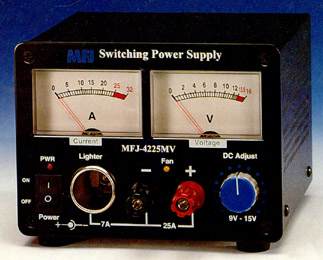
rechargeable batteries. If they will operate off of rechargeable batteries, I would recommend you go this route. All mobile radios, because of the nature of being mobile, will operate off of 12 VDC, which is actually 13.8 VDC. If you choose to use a mobile radio as a base radio, then you will need a separate power supply. Most receive radios use very, very little power. Just about any power supply will work. If you use a mobile CB as a base station then you will need a power supply that puts out 3 or 4 amps. If you're going to operate a ham radio or more equipment off of your power supply then I would recommend that you go ahead and pick up a 30 amp power supply. This will provide you with enough power to operate your radios, receivers, battery chargers, charge your cell phones and other similar items. 

Antennas. Some radios will need an external antenna. If you are operating
in a vehicle, the only radio we have discussed that will need an external antenna, is a CB radio. Most people use a magnet mount antenna. If you decide to go into ham radio, then your antennas will become more varied because different frequencies need different antennas. There is no one antenna fits-all frequencies. For your CB base station at home, you will also need an external antenna. Go to the post where we talked about CB base station antennas. Your handheld radios, like GMRS and MURS, will operate for the most part off of their attached antennas. If you choose to attach an external antenna to your scanner or weather radio, I would recommend a basic discone antenna. It is built to receive these VHF frequencies. If you choose to connect an external antenna to your shortwave receiver, then I would recommend a long wire type antenna for this purpose. In the previous post about shortwave receivers, there is information about antennas. There may come a day when you need some coaxial cable. This is what connects your antenna to your radio. You will also need a plug on each end of this cable and in most cases, it will be a PL-259, or a BNC type connector. For overall general purpose use, I would recommend RG-8X cable. It is a good all purpose cable for low power, short distance runs of under 25 feet. It also works well for your receive only radios.

Licensing. There is no license required for any receive radio. If you choose to become a ham radio operator, you will need a license. More on that in the next radio post. CB and MURS do not require a license. GMRS does. As I stated in a previous post, I have never met a person with a GMRS license. Which brings us to legal regulations. If you operate any transmit radio that interferes with any other type of telecommunications signal, then you are required by law to either fix your problem or cease transmitting. This is seldom, seldom a problem with legal power transmitters. If you choose for example to increase your CB power from 4 watts to, let's say, 400 watts of power, and you cause the lady next door's TV signal to be distorted, then you are running illegal power. If your 400 watt CB radio does not bother anybody or anything, then your radio is still illegal, but for the most part,
no one will care. If you decide to buy a commercial radio, which you can, and you choose to operate it on a frequency, for example the one the local airport is using, then you will find out very quickly that being stupid does not pay. If you choose to use an unauthorized frequency that interferes with the local fire department, again you will find out that some people might not think this is cute. If you run 5000 watts of power, as an example, and you want to talk to your buddy down the road and you don't bother grandma's TV signal and you don't interfere with the local airport or fire department, then probably no one will care. If you choose to operate or modify your radio, and it is now considered illegal, this is your choice. Something I said earlier, if you are driving 36 in a 35 MPH zone, probably no one will notice or care. But....if you choose to drive 96 in a 35 MPH zone, then someone will notice and care. Again, this is your choice.

Speaking of 5000 watts. 5000 watts may be a tad bit of an exaggeration. But if you choose to pump up whatever radio you are using and you do not know what you are doing, you can fry your brain. No joke. No kidding. If you don't know what you are doing with radio frequency, then DON'T DO IT. Lot's of ham radio guys and non-ham radio guys run what is called, extra power. It's not a question of legal or illegal, it's a question of, if you don't know what you are doing, you can cause permanent damage to your cute little girl's brain. So, one more time, if you don't know what you are doing, DON'T DO IT. Safety comes first. Always.

Next time, we're going to get into ham radio. You will find the frequencies very similar to GMRS, FRS, CB and MURS because ham radio is not some miracle, mysterious thing. It's just a group of frequencies or bands or meters that we all share every day. I hope this has helped somebody, somewhere along the way to understand radio communications just a little bit better. Look through the previous radio posts. They are filled with links, dealers, manufacturers, and regulations. 

We'll talk more later. 73, Frank

Thursday, December 10, 2015

Antenna Tower Sneak Peak


Over the last few weeks, Frank has been working on upgrading our antenna towers. We're still not finished, and hope to raise the last one today. There are many details that Frank will explain in a future article, but for today, you get a pictorial of our progress. Please feel free to ask questions in the comment section. We have learned a lot doing this project and are very pleased with the outcome so far.


Prayer is healthy.


This has been, and continues to be, a big project for us. We are very excited about increasing our ability to communicate via radio, whether it is GMRS, MURS, CB or ham radio. This is a very important part of our survival plans. If at all possible, we want to know what is coming down the road before it gets here, and you should want to know, too. Don't get on the truck.

Until next time - Fern

Friday, November 28, 2014

Radio - Stay In Touch

Hi Everybody, Frank here.

Hope all are well, and I hope everybody had a pleasant Thanksgiving. It's always nice to stay in touch with friends and relatives, and Christmas is just around the corner. 

There are some of us out there that see we're in perilous times. Let me explain. Have you paid attention to the Dow Jones lately? Record highs, right? And I know you're paying attention to crude oil, copper, silver and
Baltic Dry. One market's going one way, while other markets are going the other direction. And I know you've been paying attention to Ferguson, Missouri. A tragic event happened there. But the way the community responded, should have you seriously concerned. And I know you're paying attention to the amnesty issue. On the other hand, there are multiple issues, and if I take off my shoes and socks, I can count many, many more issues, seriously pushing the envelope. If you can't see what I'm talking about, then quit reading, turn on the football channel, and watch the cheerleaders jump up and down. Good. There went the vast majority of people to the football channel. Now we can talk without interruption. And, that's what you want to do. To be able to talk without interruption. 

As mentioned above, you want to stay in touch with your friends and relatives. Here are some ways that you can stay in touch without grid power. Because if you agree with some of the dark topics I mentioned
earlier, then you know that one day we're going to have some form of economic shutdown. We are in the process of it as we speak. Now. How are we going to stay in touch when the cellphones and hard line phones don't work? When the internet is not working? We're going to stay in touch the same ways hunters do when they're out walking in the woods, and the same way the military and FEMA does for longer distance communications. Okay. Let's go.

First, short distance communications. This is considered to be line of sight. If you're on water, it'll go a long ways. Hilltop to hilltop, a long ways, but it's still line of sight. Now I'm going to talk about UHF and VHF frequencies. The first little radio is a GMRS/FRS. You can buy these at any sporting goods store, big box store, or online. They have 22 channels, up in the 460
MHz range. This is the type of radio hunters use, kids play with, and for the most part they are good solid radios. But, what you have in your hand, is what you've got. Some advertise 50 channels, not true. It is 22 channels with slight variations. Some advertise 36 miles, not true, unless you live in a perfect world, and that's not true. I'm going to direct you to a previous post. But here is the GMRS that I recommend. These radios are not expandable and you cannot modify them. But if your buddy down the road, one mile, two miles or farther, depending on your terrain, has one, you can stay in touch. These are good radios, they'll last for years if you take care of them.

Next, I would like to introduce what is called a commercial radio. It is made by BaoFeng, it operates in the VHF/UHF frequencies. It can be modified and expanded. Let me explain what a commercial radio is. If you buy this radio, there are no pre-programmed frequencies in it, like the above mentioned GMRS. It's what is called open. The GMRS is UHF around 460 MHz. You can program in these same channels or frequencies into the 
BaoFeng radio. They are made for police department, fire department and ambulance type use. Some businesses also use them for commercial purposes, hence the name, commercial radio. Some big stores use these frequencies, Wal-Mart, Sam's, and drive through type restaurants may use these commercial frequencies. But, remember, you need to program these radios, and there are various ways to do this. At this site, if you scroll down you will see a programming cable. It comes with a little disc, you put this in your computer, use the programming cable, and you can program this radio via your computer. This is where you can put in your GMRS frequencies. This is where you can put in the police department, fire department, and VHF/UHF ham radio frequencies. This little radio will work perfectly fine on these ham radio frequencies. Here is a link to a broader explanation about these handheld radios. The good part is, this handheld radio costs about $35.00 to $40.00. It is not a sophisticated radio. It is two channel operation, but you can only listen to one channel at a time. Read the previous posts, and you will get a lot more information. But these little radios work. They cost about the same as the GMRS mentioned above, will do the same job the GMRS does, and a whole lot more.

Word of caution. To operate the GMRS radio mentioned, you are supposed to have a license to do so. I guess some people do, but I've never met one that did. To transmit on any ham radio frequency, you will need the appropriate level ham radio license. These ham radio folks are very serious about other folks using radios inappropriately. Police, fire and EMS are also very serious about unauthorized people using the police and fire frequencies. Do not under any circumstances broadcast on any police or fire frequencies. They will find you and they will shut you down. But for the other frequencies, like GMRS, that is your call. These handheld commercial radios can be connected to an exterior antenna, something like a magnet mount on top of your car, that will sharply extend your range. You can find this information mentioned in the previous posts.

Next, we're going to do a step up to another type of commercial radio. It will require an external antenna, an external power supply, and produces quite a bit more power. These are often used in automobiles, they can be used for home operations. For your home you will need a power supply and an external antenna. For your automobile you can use the same
antenna mentioned above and your car battery for a power supply. They have the same basic features as the handheld, except that you can listen on two channels at the same time, and you have much greater range due to the higher power. These radios also cost more, starting around $300.00, some a little more, some a little less. I would recommend the AnyTone AT-5888UV. The same laws and regulations apply to this radio that applies to the handhelds. For your ham radio operator, they're sharply cheaper than most dual band ham radios. If you do search and rescue with proper authorization you can use these radios on police, fire, EMS, and you can use them with the ham frequencies if you have a ham radio license. It is legal with proper authorization and with proper licensing.

All the above mentioned radios are either VHF/UHF or just UHF. These are considered line of sight communication devices. If you live in an area that has a ham radio repeater, and you have a ham radio license, you can use the commercial radios. You can use the repeater which is still line of sight, but you broadcast from your radio to the repeater, then it repeats the signal out to other radios. Now to use these radios, as mentioned above, you'll need an external antenna, and a power supply if you want to operate inside your house. I will provide links to some of these sites. 

This is a good time to mention safety. Handheld radios as a general rule do not produce enough power to do anyone harm. Your mobile radio, with more power, can. If you don't know what you're doing, don't do it. Take a little time and read some of my previous posts about safety and equipment, and most of your questions should be answered there.

Now let's talk about a little bit longer distance radio communications. The same safety rules apply. This type of radio communication is seldom used with a handheld or mobile radio. It can be, but not very successfully. You will be required to have a ham radio license to transmit on this type of system, but that doesn't mean you can't listen. ICOM makes an entry level HF radio, which is a solid, functional High Frequency transmitter and receiver. This radio will also receive all of the shortwave frequencies,
and it will transmit and receive all of the lower band ham frequencies with the proper antenna. You will also need a power supply. But the type of transmitting that I'm going to talk about now is NVIS. Do a Google and check this out. It has a radius of around 300 miles. The military and FEMA use this same type of system. It is a fairly reliable way to transmit and receive, covering a larger area. Again, about a 300 mile radius. You see, ham radio transmissions that bounce off of the atmosphere, some days are reliable and some days aren't. But this type of system, NVIS, for the most part is reliable. NVIS, check it out. You will need a ham radio license to transmit on any ham radio. I've mentioned this type of system in other posts. Please take the time to read them. Follow all safety requirements.

What I've tried to put together today is a group of relatively inexpensive radios that are solid performers, and do a more than adequate job. If you need a radio with more bells and whistles, they're available. If you want basic, reliable communications, what
I've given you here is a good start. There may come a day when you want to stay in touch with your friends and family, when normal forms of communication may not be available. I make no profit whatsoever from any radio post, it's just that God has given me the ability to see what is coming. And if I can share with you, just a little bit, and encourage you to make that step, then maybe you can stay in touch with your loved ones when there are no other means of communication available. Under a very worse case scenario, you might be able to let your Bubba down the road know that something bad is coming his way. And in return, he can do the same for you. This is all just food for thought. 

While you're at it, please check out the humble CB radio. At this link start at the bottom of the page and you will see four posts dealing with CB radio. There is a lot of very good information there. When things shut down, it will find it's place again. 

You ask, "Well, how do I power these radios when things have shut down?" Read some of the earlier posts. A solar panel is a real easy way to have radio communications. If you've got a little extra jingle in your pocket, read the post about scanners. That's all they do, and they're much faster than the scan on your handheld radio. 

Get ready. It gets closer everyday. Now, aren't you glad you didn't change to the football channel? This is not a joke boys and girls, and once it hits the fan, it will be too late to prepare.

We'll talk more later. Frank