The Road Home

The Road Home
There is no place like home.
Showing posts with label whey. Show all posts

Thursday, August 20, 2015

Homestead News, Volume 9

Time continues to fly by and autumn will be with us before we know it. We are finally out of the 100+ temperatures. It was 59* here last night! I don't think it will last, though, we are supposed to be back up into the low 90's by early next week, and that is fine. It is much more manageable than the 100+ stuff with high humidity. With the cool weather this morning, we were able to use our new double hung windows to fill the house with cool, fresh air. They work great.

We want to send our thoughts and prayers to those that are being affected by the wildfires around the country. We have friends in the northwest that have had to evacuate their home, and we haven't heard from them since yesterday. It must be very difficult to leave your home not knowing what you may return to. There are many different types of challenges we are all given, but many times on the other side of it, we are stronger for having been tested and refined.

We continue to pen up the youngest kids and accumulate milk for cheese making. The last batch of cheddar is ready to wax, but I ran out of steam before I got to it today. Two more wheels of cheddar are now in the cheese press and will be ready to remove and start the drying process tomorrow evening. Since I won't be able to wax these two wheels until Saturday, I put them in a plastic storage bag in the refrigerator. I will be having a sinus dilation procedure tomorrow morning, so I don't expect to get much of anything done for the rest of the day.


We continue to eat our cheddar at room temperature, but have found that it gets too oily if we leave out the whole wheel. This time we cut it in half covered the open end with plastic wrap and put it back in the cheese frig until we are ready for it.


We also filled up the fermentation crock with four heads of cabbage today. The last batch of sauerkraut stayed in the crock for a month and it was the best tasting we have had so far. We still have three quarts of it in the refrigerator that we are eating, and wanted the next batch to have plenty of time to ferment. It's interesting how quickly things like making sauerkraut becomes routine.
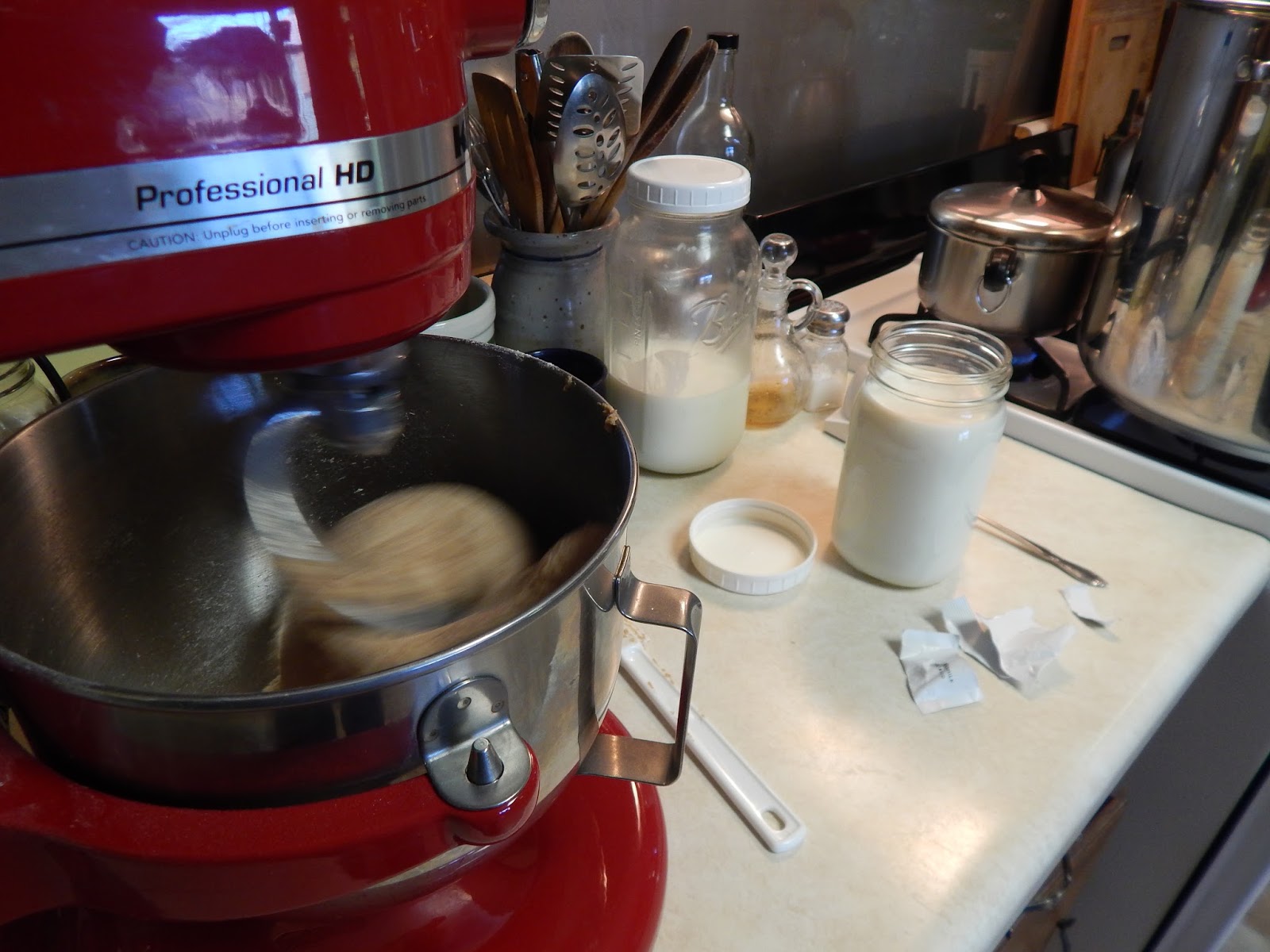

Today was also bread day. The sourdough was still doing it's thing and predigesting all those carbohydrates for us on top of the frig while I was writing this. We didn't get the dough mixed up until about 11:00 this morning, so I didn't bake the rolls until 8:30 this evening. I wanted to give it plenty of time to ferment and digest beforehand. They sure are good.


I've tried to make cottage cheese twice by leaving the milk on the counter. The first time it didn't really curdle, so I thought I hadn't left it long enough.

The second time I left it for about four days and it was definitely soured, but still didn't really make curds like it was supposed to. That's too bad, I was really hoping it would work. Now it will be back to the cheese book and making another stab at modifying the recipe so I can get good cottage cheese.

We still have roosters and wethers to butcher, and we hope next week after my sinuses clear up we can get a lot of butchering done. That and get some fall crops planted. My headaches and general feelings of sickness have put everything like that on hold for way too long. So I hope to have more to report in the butchering department very soon.

The pigs are doing much better in the behavior department. There are some folks at church that have raised pigs for years and Frank was quizzing them on 'normal' pig behavior last week. We are still learning, and they are still growing. It will be very interesting to see how they do in the long run. I'm also very interested to see how Lance and Liberty behave once we have butchered the barrows. I think the interaction will be different then. We pay a little more attention to them since they are our breeding pair and the barrows will end up on our dinner plates. I have a question for you. Does a pig's tail continue to grow longer and get more curly as they grow up?
The whey produced from making cheese goes to good use as pig food. They get upset with me if I take them a bucket of scraps without some kind of liquid in it. I can't help but laugh at them when they fuss at me. It's a funny little squeal.


By the time we got most of the day's activities completed, the kitchen was really a mess. 


As the week has progressed we have watched more major fluctuations in the financial markets around the world. It is just another indicator of the instability of the underlying foundations of economies everywhere. We continue to discuss what tangible items we can invest in that we will be able to use in the future, come what may. An example of one of our acquisitions is a stainless steel water bath canner. We have two like the one pictured above that the whey is in. One of them, after three or four years of use, has chipped and has a place trying to rust on the inside of the bottom. Knowing they won't be durable for long term use, especially if we get to the point that we can't buy or trade for another one, we chose to invest in stainless steel. As you can tell, it's still in the box. We'll keep using the enameled version as long as we can.


We continue to pick peppers, tomatoes, cowpeas and carrots from the garden. I really hope to write another garden article before long with the things we have been able to plant for fall. 


Thank you for all of the great comments. It's neat to be able to share. Frank and I have learned a great deal from other folks experiences. Please keep sharing. 

Prepare for the fall of the year and the fall of the world. They will both be arriving soon.

Until next time - Fern

Wednesday, May 13, 2015

Getting Ready For Pigs

We spent part of today getting ready for the arrival of our American Guinea Hog piglets. The original plans included doing some of this work yesterday while the sun shined, but a relative's unscheduled hospital stay, changed our plans. We were glad we had the opportunity to visit him for a while. So today before the rains arrived again, we rearranged some of the goats, brush hogged down some wet, wet, tall grass and weeds, and got ready for the pigs. Well, not really before it rained, because we got some light showers shortly before dawn. Thus, the grass was extra wet, but sometimes these things just can't be helped, and you make do with the circumstances you've been given.

American Guinea Hogs. I had never heard of them until I read an article from Leigh at 5 Acres and a Dream last June. I had no idea a pig could grow so small. That is what captured my attention and started a slow,
gradual bit of research that has landed us in the current predicament, the adventure of becoming not only goat herders and chicken cluckers, but pig farmers as well. We can only pray it is not the misadventures of becoming pig farmers. If you have read here very long you have probably run across a statement from me saying something like this. "I hate pigs." And I did. I just hope I don't anymore. Part of that sentiment is because I am afraid of pigs. I think they will bite me. It's kind of like being afraid of dogs. It's just a fear that I have decided I want to get over, because the benefits of raising American Guinea Hogs can far outweigh this fear.

I am including a number of links throughout this article so you can see where my research has taken me. The first thing that captured my attention when reading Leigh's description of her new pig was that they only grow to be about 200 to 250 pounds full grown, even the boars. I was very surprised. I had never seen anything about pigs being less than 800 to 1000 pounds or more full grown, and I didn't want anything to do with animals that large. So I read the link she provided and thought it was very interesting that these pigs are naturally small. They aren't miniatures, dwarfs or midgets of any sort, they are just naturally smaller than most commercial pigs.

Then I started looking up more articles, and found that another characteristic of these pigs is their docile, friendly nature. Well now, how is
a person that is afraid a pig is going to bite them going to handle a pig that wants to run over and be petted and scratched? I've decided I'm going to treat them like a dog. Sounds funny, doesn't it? But if a dog does something that is unacceptable they get corrected and trained to exhibit behavior that is acceptable. I plan, or hope, to do the same things with the pigs. I've read that they may try to jump up on you like a dog, but are easily trained not to, so their friendly personalities are another plus.

The next major plus from my perspective is that these pigs thrive on pasture and do poorly if they are confined and only fed grain, or fed too much grain. That's great! We have been trying to produce more and more of our animal feed, and if these pigs are healthier and happier grazing in
a pasture, then wonderful, we have plenty of room for them to graze and grow. Another example Leigh has given me is that she feeds very little grain, and what she does feed, she sprinkles on the ground for the pigs to forage and root. I thought that was a great idea and will be doing the same. I will also now have another bucket to take to the barn at feeding time. The pigs will get whey from our cheese making projects as well as garden scraps and other kitchen waste. For instance. Today at lunch I emptied a jar of beets, and told Frank that after the pigs arrive the water from the beet jar will go into the pig bucket instead of down the drain. They will get all of the scraps that don't go to the chickens or dog, and that will be great.

When I realized how small these pigs grow, I like to think of them as small, even though a 200 pound animal isn't really very small, I thought about having another source of meat on the hoof. That's how I think of our
goat wethers. They are just meat walking around in the pasture waiting to make it into the freezer. Frank and I can handle butchering a 150 to 200 pound pig, and it would be another great source of meat. But not only that, Guinea Hogs are well known for the quality of their lard, like some old heritage breeds used to be. These hogs will not only provide us with meat and lard, they don't require a lot of feed to do so. The lard will provide us with a natural cooking oil, and we hopefully will also be able to use it in our goat milk soap recipe. The smaller carcass of these pigs will mean less meat to preserve before spoilage if we live in a grid down situation, as well. Just like with our goats, I view a smaller carcass to be to our advantage.
 
The breeders in the area that I have talked to all agree that these pigs are healthy, friendly, easy to manage and very productive. They don't require vaccinations or worming, even in our area that is known for wet years that are very conducive to the worm population, like this year. Guinea hogs will have litters of six to eight piglets about three times every two years on average, according to my research. This is yet another benefit to raising this small, heritage breed pig.

These are the reasons why we are embarking on the adventure of adding pigs to our homestead. These animals don't grow very large, they thrive on pasture, they are naturally healthy, friendly and easy to manage, the meat and lard are well known to be of excellent quality and we will be able to butcher them ourselves. A concern I have, and will for a while, is if they will stay in their pasture. Our fencing should hold them just fine according to all I have read, but this is my biggest concern so far. We'll see if more arise after their arrival.

Friday, if the weather cooperates, we will be bringing home two boars and one gilt. This is new vocabulary for us. I had this vague notion that a male pig was a boar because you hear of wild boars being hunted in these
parts, but that was about it for my pig vocabulary. One of these boars will become a barrow when we have it castrated to raise for meat. We will keep them both intact for a while until we decide which one we want to keep for a boar. The gilt, or young female, will become a sow when she has her first piglets. We have debated back and forth about whether to get one gilt or two, and actually thought we had been able to line up two boars and two gilts that we could pick up all in one trip from two different locations. Then when I called to make the arrangements, I found that one of the gilts had been injured, so there was only one available. I don't know if you ever have these feelings, but I felt like that was an answer to our question. God answered our question by only having one available for us at this time. It's interesting how things happen sometimes.


I hope to have a report for you Friday or Saturday, with pictures and hopefully no mishaps. I freely admit we are entering this adventure with a little trepidation and doubt, especially on Frank's part, but entering it we are. Fear is a powerful thing. It can control nations, it can preclude success, it can tear down dreams. But only if you let it. There is a quote somewhere that says something like, courage is fear in action. Maybe that would be a good name for a pig...... I wonder what the goats and Pearl are going to think. That should be interesting.

Until next time - Fern

Monday, March 16, 2015

Herb Cheese & Planting Roses

We have another respite from the rain today with some sunshine off and on between the clouds. I went out yesterday and pulled back some of the free mulch, from the hickory and pine trees, off of the plants that are peaking up in the herb bed. It's about all I could do since the ground is super saturated right now. We have slowly been building up the milk supply in the frig to the point where we can start making a couple of batches of cheese a week. Last week we made a small batch of mozzarella with one gallon of milk. When we have plenty of milk, I make two or four gallon batches of mozzarella and freeze the extra. For now, we are making fresh cheese to eat, and we're very glad to have it. Once our three young does, Lady Bug, Cricket and Penny, kid and begin producing enough milk, we will have way more than enough to really ramp up our cheese production. First up will be cheddar since it needs to age at least three months to start having a mild cheddar taste. We have been out of homemade for quite some time and once you get used to it, store bought just doesn't hold a candle to it in flavor, freshness, consistency and nutrition. 


So today I made a fresh, pressed herb cheese. It is the same recipe I used last year, with the same ingredients, but only the second wheel of herb cheese I have made. I mentioned last year that I thought it would be good as a pepper cheese, and that will probably be the one I try next. After that, I think I will try one with oregano and maybe marjoram. Both of those plants are coming out in the herb bed, so by then I should be able to use fresh herbs in the cheese.

Oregano peeking out, March 15th

Here is a pictorial of the cheese I made today. As I mentioned in the article last year, there are other cheese making articles that will show you some of the specifics of the process we use. If you have any questions about any step of this procedure, please let me know and I will address them to the best of my ability.

Time to dust off the old cheese press


These are the multiplier onions I accidentally planted, and then dug up out of the garden last year. They've been waiting all winter in this tub on the porch to be planted in the herb bed where they belong.

One of the garlic patches

The garlic is doing well. I chose the largest of this bunch.


The curds are ready to heat and cook down


Time to pour off the whey


We save the whey in plastic jars for the dog, cats and sometimes chickens.


I had to crumble the curd so I could add the garlic, onions and salt.


Last year I thought the cheese was a little dry, so I didn't press it as hard, and I only left it in the press for three hours.


Frank wanted to taste the cheese right after I took it out of the press. I warned him that it wouldn't taste like what he was expecting. He only ate half a bite and said it wasn't any good. Then he asked when it would be good. I told him tomorrow or the next day after it has time to sit and let the flavors blend together.
 

The recipe recommends putting the cheese on a plate covered with plastic wrap. I chose a bowl and our reusable food wrap instead. After the cheese was in the press, I had three hours to do other things, like feed us lunch. 

We received the rose bushes we ordered in the mail today, which we opened right away, then started them soaking in water. Since they are bare root, they needed to be rehydrated and kick started before I put them in the ground. I guess one advantage for them now is the fact that the ground is so saturated. There will not be any shortage of moisture for them to get off to a good start, not to mention that we have a chance of rain everyday this week starting again tomorrow afternoon. Otherwise I would wait a few days for the ground to dry up before planting. But I think these bushes would be better off in the ground than sitting around another few weeks waiting for better conditions.


I planted four rose bushes last summer that had been living in pots on the porch waiting for a permanent home. Plants here have to be willing and able to live in rather primitive conditions without a lot of TLC, or they just won't make it. These bushes are a mix of red and cream colored roses.
That being said, three of the four are budding out and seem to be doing just fine. The verdict is still out on the fourth one. It appears the upper branches are dead, but maybe not the rest. We will see. [After I wrote this I found this leaf budding out toward the bottom of the plant. Yea!]

One of the main reasons I am planting roses is for the nutrients in the petals and rose hips. We also have many wild roses growing around here and there. I used the rose hips I picked last summer, which weren't very many, to make rose water for the last batch of lotion I made. I thought that was very neat.

The new rose bushes are called Harison's, which is the name given to the classic Yellow Rose of Texas. You see, Frank and I are Texans, that have been transplanted to Oklahoma. If you are from Texas, you know how we feel. We will always be Texans. That's why Frank requested I find and plant the Yellow Rose of Texas here on our homestead. And since these roses will have to fend for themselves in our semi wild yard, I bought four of them, just in case some of them don't make it.

I gave the roses a small dose of this great barnyard compost.

I saved some extra coffee grounds to give to these new bushes since they prefer a slightly acidic soil.


I've said a little prayer that they will do well. Just for Frank. It's nice to be able to do something special for your spouse, even if it takes years to accomplish. I envision a big, wild entanglement of rose bushes all over this fence with beautiful, yellow roses that I can pick to adorn our table. This is one dream I do hope comes true.


The herb cheese is beautiful and I really get a great deal of satisfaction making it. We will have some tomorrow with our lunch. I hope it's edible then.


By the way. Yesterday at our small country church we sang Brethren, We Have Met To Worship, and it really touched our hearts. We both went back and looked at the words again. Here are two different versions of it, one very country, and one with a church choir. If you care to listen, I pray it touches your heart as well. The second verse really stuck with me. "Brethren, see poor sinners round you, Slumbering on the brink of woe; Death is coming, hell is moving, Can you bear to let them go? See our fathers and our mothers, And our children sinking down; Brethren, pray, and holy manna, Will be showered all around."

Here is the site of tomorrow's planting


I hope to get the cole crops into the garden tomorrow before the rains come again, so the next post may be a little muddy. I'll let you know how that goes and how the cheese turns out. Spring is just a few days away and life on the homestead will get much busier. We will get the garden in, and spend time tending it. I have many, many more seedlings to grow, especially for the herb bed. After we kill off all of the weeds and scrubby tree stuff at the end of the garden, we will be starting a new comfrey bed. The extra strawberries that have spread out into the garden area will also be used to start a new bed. More baby goats will be arriving in a little over two weeks, and that means more time milking each day, especially with three young does to train. I haven't gotten much more done on the rag rugs, but it will be sitting here waiting on me when I am ready to pick it up again. Life is good. It would be so much easier to sit back and be lazy, and I am actually pretty good at that, as well. But there is nothing like having plenty to do. It keeps you going, learning, dreaming and accomplishing. Blessings to you all.

Until next time - Fern