The Road Home

The Road Home
There is no place like home.
Showing posts with label sugar beets. Show all posts

Tuesday, October 7, 2014

Growing Animal Feed

Growing some of our animal feed is something we have wanted to do for a long time, but it's a goal that is not easy to meet overnight, in a year, or even over a couple of years. This summer we have been able to make a little head way on this project, and we want to share what we have learned.


In the spring when everything was turning green, I started gathering grasses and weeds to feed the chickens. Our chickens are not out ranging at this time, but they do have a run outside of the chicken house. We need to add a chicken proof barrier along the bottom of a couple of gates to keep them on their side of the yard and out of the garden. So, for now, they get some kind of greens almost everyday along with other garden or kitchen scraps as they come along.


In the early spring, I started to feed them beet greens as soon as the plants were big enough to spare a few leaves.


I also planted some new comfrey roots to expand our ability to provide more animal feed. This patch had really done well. For most of the summer, the chickens received a handful of comfrey leaves almost everyday. This was a great addition to their feed. The goats like them as well, but since they had lots of good things to eat out in the pasture, they were not a crazy about these leaves as the chickens were.

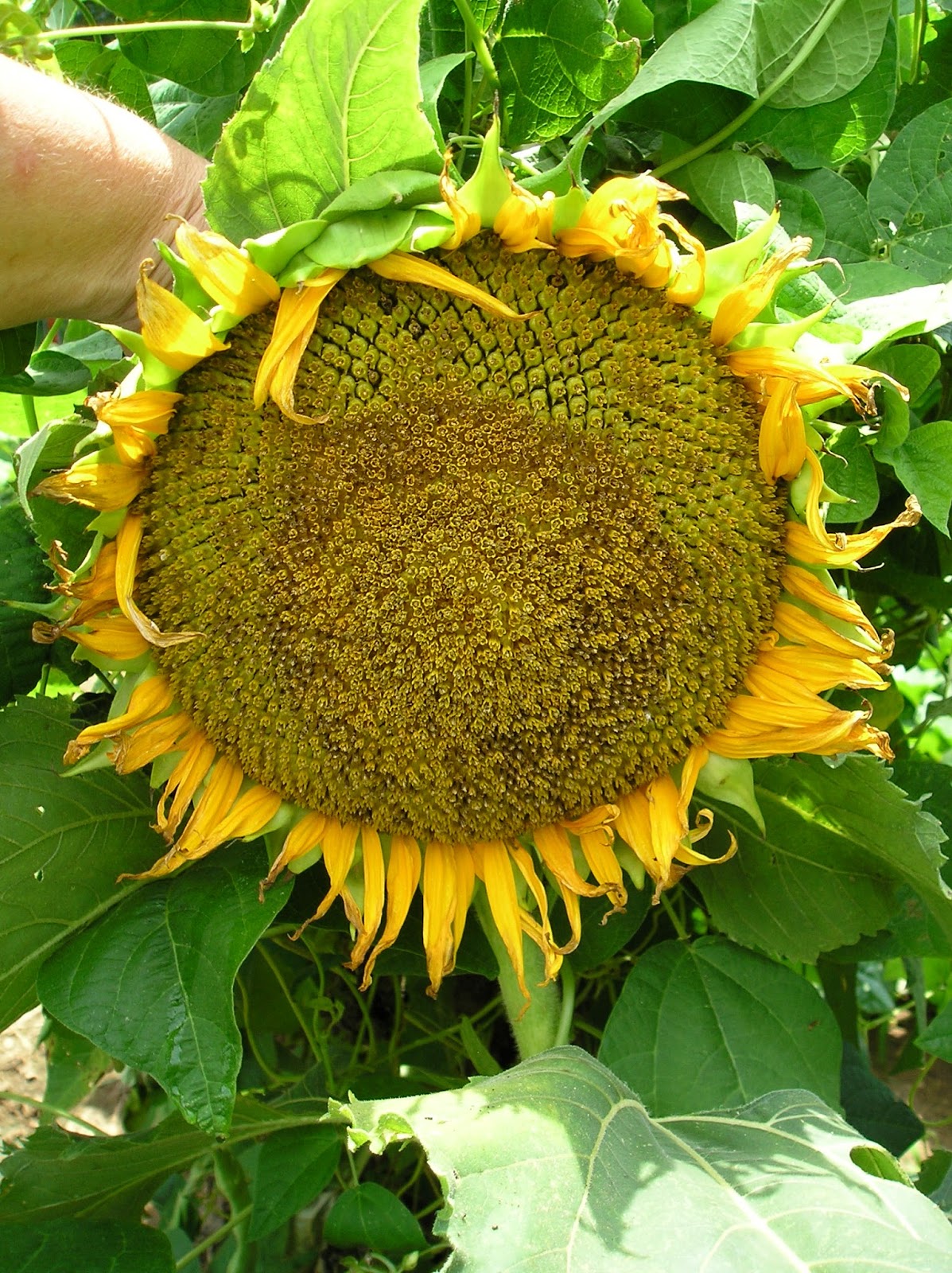
We grew some sunflowers this year to be used as animal feed for both chickens and goats. Our patch was about six feet by thirty feet with four rows of plants. Here is our harvest. All of these plants were grown from seeds we harvested last summer from our very first plants. I think there were about six of them. It's good to know the seeds are easy to save and replant. If we wanted to grow enough to feed a little all winter, we would need many, many more plants than what we grew this year. But it is a start.


The corn we grew ended up being dried for the animals instead of canned for humans. Sometimes things just end up that way. It is interesting to see how it has dried, and figure out an easy way to remove it from the cob. Once it is this dry, the kernels separate from the cob fairly easy just by rubbing two cobs together. I will keep the dried shucks to see if the goats will be interested in them this winter. Another thing to learn. This small amount of corn won't go very far as animal feed, either, but it has been a very interesting learning experience.

 
Now that the fall crops are up and growing well, I pick a batch of greens for the chickens every morning. They get a bucket full of turnip greens.

Turnips, Kale & small Swiss Chard


Add a handful of kale.....


 And a handful of beet greens.


The fall carrot crop is growing pretty well. It will be interesting to see how the animals take to carrots, turnips and Mangel sugar beets as a source of winter feed. Very interesting. This is something I have wanted to try for a long time.


 Our patch of purple hull peas has been taken over by the grass and weeds. But before that happened, we were able to pick several batches that had dried on the vine and fed them to the chickens and goats. They were all more than happy to eat them, the chickens just the seeds, but the goats, pods, seeds and all. This is a very easy crop to grow that is highly nutritious, for both animal and human.

I still throw in a few comfrey leaves every now and then, but I am letting the comfrey put energy into their roots for winter. The original comfrey plant I added to the herb bed about four years ago stays green until about January when our weather turns cold. I have been surprised every year that it takes that long for it to die back. It starts peaking out new leaves in late March when it starts to warm up, but doesn't produce enough leaves for fresh feed until sometime in April.

The amount of feed we are harvesting each day for our animals really doesn't amount to a whole lot, but it is a start. There are some other things we also want to try. Our friend Grace found a article in Mother Earth News that talked about Austrian Winter Peas that can be used for chickens and deer. Some folks also eat the shoots in salads saying they taste just like peas. It is better known as a cover crop for fixing nitrogen in the soil. After Grace told me about them and I read about them, we ordered some seeds. It will be another thing we can try for animal feed. Thank you, Grace.


If times get hard and we have to provide for ourselves and our animals, this small amount of experience will hopefully help keep us on our feet while we learn even more. Challenges will always come our way, and we have had more than a few this year. Even so, our little animal feed growing project has taught us a lot. And we hope to learn even more through the winter and during the growing season next year.

Until next time - Fern

Saturday, August 9, 2014

Playing in the Dirt

Don't you just love dirt? Well, most people probably don't have the same affinity for dirt that I do, but most gardeners love dirt. To me, a new patch of dirt holds so many possibilities. Of course the grass and weeds will take advantage of any new ground around, but with a little work and encouragement, a tiny little seed will turn into something amazing to behold....and eat.


After the potatoes, beets, onions, sunflowers and corn were harvested it was time to till up some of the garden again for the fall crops. I have tilled the garden with the tractor exactly one time before, and since Frank's back surgery was recent, he could not do this for me like he usually does. He did stay with me for moral support and advice, like, "Watch the bucket (on the front of the tractor) and make sure you don't take out a chunk of the house or storage shed." This was very good advice. I am still very slow and awkward using the tractor between the house, fences, vegetable trellises and storage buildings. For some reason backing up and turning the wheels in the right direction just does not follow the same pattern I have in my mind for driving a car. I had to laugh at myself several times as I got the tractor all whopper jawed and not aligned at all with where I wanted to be. Frank could only just stand there and shake his head.


But the job is done, and now I have some beautiful dirt to play in. We got the tilling done just in time to plant six hills of Cushaw winter squash
before evening fell. Then along came two days of a nice, slow, soaking rain. After that, I had the terrible poison ivy outbreak. I finally went to the doctor and he said it was not my psoriasis, which I thought it was. By then it had covered over a third of my stomach, the tops of my thighs, the inside of both arms and a few spots on my neck. I was truly miserable. I am finally healing up, but I haven't been back out in the garden except to pick a few things. Today, we are getting another round of rain, which is great. When the earth has had some time to dry a little, it will be time to play in the dirt some more and plant the rest of my fall seedlings and a few more seeds.


The cantaloupe will share this small area between the two storage buildings with the neighboring Cushaw. I have broadcast some zinnia and radish seeds around in hopes of deterring some of the squash bugs that reside not too
far away. I also spread some wood ashes around the base of each plant to deter squash vine boring worms. While I was at it, I shared some of the wood ashes with the green beans to try to help their blossoms to set fruit.


I'm going to plant the cabbage over in this small area by the dying yellow squash. We were still able to pick a few squash until recently, but the plants and a lot of squash bugs have now gone to the chickens. 


I will plant the Brussels sprouts and carrots in the front of the herb bed so they can have lots of time to grow. That way I can till the regular garden at the end of the season without working around these two crops.

The area that held the corn will become sugar beets, both Mangels and Bucklunch. It will be interesting to see how these two crops do. If we can get a decent harvest our goal is to see if we can make some sugar. That will be a real learning experience. We will feed the beet silage to the goats and chickens if this experiment works out.

Then, next to the new beet patch we will plant another row of potatoes. We probably have enough potatoes to get us through the winter, but I would like to have some fall potatoes to store for next year's seed potatoes. Just like saving seeds from some of the other crops, I would like to grow our own seed potatoes. What if I couldn't get anymore from the store in the spring and we had eaten them all? Potatoes are a very nutritious, energy rich food that we would like to be able to produce on our own if the need ever arises.

Next will be our first crop of turnips....ever. We have heard lots of folks talk about raising turnips, both for themselves and livestock. It' time we tried our hand at it.


With the continuing discord throughout the world, we are all feeling a growing tension and a sense of dread. What might be around the next corner is an unknown at this point. The need for vigilance and determined self-reliance is more important now than ever. Do you have what you need, both in knowledge and supplies? Get with it before it is too late. Keep your family close, and to borrow a phrase from Ol' Remus, avoid crowds.

Until next time - Fern

Wednesday, July 23, 2014

Corn & Fall Seedlings

The corn was ripe and ready to pick, so that was the chore for today. I have found it easier to pick the patch if I pull up or break off the stalks as I pick. It clears the ground and helps get it ready for the next crop.


I plan to use the corn stalks as a heavy mulch in a new area we want to turn into another herb bed. In years past, I have pulled up the corn stalks and piled them right outside the garden. This time, instead of stacking them on the ground, then loading them up to go somewhere else, I decided to load them directly into the back of the pickup. When I finish mowing the grass and weeds down in the area for the new bed, I can just drive by and unload these directly onto the bed. Well, that is the plan anyway.


Here is our corn harvest for the year, minus the half dozen ears we have already eaten. There are quite a few small, irregular ears that I will give to the chickens. Our young hens that are about five weeks old, have really taken to eating the scraps and comfrey leaves I bring them, so I hope they enjoy these small ears of corn. My plan is to cut the corn from the cob and can it. We tend to eat more corn from the can than from the cob, and this will also give us another learning experience since we haven't canned corn before.

I have almost finished digging the potatoes. Once the potatoes are out this area, I will till this space, along with the adjoining old beet and onion beds for some of our fall crops. The area the corn was growing in will be used as well. With that in mind, and the time growing short, at Frank's recommendation, I planted most of my fall crops in tubs on the porch a couple of days ago. The only thing I didn't plant like this are the turnips, which are Purple Top White Globes. I will direct seed them.

The things I have planted in the tubs are:
  • Dr. Jaeger's Cantaloupe - 85 days
  • Autumn King Carrots - 70 days
  • Earliana Cabbage - 57 days
  • Bloomsdale Long Standing Spinach - 45-50 days
  • Long Island Improved Brussel Sprouts - 100 days
  • Cushaw Green Striped Winter Squash - 110 days

  • Bucklunch Sugar Beet - 110 days
  • Mammoth Long Red Mangel Beets - 110 days


Our first average frost date here is October 31st which is 102 days from the time I planted these seeds. The cantaloupe and winter squash vines cannot tolerate a frost.

If we have an early frost I may be able to save some of these plants with frost cloth, so I will plant them in the same area. The beets, carrots and spinach can tolerate a mild frost, so they should be fine.

The cabbage and brussel sprouts will be happier once it cools off and can take a hard frost, so I'm curious how they will do.


Gardening is an ever changing outdoor 'school house' where I never quit learning. The possibilities are endless and can reach as far as your knowledge and imagination can take you. Grow something. Anything. It never ceases to amaze me that I can take one small, tiny seed and watch it grow into something truly amazing. Something that can feed and sustain me. I am in awe.

Until next time - Fern

Saturday, March 22, 2014

Researching a New Feed Ration

The more I read about and learn about GMO corn, the more I wish we could totally eliminate it from our diet, even though I know that's close to impossible. We do have a few cans of store bought corn in the pantry, which I don't even like to eat anymore. But, for me, the biggest stumbling block we have is the feed we give our animals. So, more research and more reading.


We used to have our goat and chicken feed mixed according to our own recipe at a small, family owned feed mill. This location does not have that option, so we have been mixing our own. Wheat was one of the ingredients we used to include that has not been available here. A few days ago when we were at the feed store, I noticed a bag of wheat bran that I didn't remember seeing before. I didn't know what the nutritional value of wheat bran would be for goats, so I came home and looked it up. According to Storey's Guide to Raising Dairy Goats, wheat bran has 13.3% digestible protein and rolled oats have 10% . Hmmm....okay. The alfalfa pellets we use have 17% protein and the sweet feed has 10%. 

Summer 2013
The ideal protein ratio for milking does is around 12%. So, what I am trying to figure out is a mix of these grains, minus the GMO corn chops we are currently feeding, that would give me about a 12% feed combination. Another thought I have had is sunflower seeds. Black oil sunflower seeds are very nutritious for both goats and chickens. We grew our first ever sunflowers last summer and actually had seeds to harvest. This summer I hope to grow hundreds of sunflowers all around our place with the plan to harvest them for animal feed.

So, the new feed ration we are going to try is:
  • 6 parts rolled oats
  • 4 parts sweet feed
  • 1 part alfalfa pellets
  • 1 part wheat bran
  • 1 part sunflower seeds
For now, all of these ingredients will come from the feed store. This combination will give me a feed ration of about 11.5% protein. Of course, the protein content is always dependent upon growing conditions.

Summer 2013
I am also going to start several patches of comfrey this summer. Right now I have one plant in my herb bed. I have ordered and received 5 more roots which will begin bed number two. Then the next step will be to start comfrey seedlings. 
Once I have them up and established, I will plant bed number three. Comfrey, also called knitbone, has long been used as a medicinal herb and as a supplement for livestock feed. It is very high in protein and vitamin B12.


Another crop I am going to try to get established for supplemental livestock feed is plantain. I have read about it for a number of years, but didn't really pay much attention to it. When I was ordering some more herb plants from Crimson Sage, I ran across plantain again, right after I had read another article about feeding it to chickens. I have been wondering what I could grow that would supplement our chicken's diet more naturally than grains. It would have to be something that is easy to grow, pick and dry for winter use. So I ordered some. I will let you know how it grows and how the animals like it.

Fall 2013
The third thing I am going to grow more of this summer is kale. I have a few rather sad looking plants that made it through our cold winter. After reading this article, I started picking off some of the bottom leaves and feeding them to the chickens. They took to them right away, but the goats didn't seem to care for them. I will try feeding them to the goats again after they have started producing newer leaves.

Summer 2013

We will try our hand once again at growing carrots, sugar beets and turnips for the animals. Last summer, our fall garden didn't produce much of anything. I got started late and the weather didn't cooperate very well either. If we are really going into another Maunder Minimum, we will see how that affects our ability to produce plentiful gardens like we have in the past.


We may all be learning to garden a little differently if the quality of our sunlight and warmth are affected by decreasing solar activity. Another thing to learn more about so that I can adjust our growing habits to match what nature is providing.


There are many things to take into account when pondering feed rations for both animals and humans. Learn all you can, put it to good use, and hold your family close. They are the most important thing there is in your life. Don't let anyone, or anything, convince you otherwise.


Until next time - Fern