The Road Home

The Road Home
There is no place like home.
Showing posts with label digestive health. Show all posts

Saturday, April 18, 2015

Adjusting to Fermented Vegetables

We wrote about our adventure with making sauerkraut back in March. I'm happy to say that this adventure continues on a daily basis. We have since made a third batch of kraut using a little of the juice from the second batch as an inoculate. We also shredded the cabbage this time instead of chopping it. I think the texture is better shredded. But this article isn't really about how we made sauerkraut, it's about how we have adjusted to eating it on a daily basis.

About two days after we started eating the sauerkraut, my knees were really hurting. I mean really hurting. Now, I have had arthritis for many years and am used to my joints flaring up, getting red, hurting for a while, then calming down. This has happened too many times to count over the years. And no, I don't take any medication at all for it. I take ginger capsules, Cod Liver Oil and Glucosamine. 

But this time the pain in my knees was different, and the onset was rather sudden. I hadn't done anything out of the ordinary or anything strenuous that would have instigated one of my typical flare ups. As I thought about it, the only thing I could think of that was different was we had begun to ingest a naturally fermented vegetable. We already eat sourdough bread about three to four days a week and drink milk kefir everyday, so it's not like our bodies were totally unaccustomed to fermented foods.


When my deductions came down to the possibility of the pain being caused by the sauerkraut, I went to the internet for some research. Here is what I found. This is a very lengthy article and contains some very good information about the need for fermented foods for a healthy life.

~~~~~~~~~~~~~~~~~~~~~~~~~~~~~~~~~~~~~~~~~~~~~~~~~~~~~~~~

At Mercola.com in Fermented Foods Contain 100 TIMES More Probiotics than a Supplement, "There is one precaution that needs to be discussed here, and that is the potential for a so-called healing crisis, or what Dr. McBride refers to as a die-off reaction, provoked by the massive die-off of pathogenic bacteria, viruses, fungi, and other harmful pathogens by the reintroduction of massive quantities of probiotics. It can significantly worsen whatever health problem you’re experiencing, before you get better.

The reason for this is because when the probiotics kill off the pathogens, those pathogenic microbes release toxins. These toxins are what’s causing your problem to begin with; be it depression, panic attacks, rheumatoid arthritis, multiple sclerosis, or any other symptom. When a large amount of toxin is suddenly released, your symptoms will also suddenly increase."

~~~~~~~~~~~~~~~~~~~~~~~~~~~~~~~~~~~~~~~~~~~~~~~~~~~~~~~~

From Gaps.me I found, "You’ll meet people who will tell you that they “cannot tolerate” fermented foods: the reason is that they suddenly had a sizeable helping of a fermented food and got a serious “die-off reaction”. Never start from more than 1 teaspoon of any probiotic food per day. Depending on the severity of the condition, different people can introduce fermented foods quicker or slower. If on 1 teaspoon per day your patient gets a “die-off reaction”, let him or her settle for a few days or longer, then increase the amount to 2 teaspoons per day. Once 2 teaspoons are well tolerated, add another teaspoon. Continue increasing the daily amount of the fermented food gradually keeping the “die-off reaction” under control."

~~~~~~~~~~~~~~~~~~~~~~~~~~~~~~~~~~~~~~~~~~~~~~~~~~~~~~~

After I read this, I realized that I was probably having a reaction to the 'die off' in my gut caused by eating the homemade sauerkraut. Painful, but interesting. We continue to eat a small serving of our kraut everyday. I think we missed one day since March 11th, a little over a month ago. Since that time, I think we have gradually repopulated our digestive tracts with healthy bacteria.

~~~~~~~~~~~~~~~~~~~~~~~~~~~~~~~~~~~~~~~~~~~~~~~~~~~~~~~~

I found an example of this at Breaking Muscle in The Real Reasons Your Guts Need Fermented Foods. "Some of the important health benefits of fermentation:

  • Fermentation is the only type of preparation of foods that cannot destroy certain nutrients, will creates more nutrients and enhances others.
  • It removes toxins and harmful bacteria found in many foods.
  • It will improve your digestion, especially when consumed before your meal and also allows for your nutrients to be absorbed properly.
  • It aids in the preservation and creation of important enzymes.
  • Fermentation is a huge supporter to your immune function. It increases your B vitamins, omega-3 fatty acids, digestive enzymes, lactase and lactic acid that fight off harmful bacteria."
~~~~~~~~~~~~~~~~~~~~~~~~~~~~~~~~~~~~~~~~~~~~~~~~~~~~~~~~

We are very pleased that we have been able to add fermented vegetables to our diet. I think over time, it will continue to add to our overall health, and especially our digestive health. My arthritis appears to have gone back to 'normal', although my hands seem to hurt more than they usually do. I can't say that I think it is a reaction to our continued consumption of sauerkraut, though. We have gradually increased the size of our portions to about two tablespoons per day. 


As the garden grows and we produce more fresh vegetables, we will be trying a number of different vegetable combinations. I also plan to try fermenting our pickles and jalapeno slices this year instead of canning them. I think that will be a fascinating experience. I truly hope to have a section of jars on the shelf that contain vegetables we grew in our garden with no pesticides, herbicides or commercial fertilizers, that have been fermented using whey from the cheese we made. I think that will be really neat.

As I served another portion of sauerkraut the other day, Frank took a bite and said, "This even tastes like regular sauerkraut. It's pretty good."  I asked Frank recently if he ever thought his wife would be making cheese, waxing cheese, growing a garden, fermenting vegetables or even milking goats. He said no, and I agreed. Sometimes our life seems like a dream. And it is. It is a dream come true. Make yours the same.

Until next time - Fern

Monday, April 21, 2014

Kefir, A Regular Part of Our Diet

We introduced kefir into our diets about four months ago. If you want to look back at that link, kefir has a very interesting history. One of the reasons I was drawn to kefir to begin with was the positive health affects it can have on the digestive tract. Has it lived up to my expectations? Yes, it has. I think I am healthier from ingesting kefir everyday. I have had to use over the counter products to maintain regular digestive health for many years, but since I have started using the kefir, I have been able to decrease these products quite a bit and look forward to eliminating them altogether.


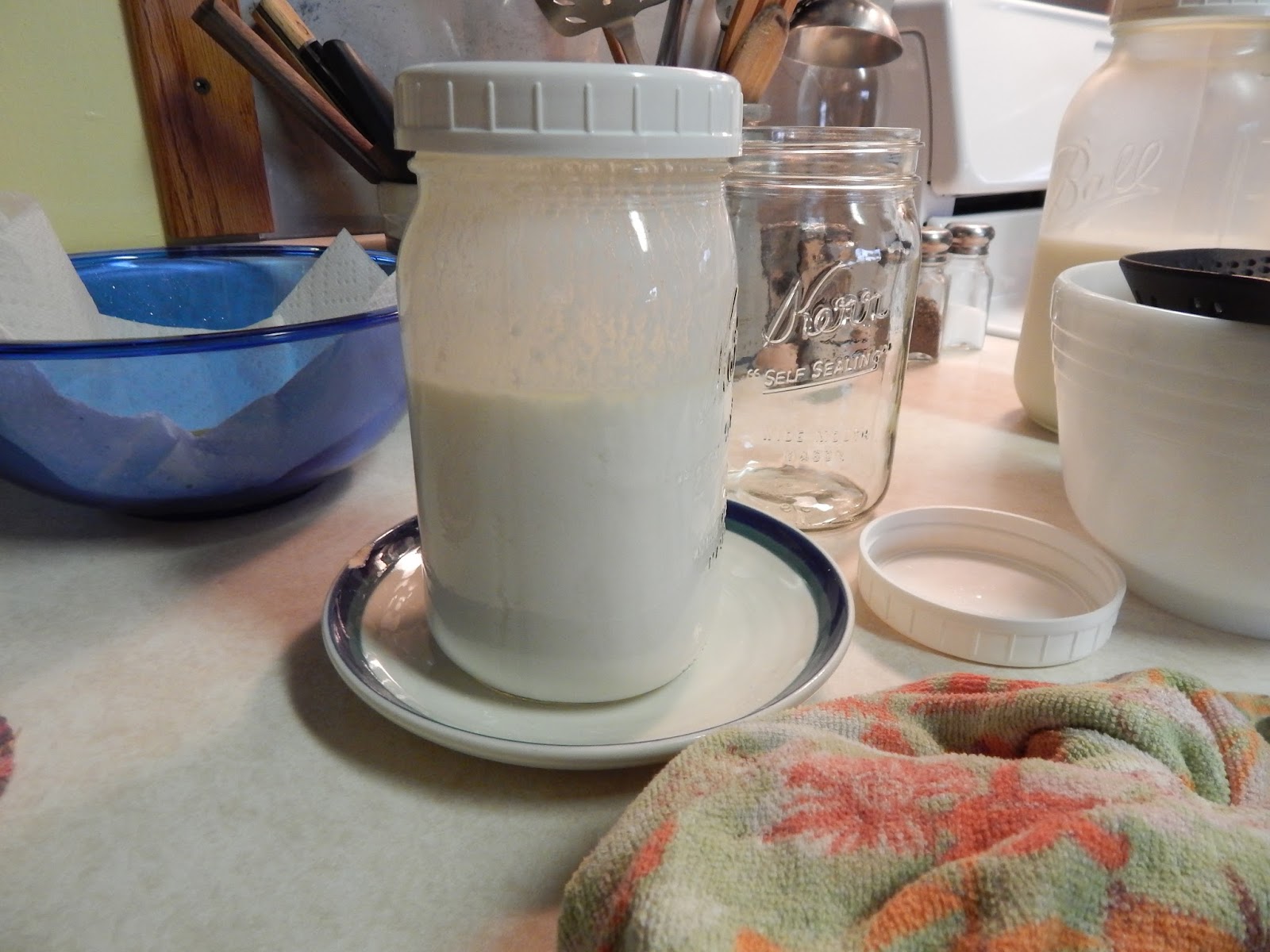
Kefir has become part of our everyday routine. Each evening I strain the grains and 'feed' it new milk. Just a reminder, kefir doesn't do well with metal, so we use glass jars with plastic lids. I also use a glass bowl and a plastic strainer when I work with the grains.


There were some things to learn along the way. I was surprised at how quickly the grains grow. If there are more grains in the jar than the milk will feed in a 24 hour period, the milk will start to separate into whey and curds, of a sort. It's not quite like cheese curds, but I have read that you can hang these curds in cheese cloth just like other curds and have a spread or cheese. I haven't tried anything like that. So if the grains begin to get too large, they need to be separated and part of them discarded or stored in the frig. I feed our extras to the chickens.


The kefir will thicken and culture the milk more evenly if it is shaken several times throughout the day. The lids we use don't seal very well, and sometimes let some of the milk run down the side of the jar, so we keep it on a plate to contain the runoff.

 
I use about a tablespoon of grains and 2 1/2 cups goat milk. Any milk will do, we have used whole store bought milk as well. We have found that leaving the kefir out on the counter for 24 hours gives us the flavor and consistency we like.  Well, Frank doesn't really care for the taste, but he drinks some anyway. We like to add a little maple syrup to offset the tartness of the kefir. I have read many different things people do with kefir, but this is all we do. We drink this amount each evening sometime after dinner. Kefir has a different kind of taste and not everyone likes it. We don't know anyone else that drinks it, so it must not be for everyone.


The Kefir Lady has a lot of information on her website about how to care for kefir and she also sells grains. This is not where I got mine, so I can't comment one way or the other on the quality of her products, but I do like her website and the information she provides. I received my grains from a friend who chooses to remain anonymous.


This is just one more way we are trying to eliminate some items from our bodies and replace them with something more natural. We feel in the long run it will make a difference. It feels good to be able to make an informed decision to care for our physical well-being with non-chemicalized, homegrown products. 

Until next time - Fern