The Road Home

The Road Home
There is no place like home.
Showing posts with label purple hull peas. Show all posts

Thursday, June 18, 2020

What's Growin' In the Garden 4

Well folks, it truly is turning out to be a hot summer, isn't it? Frank has long thought the unraveling of our society would come to pass about this time. The uncertainty of life affects us all in many different ways, even the earth is unsettled and behaving quite different. Gardens and pastures in these parts are not growing anything like they usually do. Some things do okay, not great, but okay. Other standard crops are barely growing or doing anything. I have found ONE squash bug this summer. ONE. By now they are normally here by the hundreds and the plants are dead. Instead, we have had many fewer yellow squash, but the plants are happy.

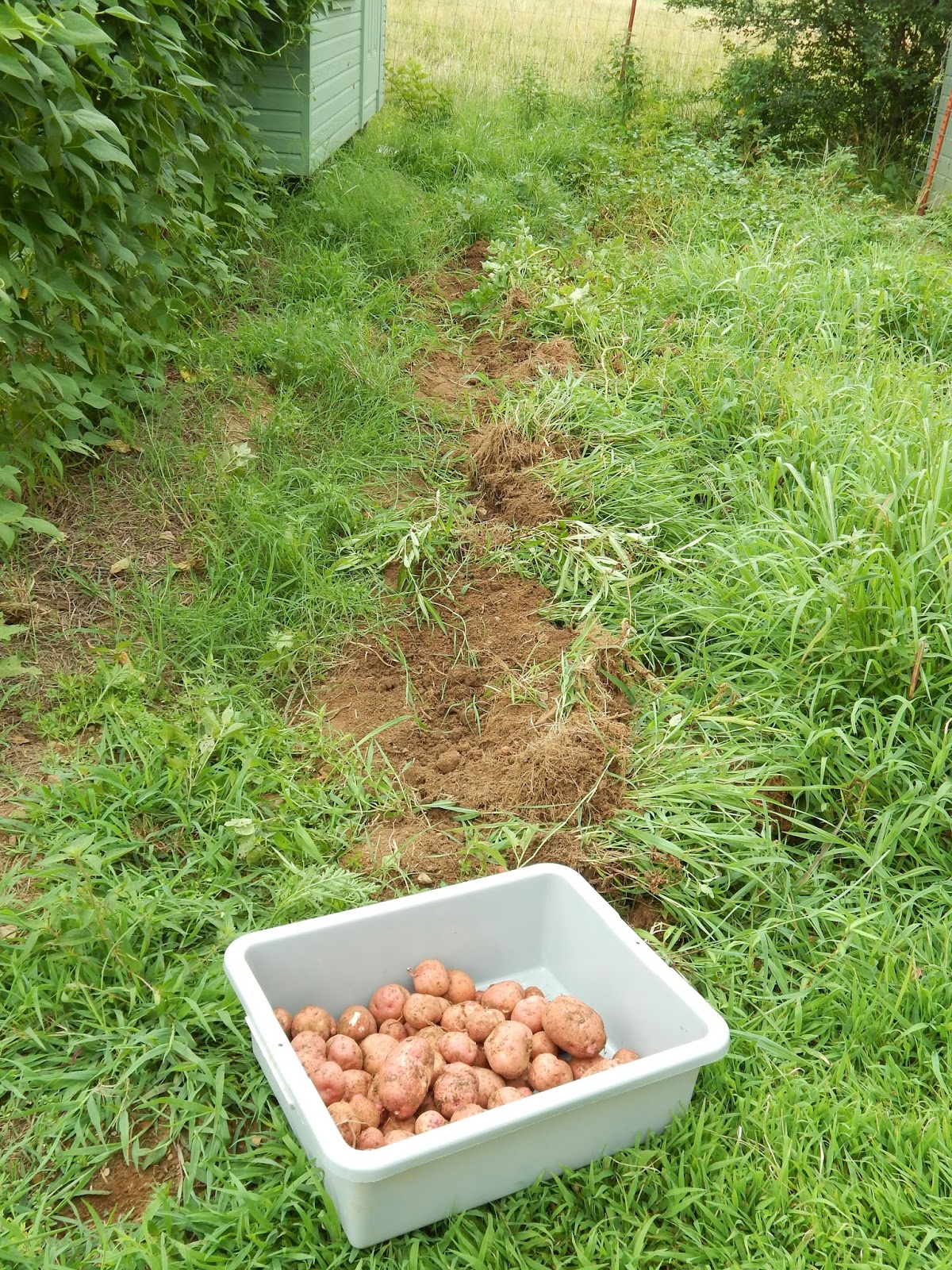
Today we pulled the beets and planted grocery store red potatoes. Yes, it's very late to plant potatoes and it's a toss up whether they will grow in the heat of the summer here. We weren't going to grow any at all, but feel the need to grow more calories and nutrition.
Old beet patch, one new potato patch


More potatoes between the cabbage & sunflowers

                Here is a look at the rest of the garden.

Parsley in the front, carrots and yellow squash

Sweet potatoes on  stock panels are growing well.

Pinto beans, some are climbing and some are not....

Tomatoes are growing slowly with little production

Purple hull peas after 4 plantings

Okra, barely growing, and it's mid June

Sunflowers for chicken feed

There are a number of cabbages that survived the worms.

Small pepper plants

Planted Thelma Sanders winter squash by wooden stakes today.

Apple with curculio infestation

I was very hopeful of a good fruit crop this year. Our young plums were loaded with fruit, but each had this little brown mark on it. Every plum dropped and now the apples are slowly joining in. I pick up half a dozen or so every other day as they fall and feed them to the chickens. I found a beneficial nematode that is supposed to help control curculio and applied them below the trees a month or so ago. My research indicates curculios may produce up to two generations per year, so I hope the nematodes are established enough to affect the second generation this summer. I don't know if there will be any apples left to harvest or not, only time will tell.

Rather dismal outlook, isn't it? It is definitely a strange growing season. As the COVID19 outbreak grew more serious, we decided to grow more food this year instead of less like we had planned. But the way the garden is performing, we don't know how much food it will produce at all. If we were truly in dire straits and dependent upon this growing season for survival, it would be a very stressful situation indeed. Well. What if this is it? What if our life does depend upon this harvest?


Folks, we are in perilous times. Do everything in your power to have enough food for your family for the long term. It matters not if you grow one morsel, have food for your family. Do everything in your power to provide a safe environment for your loved ones. Between the virus, the economy, the riots, the anger and hatred, our country is a pressure cooker just waiting for the lid to blow. The tentacles of the enemy are long and well camouflaged. Distance is your friend.

Frank has been saying for many months that it is going to be a very hot summer. The summer is upon us with burning and death. There are a couple of videos at the end of this article that may give you pause. If nothing else, I hope they give you something to think about.

Food. You can't have too much & without it you are dead.

Until next time - Fern


Friday, September 12, 2014

Gardening When You Can

Our gardening experience this year has been different. Not a total failure, just different. It started out like it usually does in the spring, in bits and spurts around my work schedule at school. Then Frank started having serious trouble with his back. School was almost out, so work continued around his medical needs and the garden was last in place. We still got it planted and many things came up, but then they were pretty much on their own. I did get some squash and squash relish canned but that was about it. After that, I picked and cooked what I could, but haven't canned anything since spring, that in itself is strange. We have frozen many tomatoes and a few peppers for later use, and hopefully canning. For now, here is a tour of the garden, which in spite of me, is still producing.


The green beans are worse for the wear, between the grass, weeds and grasshoppers.


The Cushaw squash is growing and starting to put on quite a few squash. There is this one big one and many small ones. I have been checking for, and squishing squash bugs morning and evening on the way to the barn to milk the goats. Powdery mildew has begun to grow on some of the leaves. Most of these I have cut off to try to prevent spreading. One organic remedy I have read about is mixing one part milk to 9 parts water and spraying the stems and leaves. I haven't tried it, but it sounds like an easy solution if we need one.


The turnips are up and doing well. I have thinned a few plants in places and fed them to the chickens. As the plants get bigger we will be enjoying turnip greens as well as continuing to feed them to the chickens and goats. This is one of our experimental livestock feeds. We hope to be able to supplement the animals feed with turnips and cut down on the grain we buy.


The kale is doing okay. It hasn't really taken off yet, but it has a decent start. I don't think it likes the hot weather we have been having, but that should change before long.


The carrots and broccoli are just barely peaking out. The challenge will be to keep track of them among the weeds that are growing faster than they are. Here is where they are growing, and I have to be very careful even walking out here, let alone trying to weed without getting the vegetables. The carrots are another crop we hope to use for supplemental livestock feed. They will be left in the ground until we need to till the garden again. It will be another experiment of how to store some feed sources in the winter.


There are a few Mangel beets coming up here and there, but not in any abundance. The extra patch of beets we planted down by the okra appears to be a tasty snack for someone. Our experiment of making sugar from beets will probably have to wait another year. We'll see how big these get before winter gets them.


Our fall potato crop is almost non existent. Out of the two rows we planted, only these two plants have emerged. I dug around in one of the rows and found the potato we planted and it has just begun to grow. I don't know if the hot weather is holding them back, or if growing a fall crop just won't work in this area. The interesting thing is that some of the potatoes we missed when harvesting the spring crop have come up here and there down by the Cushaw squash, so either way, we hope to have enough fall potatoes to use for seed next spring.

 
The purple hull peas are still there, it's just that the crab grass has taken on the roll of camouflaging them. That's a nice way of saying the grass has just about taken over the pea patch. Interestingly enough, more peas are coming up next door in the potato patch and other areas we tilled for the fall garden. I don't know if they will have time to produce before frost, but they might.


I have tried something different with my okra harvest this year. As I picked the pods, I trimmed off some of the leaves that stick out into the isle I was working from. This way I can see better to pick and I am not getting itchy from constantly brushing up against the leaves. I got this idea last year from CQ at Hickory Holler. It works great.


Another thing I did a few weeks ago was cut the top off of the plants that were too tall to reach.
 This prompted the plants to sprout out from the bottom forming new 'branches' or suckers. I wasn't sure how long it would take, but now as the branches get big enough, I am cutting off the top part of the plant altogether to concentrate the energy into the new branches. I have already started harvesting okra on these 'new' suckers.


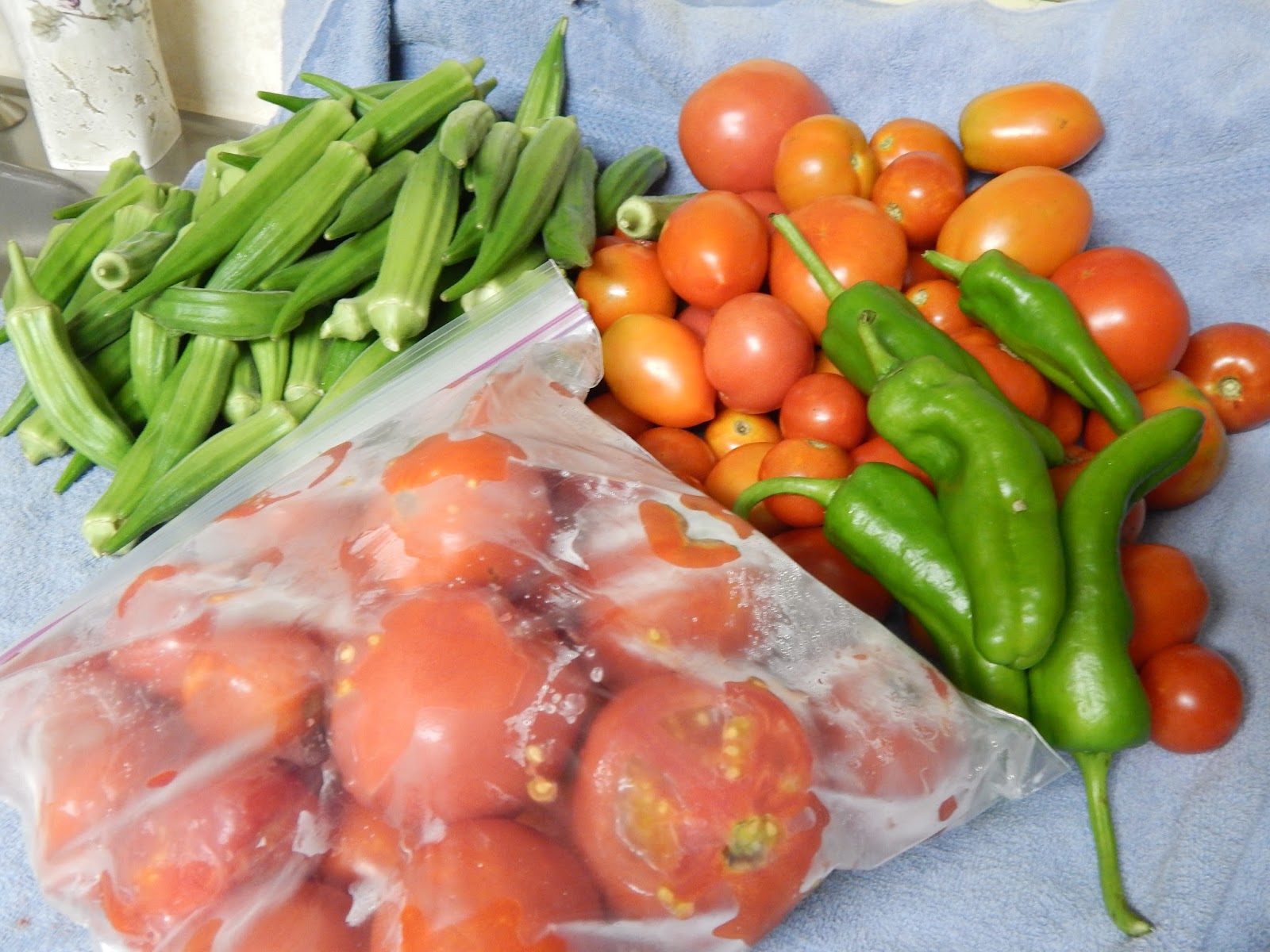
I continue to be surprised at how many tomatoes we are still harvesting. I have lost count of how many gallons we have in the freezer, at least 15, that we plan to can plain and make into salsa later on.


It has been a very wet year compared to most. We have only had to water a handful of times. In years past, we had to water regularly from the beginning of July, so that has been very nice. We have had a cooler summer, like everyone, but still days with the heat index at or a little over the 100 degree range. Overall, the garden has been very happy among the weeds and grass. It's nice to know that during years like this, with surgeries and accidents, there is still food to be had from a forgiving garden. I hope the first frost of winter holds off until October 31st or after, which is our first average frost date. But many are talking about an early, long, very cold winter. Even so, we will manage. Hope your pickings are plentiful and your shelves are full.

Until next time - Fern

Friday, August 22, 2014

Preparing the Harvest

Hello, Fern here. I wanted to steal Frank's line, just this once. Our garden is still providing us more than enough food, even though for a while it was sorely neglected and the weather has turned off very hot and humid.
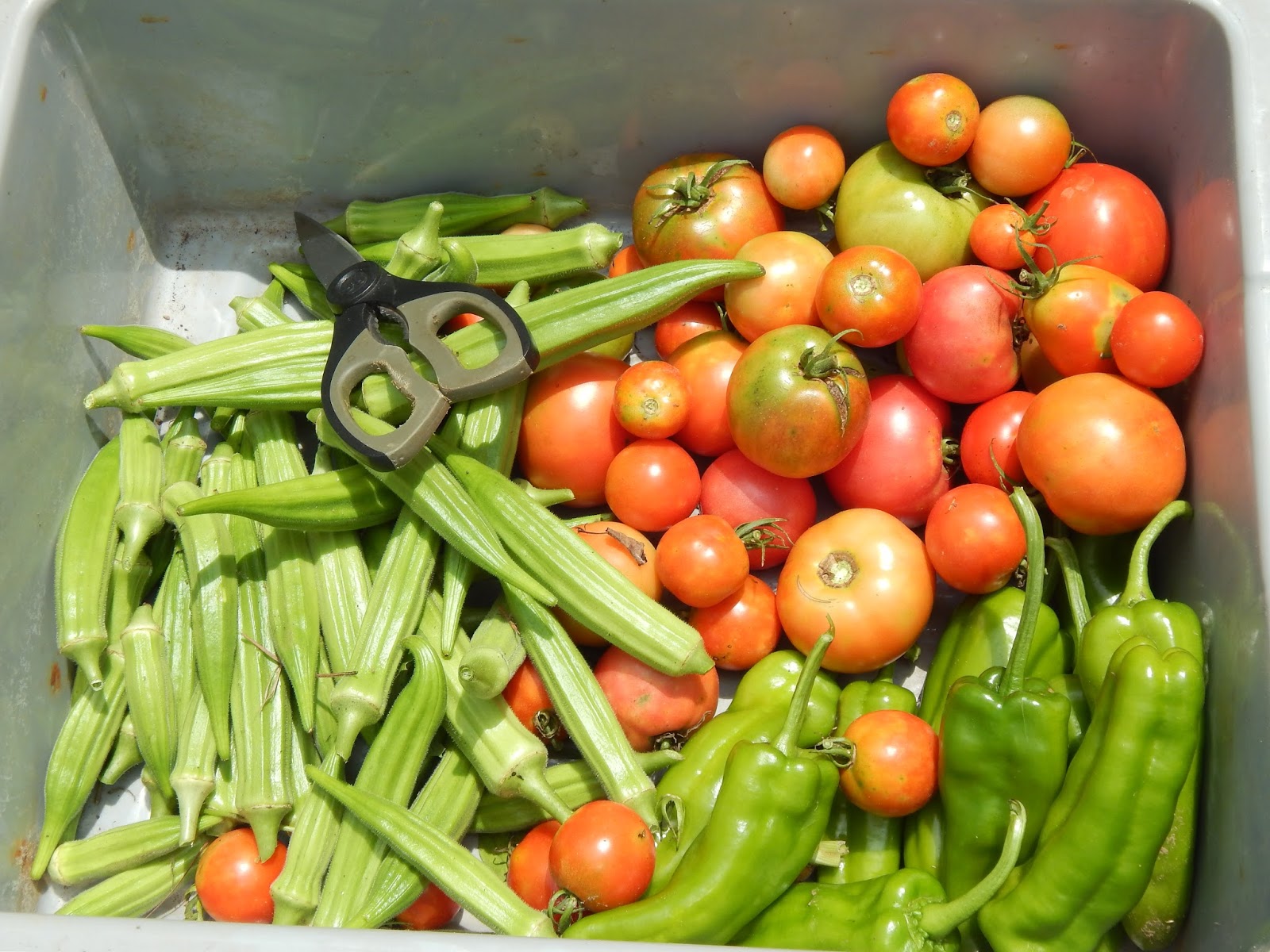
Before, during and after Frank's surgery the garden didn't get hardly any attention at all and I was glad it really wasn't producing much. I did wonder if it would produce at all this year, but didn't really give it much thought. I was busy. But now, in the middle of August in the blistering heat, the green beans are finally producing and the tomatoes are just amazing. We would get a whole lot more okra if I would pick it more regularly, and the same goes for the purple hull peas. For the last couple of days the harvest has been good so I thought I would share it with you.

I have picked green beans all of four times this year. Isn't that odd? We had a meal or two from the first mess, then I snapped, washed and stored the last picking. Now I have a bucket that's almost 3/4 full from today's harvest. Outside of those little green worms that like the mature beans and the grasshoppers working over the leaves some, the plants continue to bloom and bring forth beans. I told you a while back that I gave the beans some wood ashes for potassium after I gave them milk for calcium. I don't know if that is what made the difference or if they were just told to wait until I had time to tend to them. I really think it is the latter.

The purple hull peas patiently await my arrival to pick them. If I don't get there in time, they just dry on the vine and continue to wait for me. I planted a lot more this year with the intent of using some of them for animal feed, which is happening. When they are already dried on the vine, I feed them to the goats and chickens, both of which have come to clean them up quickly when they see what I have brought. We haven't kept any to store for winter which was a goal, it just hasn't happened this year. The plants have really vined out this summer. I don't remember the vines being so long and intertwined last year or the year before. We have gotten more rain and had a cooler summer overall, but I don't know if that is the reason. The way they have grown this year makes me think they would do better on a trellis.

The peppers are steadily producing, just not in large quantities. The first batch of jalapeno peppers I picked didn't get processed, so I had to throw them out. Funny the animals don't care for such hot peppers. The next batch got chopped up and frozen. I haven't tried this before but know people that do, so I thought I would try it. I will do the same with some of the sweet peppers.


The okra is steadily producing, and we are freezing it up by the quart in freezer bags, if there is any left over after we have had some for dinner.


The tomatoes have surprised me. We have not canned anything since Frank's back surgery in early July. Once the tomatoes started ripening, I knew I would have to do something with them or they would all end up being chicken feed. I had read about people freezing their tomatoes for later use. Then I talked to my friend Grace and she said she had done the same thing. One benefit of freezing the tomatoes is not having to blanch them when you thaw them out. That will save time and propane when I thaw them out to can or make salsa. This has given me yet another opportunity to learn something new. We now have about nine gallons of tomatoes in the freezer which I think is very interesting.

Wilson, aka Frank


I finally dug up all of the carrots except the one that is going to seed. It has fallen over the top is so heavy and the carrot is so small. It is almost time to pull it up, I think. Our harvest yielded about a gallon after I sliced them up. We would still like to have many more, but it is better than last year. There are more carrots and they aren't all gnarled up.

I hope to start up the canner again tomorrow with the carrots and green beans. Maybe next week I will have enough purple hull peas to can up a batch. We have always canned our garden together, with Frank handling the heavy stuff, but he can't do that just yet. He is recuperating well, but still has restrictions to follow until he is released for full activity. We have had a slow, peaceful summer and plan to keep it that way. I really believe our garden was told to slow down and wait until I could tend to it and the food it is producing. It is an odd feeling. I know we are blessed and cared for, and I am deeply grateful.

Until next time - Fern

Monday, July 21, 2014

Lessons I've Learned From My Garden

These lessons work here in Zone 7 where we live in southeastern Oklahoma. The techniques we use may need to be tweaked to work in your neck of the woods. There are several things I have learned this year in the garden that I would like to share. It teaches me something every year with every crop. We have also learned a lot from the comments and interaction we receive here on the blog. I have grown rather fond of this small piece of dirt...and weeds.....and grass....

Don't plant onions too deep or they will not make a nice onion bulb. I have never grown a decent sized onion until this year. When I mentioned this on one of the gardening articles, one of the comments indicated that an onion should basically have only the roots in the ground.

I have always planted them much deeper than that. Then the next day or so, we stopped by Grace's house and she had a beautiful onion in a tub that barely had it's roots in the ground, but looked great.
So, I uncovered the base of some of my onions, and guess what? They grew bulbs! Real, live onions! I was very happy and thankful I finally figured out what I had been doing wrong.


We are having the best corn crop this year we have ever had, but I can't really tell you why. I planted a new variety, Stowell's Evergreen, an open pollinated, white, sweet corn variety. One difference this year was my planting technique. I tend to plant corn way too close together trying to utilize all of our space. Corn doesn't particularly
like to be crowded. This year Frank recommended I poke a hole in the ground with the handle end of my hoe, drop in a couple of seeds, then step on them. This worked very well and kept me from planting so close together. The result? Nice full, large ears of corn. And it tastes good to boot!

I planted the green beans in the new part of the garden that hadn't been fertilized much. In some years past, I didn't have a very good green bean crop and the only thing I could figure out was the soil was too rich. Because of that  
experience I thought this would be an okay place for the beans this year. They are growing well, just not producing any beans. I 'watered' them with some old milk a few times for the calcium. Next, I was thinking of putting on some wood ashes for the potassium. I'm glad we still have plenty of green beans we canned last summer. We'll just have to wait and see how they do.

 For some reason, I have not figured out why, we also have the best potato crop ever this year. There are many more potatoes, and they are much larger. The only difference I can think of is that we set the tiller a little lower and got the soil loosened up a little deeper. I was able to hill them up twice before Frank's surgery and the weeds took over. Now that I have mowed down the grass, I am getting them dug up to make room for the fall crops.

 What makes a carrot go to seed? From my reading, if a carrot goes to seed the first year it will not make good seed. Carrots are biennial, which means they need a 'winter' or a spell of cold weather to produce viable seed the second year. I am really surprised at the size of the seed stalk this carrot is producing, compared to the regular carrot greens, it is huge. I will still try to harvest the seeds from this plant and see how they do. I will plant them separately in seedling pots and see if they germinate just to learn something new.


I have a tomato jungle growing. Since this year in the garden has been hit and miss, I have not been keeping up with the tomato suckers. In years past, I have been pretty vigilant in removing them, but not this year, and it has turned out to be a good
thing. I was taught to remove the suckers to allow the energy to be focused into the main plant. But, this year, with many, many suckers, I am finding I have a lot more tomatoes coming on. Now I need to learn a happy medium between removal and encouragement. Interesting.

The purple hull peas seem to have vined out more this year. I almost think it would be beneficial to plant them along a stock panel trellis the way we do tomatoes. It would make them easier to pick and I would walk on them less. That would be a lot more panels to dedicate to the garden, though, so I will have to ponder that one. Maybe it would do just to plant my rows a little farther apart. They are such a hardy plant and will keep on producing as long as you keep picking. They don't require near the moisture of other plants, such as corn or squash.

We don't eat fresh cucumbers, but I do like pickles. Last year I planted too many cucumbers, this year I planted too few. If I want enough cucumbers to make pickles, I need more plants than this. Next year, I will go back to more plants and pull them up when I am finished making pickles.


There is always so much to learn in the garden. No two years are exactly the same. The weather is different, the time I can spend is different, the bug population is different, there are just untold differences to learn about and deal with each and every year. If you believe that extremely hard times are coming to our country and world, and you want to be able to grow your own food, don't wait until that event happens. It will be too late to learn the lessons of gardening in your location, or the location you plan to go to. Even folks that have gardened all of their lives come up against something new that requires a change in plans when it comes to growing food. Grow what you can. Can what you grow. Enjoy the blessings of the harvest.

Until next time - Fern