The Road Home

The Road Home
There is no place like home.
Showing posts with label technician license. Show all posts

Saturday, September 5, 2015

Survival Radio Q & A

Hello Everybody, Frank here.

Over the last week or so, more on the so side that is, I have received some interesting questions via email. Serious questions. I'm going to attempt to give some serious answers, with some embedded humor, of course. Others out there may have the same type ideas, and I hope these folks' questions will help fence sitters decide which way to go. So, here goes.

~~~~~~~~~~~~~~~~~~~~~~~~~~~~~~~~~~~~~~~~~~~~~~~~~~~~~~~~

Question #1 


Hello Frank,

First, I want to thank both you and Fern for what you do to help us and others.  I know that just like the rest of us, you are busy doing your best to prepare for whatever is coming our way, yet you take precious  time to extend a helping hand to anyone who will take the time to read your blog.  Please know that you are very much appreciated!

Secondly, I want to apologize for the length of this email and thank you in advance for the time you spend reading and hopefully responding to it.  A man's time is a precious commodity.

We are attempting to set up an emergency communication system between three family member locations.  I am a total novice at this but I have been reading and researching for 2-3 months and based most of our plan on the information gleaned from your "Frank's Radio Communications" articles.  I fully realize that I am stretching things to the limit here both technically and legally, and that it may not even be doable, but I have to try.

I'll describe our situation as best I can, then list my questions.  We want to link the three family member locations, without relying on repeaters.  Since this is for emergency use, we want the system to be free standing.  We are located in hilly Southeastern Ohio, but fortunately all three locations are at or near the hill tops.  No one is down in a valley or a low area.

Location A:  This is my location.  I am not licensed yet, but I am studying for my Technician license and will be taking the exam September 17 (that's the next exam date here).  I am setting up a "basic" 2 meter base station at this location.  I have a Yaesu FT-1900 (modified) for the base radio and have mast materials to put my antenna up 30-40' AGL.  My mast will probably be okay close to 40' with a small antenna, but less with a large antenna.  I'm using the military camouflage net support poles (heaviest aluminum type) and it is at the end of my house, supported firmly at 14', leaving 26' unsupported if I go to 40'.  I don't want to use guy lines unless absolutely necessary, but I can if you think it's required.  There are no power lines and if it came down it could only hit a metal roof.  At this location I want to be able to use the 2 meter ham band and maintain contact with locations B & C.

Location B:  This is my daughter.  At home, she is about 8 miles from my location with no major obstructions between us.  At work she is also about 8 miles away, but with some small building obstructions. Her plans are to use the system only for emergency contact with me, and it needs to be mobile so that she is covered at her work place.  For convenience, and cost control, we hope to be able to meet her needs with a 5 watt HT and a good quality antenna.

Location C:  This location is about 12 miles from me, with no major obstructions between us.  This is a stay-at-home person, but would also like the ability to go mobile if necessary.  I would still like to use the 5 watt HT if possible, but with a small mast if necessary.  I was hoping that we could use an antenna that would work for both the mast and mobile if needed.  The one I had in mind was the CA-2x4SR with a ground plane for the mast and a mag mount for mobile.

What I hope to do is use my base to access the 2 meter ham band and use the low MURS channels (151) to communicate with B & C.  Certainly, we are testing the limits here, but this seems to me to be the most economical  way for us to set up an emergency communication system.  I realize that we are asking a lot for a 2 meter antenna to also be effective for the MURS channels at 151 MHz, but my hope is to use a wide band antenna that is tunable to be resonate at about 148-149 MHz.  If I am correct, this should give me a usable range including the upper portion of the 2 meter band and the low MURS channels. 

My plan is to finish setting up my base as soon as I make the antenna decisions, then use my 5 watt HT with a mobile mag mount antenna on my vehicle to test the "system" at locations B & C before we buy any more equipment.

First question, in your opinion, is it possible to do this with the HTs and mobile antennas as described above?  If not, what would you suggest as minimum equipment requirements to get the job done?

Second question is which antennas would you recommend?  I have read and researched until my eyes are crossed and I cannot come up with a definitive answer.  For the mobiles, the CA-2x4SR looks good to me but I'm wide open to the voice of experience.  For my base antenna, I'm really undecided.  I currently have three on my "possibles list,"  the Hustler GC 144 (with the MKR-2 ground plane kit), the Hustler G6-144B (pricey & big), and the Diamond X50A.  The X50A is described as "pre-tuned" so I haven't been able to find out if it is field tunable or not.  But, from the reviews I've read it seems to generally be tuned toward the upper end of the 2 meter band, which is just what I need.  One fellows review that I read said his was resonate at 149.5 out of the box.  Again, I am wide open to the voice of experience.

Soooo, there you have our situation.  Don't worry about hurting my feelings with your comments and suggestions.  I've already been told by two Hams that I can't do this with less than 200 Watts at each location.  I prefer efficiency to brute power, but if I am way off track here don't hesitate to say so, just please give me some direction as to how to get to where we want to go.

Thank you

*******************************************************************************

This is the first of two emails. The second email will contain product recommendations and significantly more detail, but I want to assure you that this is doable. This is what I do.
 
Your CA2x4SR is an excellent choice. I use it for mobile and base with a ground plane. I'll send more detail later, but you don't need 200 watts. On a clear day 5 watts will get you where you want to go. During a torrential rain storm, more power may be needed, but not 200 watts.
 
I will send you a second email. I talk to friends 30 miles away on MURS 1, 2, & 3 simplex, or line of sight, on a handheld with a 2 inch stubby antenna. Does your tower really need to be 40 feet?
 
We'll talk more later,
 
Frank
 
 *******************************************************************************
 
Thank you so very much.  After the response I got from two different Hams (one was at Universal Radio) I was beginning to doubt myself on this project.  As far as the antenna height goes I was just trying to make it as effective as possible.  I would be thrilled if it didn't have to go that high.
 
Thank you again and Please have a Blessed Day.
 
~~~~~~~~~~~~~~~~~~~~~~~~~~~~~~~~~~~~~~~~~~~~~~~~~~~~~~~~


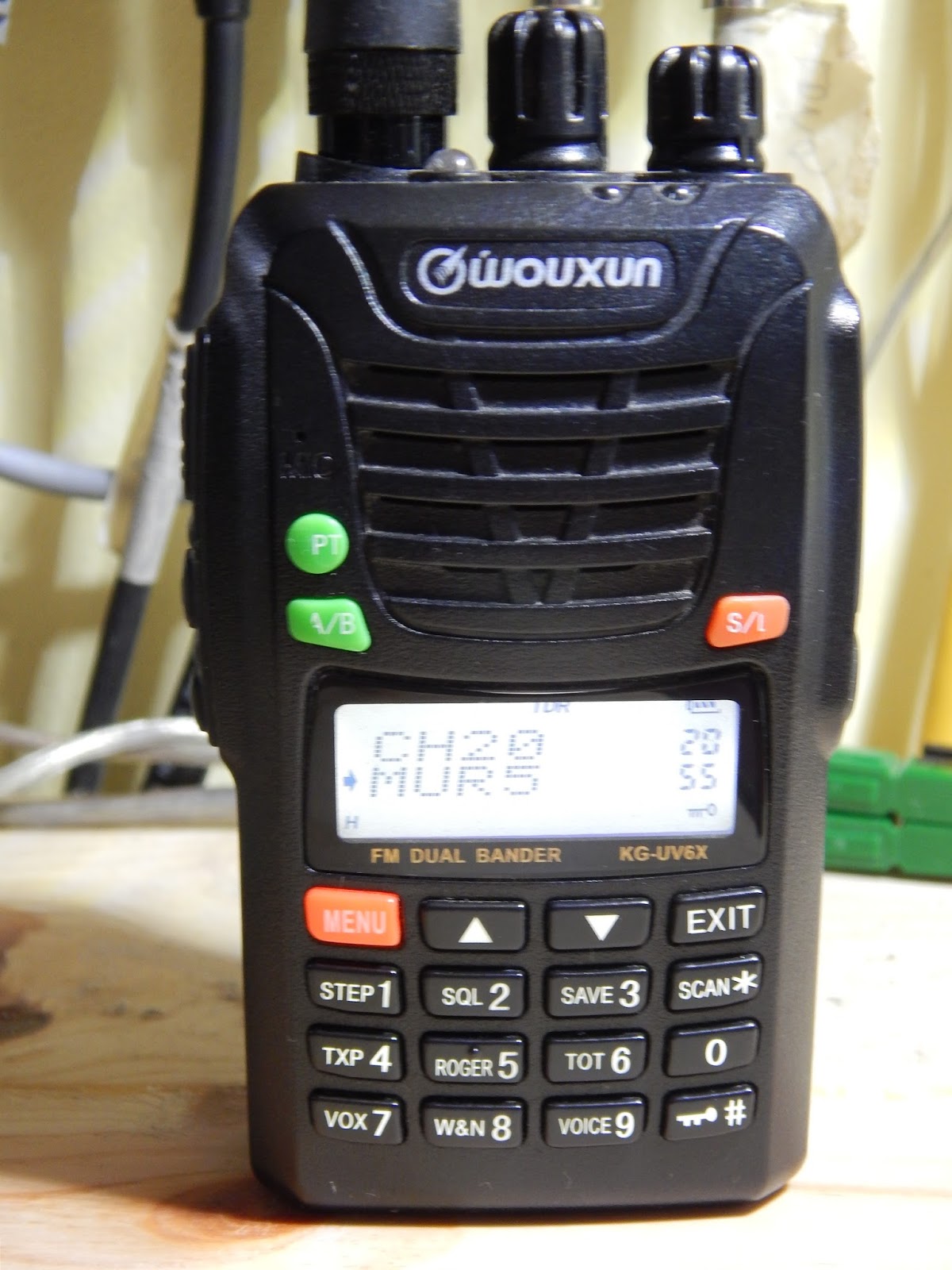
Thank you for taking the time to read Frank's Radio Communications. To answer your most important question, Yes, it is doable, and your ham buddies are wrong. If you've read Frank's Radio Communications then you know that Fern and I did this exact same thing on the MURS frequencies, and later on the ham bands. We would commonly talk on MURS at a distance of 25 miles using standard mag mount antennas, the Comet M24 to be precise, Wouxun HTs, an adapter for the antenna, and a quality microphone, using a battery eliminator. It works, and that's what you want, you want it to work. This was about four or five years back. But remember, it worked.

Now, today, I use the CA-2x4 SR on all of my vehicles and my base station. The base station uses a ground plane adapter, and all use the UHF type connector. I have done nothing special to these antennas. They are tuneable, but I haven't needed to do anything.


Your tower height may be a tad bit excessive. I take it 14 feet is close to your ridge. Unless you plan on putting up other antennas, if you don't need the extra height, then don't use it.

Your Yaesu is a nice radio and it's been modified. Consider an Anytone AT-5888 for a base radio. It is UHF and VHF. The HTs are great when there is no weather around. The extra power of the base station will help drive through heavy rain. The reason I recommend the VHF/UHF Anytone is for UHF. Check out the GMRS frequencies, find one that no one uses. It can be your back up or your primary. Food for thought.

If you do use the battery eliminator and the external antenna, always keep the original antenna and battery handy in case you have to leave on foot quickly.

Yes, your idea is doable. The little Baofeng UV5R, is inexpensive and it works. For accessories check out Radioddity.com, because some use an SMA female and others use an SMA male type antenna connector. Buy two of the little handhelds, get your cell phone out and have somebody at
the other locations with their radio in hand and cell phone out. Call each other on the cell phone, pick a frequency or channel that no one is using. Remember you'll have to program these radios yourself. Call each other on the cell phone, face the direction to which you are talking and see if you can make contact. You'll have the cell phone as a back up to know. Set your power on your HT to maximum power. If you get a weak or bad signal, remember, be facing each other. Hold the handheld straight up and down. Try VHF which is MURS. Try UHF which is GMRS. If you have the ability, get up on a tall ladder, or up on top of your house. This should tell you what you want to know.

If it will work with two handy talkies, make sure you're both outside, not inside a structure. If somebody has to be inside a building, have them stand in a window facing the direction they want to talk. Give it a try, see if it will work. What you've invested at this stage is the cost of two handy talkies. On Amazon the UV5R sells for about $25.00 with free shipping. It is critical that you are facing each other just like you are having a conversation. If you get a poor signal, move two or three feet to the right or left and try again. If it works, then put up the outside antennas and you should be good to go. If you want to get a bit more sophisticated, then use a base station with a power supply. Always get a bigger power supply than you think you'll need.


Now the procedures described above are for emergency communications. You've read this before. Doing 36 MPH in a 35 MPH zone is illegal. Doing 96 MPH in a 35 MPH is also illegal. Nobody cares if you do 36 MPH, but they do care if you're doing 96 MPH. Always run the lowest power you can.


By the way, in reference to the 200 watt VHF radio? Some old time hams do not support any type of radio communication except ham radio. Many of the older hams see it as the ultimate hobby, and that's great. You probably are going to use radio for a different purpose, and that's great, too. It's a big playing field and there is lots of room for everybody. I would like to see a 200 watt VHF that anybody sells.

A different topic. Copper Electronics has an SSB-CB on sale right now for an excellent price. It is a first class CB radio that cannot be modified in any form. If this is what you're looking for, you won't find this kind of deal very often. I have one, and it works. I have two more on the way. 

For you and everybody else out there, you might want to consider a scanner. Many ham radios will scan, but as a general rule, they are notoriously slow. Why a scanner? If you know an event is occurring, you can warn your loved ones ahead of time. It's much better to avoid a problem, than deal with one. A scanner can save your life. You want to know what is out there.


Try to buy products that operate off of 12 volts. That simplifies your charging. If you're using your car battery or you're using a home power supply, it just makes life easier. Think about it. 


What we talked about up above with MURS and GMRS, I really hope this helps, but I know it works. I have used this technique, I still use it, and I use it everyday. Take care. Best of luck.      

~~~~~~~~~~~~~~~~~~~~~~~~~~~~~~~~~~~~~~~~~~~~~~~~~~~~~~~

Question #2

Hello,

I am acquainted with you both from The Deliberate Agrarian, Herrick Kimball's blog.

 
I am very intrigued with your communications post. I too believe in the profound importance of readiness and an impending radical change to our civilization.
 

I must confess though, in conjunction with an overwhelming amount of ideas/projects/responsibilities and the thought of adding something that I know is crucial but for which I lack interest/affinity or skill, stops me cold. I haven't the resources (money, time and interest) to become a ham radio hobbyist but KNOW it is a necessity that should not be ignored because I am in over my head with other projects.

So my query is, how can I set up communications for a minimum investment in time and money? I am not talking about shortcuts but levels. It sounded as if there were some in your class that are at or were at, my level. 
I know you are busy folk so I will be grateful for any information you are able to impart. I will, in the meantime, search your blog and glean what I can. Thank you for sharing with us.

***********************************************************************************

Start with a Baofeng UV5R+, about $35.oo. Programming cable, about $10.00. Use the Chirp programming system, it is free. Any frequencies you need can be obtained at Radio Reference.com. An inexpensive supplier is Radioddity.com or Amazon. For ham radio assistance or advice contact your local ARRL club. You can find this information at ARRL.com.

Read the section called Frank's Radio Communications in the right hand column, and this will answer most of your questions. Pam, I do not use ham radio for a hobby, I use ham radio and other forms of radio for survival. An inexpensive analog scanner comes in very handy, if you live in an area that supports analog.
When you get in touch with ARRL, tell them what you just told me, see if there are any classes being offered that are normally free, and ask for an Elmer, which is a teacher. If you don't click with this one, ask for another one. The shoe doesn't always fit the first time.

Best of luck.
 
Frank
 
***********************************************************************************
 
Thank you Frank, very much, for your time and knowledge.  I am deeply grateful and humble. Please know that I did not mean to be insulting when I used the word "hobbyist".

I have read some of your articles and most of it goes over my head.  I have a innate ability with mechanics but electrical blows my mind (pun intended!). For instance, I truly cannot comprehend the difference between an ohm, a watt and an amp despite multiple attempts and patient friends and family.  Indeed, I will follow up on your information or try to persuade my husband to become interested.

Today, I wish the collapse would just hurry up and be done.  The waiting is interminable.
 
But I would be forever saddened at losing contact with folks like you and Mr. Kimball.  (I would call you by your surname, but you've never shared or I've never seen it. I am a firm believer in the use of Mr., Mrs., and Ms.. And "Mr. Frank" sounds like something a toddler uses with a neighbor.)

Again, many thanks for your response.
 
~~~~~~~~~~~~~~~~~~~~~~~~~~~~~~~~~~~~~~~~~~~~~~~~~~~~~~~~

Thank you for your question. You are correct, there were people in the ham radio class that had no interest at all in getting an amateur radio license. They were interested in survival communications, which was actually part of the title of the class.

Okay, let's start. The equipment you need will depend on your desires. If you have friends down the road that you want to talk to, then you will need two way communications. If you just want to know what is happening down the street or across the county, then you'll need listening only equipment. As mentioned in the question above, a respectable scanner will meet most people's needs. If you live in a large city, you might consider a digital scanner. They're expensive and difficult to program. If you live in smaller town America, or rural America, then an analog scanner will probably meet your need. You don't know? Call your local emergency management office. They will know. Tell them what you want to find out, it is public knowledge.

If you need two way communication, first on the list is CB radio. Some people don't like the trash talk, but it is a good means of communication and lots of people have CB radios.

Next, the GMRS walkie talkies. Hunters use them, little kids use them for play radios, my wife and I have used them for years around our little farm. Don't believe the ads about 36 miles, that's under perfect conditions. They will go as far as a CB, and the signal is a whole lot better. The CB and the GMRS are both line-of-sight communications. Back to the GMRS, mountain top to mountain top? As far as you can see. Valley to valley with a hill in the middle? Ain't gonna happen. 

If you want to talk around the world it gets sharply more complicated, but it can be done. If you want to just listen around the world, a decent shortwave radio with a good antenna will let you listen, plus you can also listen to all of the ham radio frequencies with a good shortwave radio. It's all in the antenna. Look for SSB when you're checking out radios. Single side band. Sometimes called upper side band and lower side band.

For more detailed information, read Frank's Radio Communications. Don't spend any time on getting a Technician or General license. Read the other articles first about CB, GMRS, scanners and that type of stuff. I hope this information helps. After you do a little bit more research, put some more questions together. It's really not that difficult. Take care.    

~~~~~~~~~~~~~~~~~~~~~~~~~~~~~~~~~~~~~~~~~~~~~~~~~~~~~~~~

Question #3

Help, need com & antennas, handhelds, ect... Have read your site. Need to get com going as fast as we can.

***********************************************************************************

Start with a Baofeng UV5R+. Use the Chirp programming system. Any frequencies you need can be obtained at Radio Reference.com. An inexpensive supplier is Radioddity.com. For ham radio assistance or advice contact your local ARRL club. You can find this information at ARRL.com.

Read the section called Frank's Radio Communications in the right hand column, and this will answer most of your questions.
Best of luck.
Frank

***********************************************************************************

Dear Frank, Thank you for your reply. I like yours & Fern's site. I have been reading your Com page and decided to try the Hand held’s you recommended, Midland GXT 1050s. I would like to extend the range so I was looking @ the exterior antennas . I guess I must have missed the one in the article that you recommended for that set. Thanks again for all you both do.   Good luck & stay vigilant & safe.

~~~~~~~~~~~~~~~~~~~~~~~~~~~~~~~~~~~~~~~~~~~~~~~~~~~~~~~

Hello, there. I'm sorry to tell you, but the Midland 1050 is not made to accept an external antenna. It is a good radio for what it is intended for. Fern and I used these radios around our homestead for a long time before we switched to a commercial radio, which is just the same type of radio, except it is programmable. The GXT 1000 is the same as the GXT 1050, except it comes in black instead of camo. Remember, both of these are excellent radios, tough, durable and do a good job. But like anything, they have limitations. I'm glad you enjoy our work. Thank you.

~~~~~~~~~~~~~~~~~~~~~~~~~~~~~~~~~~~~~~~~~~~~~~~~~~~~~~

Ladies and Gentlemen, above I've addressed three relevant and pertinent questions. All three of these folks have the same thing in common. They all believe that we're going to need communication beyond what we currently have available today. For whatever reason, if you are reading this blog, then you know that we have serious difficulties just over the horizon,
and in many places, those serious difficulties are already here. Just look at the immigrant problem right now in Europe. Look at our own southern border. These people are leaving their homes and going to a new place, not only to better their lives, but to escape where they're coming from. This is just one example of what is happening in our world. I'm sorry, but our financial markets world wide are is disarray, and in the mid stages of collapse. Not the beginning stage, but the middle stages of collapse. If you look around, our churches are under attack, our schools are cesspools, our society, it has denigrated to a pathetic, disgusting level. 

These three questions addressed above are folks that are worried, and you should be too. I know I am. Read the questions above again. Three different perspectives, but all three see an urgent need to be able to communicate beyond normal day to day communications. What are you going to do when things shut down and your kids are miles away? Or your wife is at the dentist? Or your husband is on a trip somewhere? What are you going to do? Dial 911? Those people are going to go home and take care of their families. You should be taking care of your family, too. Look around. I don't know how else to say it, but it is very, very near.

I hope you enjoy this read. Take care. May God be with you all.

We'll talk more later, Frank

Saturday, October 11, 2014

Radio - GMRS, FRS & MURS - A Re-Post

Hi Everybody, Frank here.

We're going to do a re-post today about non-ham radios. I know some survivalist say that everybody needs to get their ham radio license, but in the real world, that's just not going to happen. I received a comment on the blog this last week or so, and I want to share it with you. This man and I have shared a couple of comments back and forth, dealing with the properties of 2-way radio communications. If you want to get your ham radio license, great. But, if you want to communicate with your cousin Billy Bob down the road, then there are other ways besides ham radio. 

The GMRS radios, made by a number of manufacturers, will all communicate with each other. Don't believe the advertisements about 36 miles or 24 miles. These are line of sight communication radios, but they work great for their intended purpose.

~~~~~~~~~~~~~~~~~~~~~~~~~~~~~~~~~~~~~~~~~~~~~~~~~~~~~~~~

Frank- first off, thanks so much for the time you and Fern put in to sharing good information and just real life results of learning homesteading skills.

My question is on repeaters. Our home is partially earth sheltered, with most of the main floor cut in to the hillside. And of course, the garden, barn, and workshop where I am most likely to be when my wife and I might want to communicate, is uphill, the barn with metal walls. So, I am thinking I may well need a repeater to make things work, but am very early in my research. If I were to get the Baofeng/Pofung radios in this post, or something similar, what type of repeater would I need, and are they very expensive? I would most likely buy the radios first, to see if I even need the repeater, but would like to know now what the hit might be if one is needed.

Are there different repeaters for different bandwidths, or are there some repeaters with features that might be of benefit if I decide to move on to ham or CB?

Thanks again for your efforts.


~~~~~~~~~~~~~~~~~~~~~~~~~~~~~~~~~~~~~~~~~~~~~~~~~~~~~~~~

Hello. Great questions, and I can see some thought has gone into the issue.

Number one. I would borrow a couple of GMRS radios and see if they will work from your house to your barn. This would be, beyond a doubt the cheapest way to go. An example. Our barn is metal, our house has a metal roof, the barn is about 500 feet from the house, and from inside the house, to inside the barn, we have absolutely no problems with intelligibility, or volume. There is a small rise between the house and the barn. I can see the upper half of the barn from the house.

Following this same theme, the corner of our property, from corner to corner is about 1500 feet. There is no line of sight, and that is due to a hill in between, not a big hill, but still, no line of sight. With this scenario the transmission has a little bit of noise, but is still intelligible.

Number two. If for some reason, number one does not work for you, an external antenna might be your answer. That means your radio will have to be connected to the antenna, which certainly limits your mobile factor. But, if you do use this type scenario with an external antenna, depending on your setup, you can talk for miles. If I were guessing, I would guess that number one will be your best answer.

Number three. A repeater. A true repeater can get expensive and complicated. It has to have a constant power supply. Now, there are ham radios and commercial radios that function as cross band repeaters. I have never attempted this technique. What cross band means is you have a two band transceiver, one channel is set on VHF, the other channel is set on UHF, and through internal programming, it will broadcast and receive on each of these frequencies. Again, I have never used this technique, but they advertise that it will work. You're looking at $350.00 for this dedicated radio, a power supply, an antenna, but according to the manual it will work.

I would either borrow or buy two real cheap GMRS radios, everybody has them. They may not know they have them, but the things their kids play with, that's what they are. An external antenna for your home is easy to make, and will extend your transmit/receive range sharply. In some of the other radio posts I talk about external antennas. Of course, I would like for you to read all of the posts. Try the two handhelds first. If you decide on the $40.00 radios, great. You will need a programming cable, unless you want to do it the old fashioned way by keypad entry, which can be done. I use the RT system and it works for me.

One last thing to consider. No matter what frequency you use, somebody can hear you. Hope this helps. Enjoyed your blog, by the way. Take care.

Frank


~~~~~~~~~~~~~~~~~~~~~~~~~~~~~~~~~~~~~~~~~~~~~~~~~~~~~~~~

Frank- I went ahead and got the Midland GXT 1050 radios you mention in the post on GMRS/FRS/MURS. Tried it out in the barn, other places, and excellent reception all around. I might even take one up in the tree stand this November and wear the ear piece.

Any comments on maximizing the NiMH battery life? For now, I plan to keep them in the recharge cradles unless we are using them, which may not be a lot till we develop the habit more.

As you and Fern say many times, until you have actually DONE something, you have no idea how it will really go down. In this case, it worked out fine, but we have many other tasks in front of us as we work to improve our self sufficiency. Thanks again for the time you two put in to sharing. After a couple more seasons on our small farm, maybe I will be able to share with the wider world what we have learned as well. 


~~~~~~~~~~~~~~~~~~~~~~~~~~~~~~~~~~~~~~~~~~~~~~~~~~~~~~~~

Hi. I'm glad that these worked for you. As far as maximizing the battery life. One, I would use the radios everyday, then they become part of your routine. It's kind of like putting your keys in your pocket, if you get in the habit, you will always take it with you.

Let the batteries drain before recharging. I know that this type of battery advertises it does not develop a memory, but it does. If you keep them fully charged all the time, then you will have much less battery life. If you're using the internal battery pack that came with the radio, you can remove it and put four AA rechargeable batteries in it that will charge in the cradle, and sharply extend the transmit and receive time. If you're going to be out all day, like sitting in a tree stand, charge the battery that came with the radio, take it out, put it in your pack and keep it as a back up.

My best advice is to not keep the radio in the charger all the time. For a long time I would always charge the radios on a Friday night. Then I would have well charged batteries that would last me a week.

Make sure you wear the ear piece when you are hunting. Because I, on more than one occasion, have listened to hunters chat between each other whispering. There is always some clown who will make a loud noise in the radio, like a duck or coyote call. Some people think that's funny.

No joke, though, don't keep your radio in the charger all the time. It will shorten your battery life tremendously. Hope all this helps, and I'm glad the radios worked out well for you.

Frank


~~~~~~~~~~~~~~~~~~~~~~~~~~~~~~~~~~~~~~~~~~~~~~~~~~~~~~~~ 

Next, I want to share with you an interesting and exciting comment I received this week from an individual that has gotten their Technician ham radio license. They purchased one of the $40.00 radios that I wrote about, and seem to be very realistic about their goals for ham radio. You see there is no magic secret to radio. For the most part, you turn the on/off switch to on, you push the little transmit button and speak into the microphone. Whether ham radio or GMRS, you can still communicate when you need to. And while you're doing your research, don't forget to check out the CB radio. Because with the right CB radio, not only can you communicate with Billy Bob down the road, but when the ionosphere is in the right position, you can also listen and talk around the globe. Do your research. Enjoy the read from the person that got their Technician license, and if you would like, please read the re-post about GMRS, FRS & MURS.

 ~~~~~~~~~~~~~~~~~~~~~~~~~~~~~~~~~~~~~~~~~~~~~~~~~~~~~~~~

Thanks so much for this review [this comment was on the post about manual grain grinders], I really needed an item like this. I also recently got my Technician ticket thanks to all of Frank's writings. I appreciate your blog!

~~~~~~~~~~~~~~~~~~~~~~~~~~~~~~~~~~~~~~~~~~~~~~~~~~~~~~~~

You're welcome for the review of the grinder, but please do your own research.

That being said, Congratulations! on your Technician ticket. I genuinely hope you enjoy the hobby, if you choose to use it as a hobby. As you are aware now, there is a whole world open to ham radio. And you are aware that I use it for survival purposes.

I would highly recommend that you go ahead and pursue your General license. Same number of questions, one more formula, and about the same level of difficulty. The General will open up the rest of ham radio to you. There isn't anything you can't do with the General, just a few places you can't go that the Extra will allow you.

Very few people ever comment on the radio posts, but on occasion I get a comment like yours, stating that an individual had received their Technician and sometimes also their General. Your comment is why I do this. Thank you again. Best of luck.

73s, Frank


~~~~~~~~~~~~~~~~~~~~~~~~~~~~~~~~~~~~~~~~~~~~~~~~~~~~~~~

Frank, I do plan on getting my general. I am a mechanical engineer so the formulas and schematics aren't hard, it is the stuff you just have to memorize that slows me down. I wanted to get my tech before the pool questions changed. I joined the local ham club and the emergency comm group, which is a great way to learn. To me, having a tech is like a learners permit - I can legally practice and learn the culture and then get my general. 73 

~~~~~~~~~~~~~~~~~~~~~~~~~~~~~~~~~~~~~~~~~~~~~~~~~~~~~~~

Fern was kind enough to indulge me when I was working to get my Technician and General. She also picked up her Technician and General. We use radios in our life everyday, and not always ham radio. Fern didn't have the interest in getting her license like I did, so she just memorized all of the answers. We took our Technician's and she did better on the test than I did. She missed one, I missed three. The funny part is, when we took our General test, I was surprised that the guys doing the testing remembered us. When I went up to get mine scored, the older gentleman said, "You missed one." Then kind of laughed and said, "And your wife still did better than you did!" I had a buddy that took his Technician and General on the same day, and he just memorized the answers. I, on the other hand, can't do that. Yes, there are a couple of them that I would never learn. So I found some cute little pattern to try to associate the numbers. But, I have to be able to see how things work in my head. So, that's our story.

I think you have a real good plan, and I really hope that you enjoy it. If you're going to do emergency comm work, check out the CA 2x4 SR. This antenna works outside of the ham bands and does a real good job. And if your area is like most, emergency comms fall in the lower 150's. And there is a ground plane kit for a stationary mount, a Tram 1460.

Take care and keep me up to date.

73s, Frank


~~~~~~~~~~~~~~~~~~~~~~~~~~~~~~~~~~~~~~~~~~~~~~~~~~~~~~~~  
Frank, thanks for the recommendation. I will check them out. I am really excited by this hobby. I can't wait to get a setup that works for me. I have a baofeng HT and am researching what more I want. I enjoy seeing your shack. 

~~~~~~~~~~~~~~~~~~~~~~~~~~~~~~~~~~~~~~~~~~~~~~~~~~~~~~~~ 


Originally posted July 5, 2013

Radio - GMRS, FRS & MURS


Hello, Frank here.

Today we're going to talk about Subpart A, Subpart B and Subpart J. Okay, do you wonder if this guy has been out in the sun too long? Well, no ......... maybe. This is what we're going to talk about today.

Subpart A is GMRS, General Mobile Radio Service. Subpart B is FRS, Family Radio Service. Subpart J is MURS, Multi-Use Radio Service. All of this comes from CFR, Code of Federal Regulations, Title 47, Telecommunications, Part 95, Personal Radio Services. This is a little review of where Federal Regulations come from. Subpart A & B we are going to talk about together - that's GMRS and FRS.

These little walkie-talkie type two way radios that guys use during hunting season, and their kids play with out in the yard, are actually GMRS/FRS radios. Okay, what's the difference? 

GMRS has 23 channels that operate between 462 - 467 MHz (megahertz). For future reference, when we get into ham radios this is UHF (ultra high frequency) and the ham people call hand held radios HT's (handy talky). But for our purposes, we will call them two way radios. 

FRS shares GMRS channels one through seven. Channels eight through fourteen are only FRS. Channels fifteen through twenty-three are only GMRS. FRS has a maximum output of 500 milliwatts, or 1/2 watt. GMRS has an output of up to 5 watts.

Now here is the big difference. To operate on GMRS you are required to have an FCC license. Not a ham license, but an FCC license. For FRS there is no license required. So, channels 8 - 14 do not require a license. Channels 1 - 7 do not require a license if you operate on low power. Do most people have a license that operate on GMRS? Do most people drive 56 MPH in a 55 MPH zone? I have never met a person that actually has a GMRS FCC license. But if you do apply for one and receive it, then legally anyone in your family or circle of friends at your house can use your radios. 

So much for legal. From here on out, I am just going to refer to these radios as GMRS.

Cobra, Midland, Uniden and others all make two-way radios. All make claims of transmitting 10 miles, 20 miles or 36 miles, but remember this is under perfect conditions. An example: mountain top to mountain top, you can do much farther than 36 miles away. So, take 36 miles distance with a grain of salt. These are line of sight communication devices. If they are putting out four or five watts, the one that advertises 10 miles will go as far as the one advertising 36 miles. What's the difference? Features. Some have duck calls and coyote calls. Some have weather ability. Some have clocks. But if you want a basic radio and you don't care about duck calls, then just about any of these radios will meet your needs.

Most of these two-way radios have rechargeable batteries that can be recharged from the provided cradle and AC and DC power connections. Surprisingly, not all radios come with a charging system. Some only operate off of AA batteries. I would avoid these. Most of the radios come with a battery packet insert that can be easily removed and replaced with AA or AAA batteries, or rechargeable batteries. Some will recharge rechargeable batteries while they are in the charging cradle, but most won't. Here's my point. If you buy a certain type of radio, you can put rechargeable batteries in it, and you can recharge them in the cradle that came with the radio. Rechargeable batteries will last much longer than the battery packet that came with  the radio. Some manufacturers make radios that look almost identical and some will recharge rechargeable batteries in the cradle, but most will not. I learned this from simple trial and error. It's a lot more handy to come in at the end of the day, take off the radio, put it in the recharging cradle and the next morning you are ready to go. Or you can take off the radio, take the back off of the radio, take the batteries out, recharge the batteries, then put the batteries back in the radio and replace the cover. It's your choice.

I'm going to make a recommendation here. I use a Midland GXT 1050. The GXT 1000 is the exact same radio, one is black, one is camo and the black one costs about $10 - $20 less. When you buy this package, it comes with 
two radios, two battery packets, a charging cradle, AC and DC power supplies, and two earphone/microphone type headsets. I have never used the earphone/microphone accessory. I use a 12 volt system to charge all of my radios, which means that you can charge your radios in your car if you have the charging cradle with you. The reason I recommend this radio is you can remove the battery pack and insert four rechargeable AA batteries and they will charge in the charging cradle. They are advertised up to 36 miles if you live on top of a mountain. Just kidding. I have used this particular radio for a number of years. I have also bought some of the other Midland radios that look identical, but will not charge the rechargeable batteries while inside the radio. Prices vary greatly from dealer to dealer, some folks are a lot more proud of their stuff than others. 

Now I am going to switch over to MURS, Mult-Use Radio Service, for a minute. MURS operates from 151 - 154 MHz, which is in the VHF (very high frequency) range. MURS is also line-of-sight communication. Maximum output power is 2 watts. It does not require a license to operate. There are five channels. In the rural areas few to none use the MURS frequencies. I'm sure over time things will change, but things change slowly in rural areas. I became aware of MURS about five years ago when reading one of James Wesley, Rawles books. He is the author of SurvivalBlog.com. There is not much traffic on channels one through three. Channels 4 and 5 are old business channels, so around some larger cities there are businesses that still use these channels because they have not been phased out yet. 

I do not know of any manufacturers that produce an exclusive MURS radio. Most guys that use the MURS frequencies use a commercial radio. I will give you more information about MURS and how to operate on the five channels in the next post. Most of the people that operate on MURS frequencies use modified ham radios or commercial radios. Both of these techniques are questionable. Remember, driving 56 MPH in a 55 MPH zone is illegal. But if you are not bothering anyone else, then you will not attract attention. As always, it's your choice.

If you would like to start looking at hand held commercial radios, try this site. Some of their radios are strictly ham radios and some are commercial. It is legal to operate a commercial radio on ham frequencies if you are a licensed ham, but it is not legal to operate a ham radio on anything but ham frequencies. While at this site, check out their power pole connectors. They have tons of information and easy to understand diagrams and pictures. I have bought from these people and in the future I will buy from them again.

Next time I'll talk more about commercial radios and modified ham radios. This will introduce us into the first part of the ham radio series.  

We'll talk more later. 73, Frank