The Road Home

The Road Home
There is no place like home.
Showing posts with label lactobacilli. Show all posts

Friday, June 5, 2015

No Shampoo & Sauerkraut; An Update

Not long ago, a reader asked us for an update on my no shampoo experience and how our sauerkraut was doing. So, here it is.

I quit using shampoo in March, 2014. I posted updates on my progress at three months and six months. I have to tell you, after looking back at these articles, I think my hair looks better now than ever. 

Before I started, March 20, 2014
Comparing the first picture, March 20, 2014, and today, I can see where my hair is healthier and has a more natural shine. I have continued to use only baking soda and water for my 'shampoo', along with apple cider vinegar and water for my 'conditioner'. I still have the occasional itch on my scalp from psoriasis, but nothing compared to what it was when I used commercial products. I have not used any of the prescription medication I needed for decades to control the itch on my scalp. I couldn't be happier.
 
April 22, 2014

June 12, 2014

September 24, 2014

June 5, 2015

This was one of the many steps Frank and I have taken to decrease our chemical exposure and intake, in our effort to improve our overall health. Fermenting our own sauerkraut has been one of the most recent experiments I have conducted on Frank. At first we were both hesitant, but now we're not at all. We happily eat our kraut at least six days a week. Sometimes it just doesn't fit into the meal, and a few times, I just plain forgot to serve it.
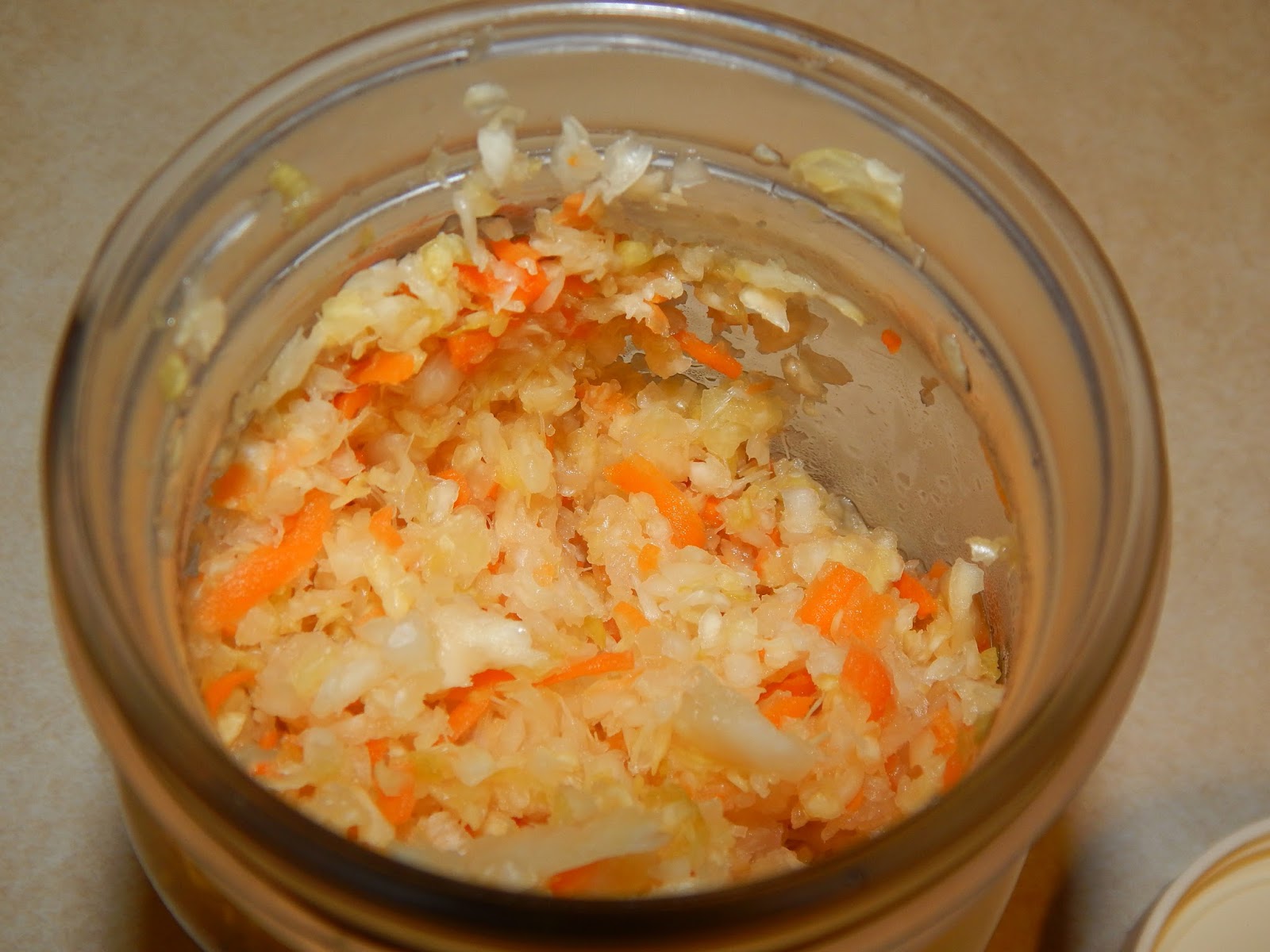
The current batch we're eating now was a combination of        1 1/2 heads of cabbage and about 15 large carrots. This is okay, but the vegetables are softer and don't taste quite as good as the plain cabbage. It was something I wanted to try, but probably won't do this combination again.

I removed all of the carrot/cabbage kraut from the crock two days ago and stored it in the refrigerator. We got about four quarts this time. I don't pack it down solid, so it's not a full four quarts, but it is enough to last us quite a while. We eat about a 1/4 to a 1/3 of a cup per serving. 


Since the crock and fermentation process seem to be going well, this time I put    3 1/2 heads of cabbage in the crock, filling it pretty full. I continue to use some of the juice or liquid from the previous batch to inoculate, or speed up the fermenting process. I also drink some of it on occasion when we get to the bottom of a jar. It is pretty stout stuff, but it's good. We prefer the cabbage shredded, which I do with our KitchenAid. I have started using sea salt instead of regular table salt for the minerals it contains. I use it in all of my cooking as well as the kraut. 


I add a little vinegar in the moat to keep it from getting slimy.


This summer I hope to try fermenting some of our garden produce, like cucumbers, okra, turnips, peppers and beets. It would be nice to discover another vegetable, or combination of vegetables we enjoy as much as we do the cabbage.


I appreciate Deb's request for an update on these two topics. There isn't any reason for me to ever use commercial products on my hair again. What I am doing now is effective, keeps my hair and scalp healthier, my hair looks better and another added benefit is that it costs pennies on the dollar compared to commercial products. The sauerkraut experience has shown us another way to improve our health by making something for ourselves instead of depending on someone else to do it for us. It takes time, planning and effort on our part, but the health benefits of consuming fermented foods well outweigh the effort expended. It's a great life. One full of learning, work and progress. I am grateful.

Until next time - Fern
 

Monday, December 8, 2014

Whole Wheat Sourdough Rolls

I haven't made bread for quite some time. It's easy to get out of the habit, especially when things like surgeries and recovery get in the way. So, it's back to the bread board, so to speak, even though I just knead it on the counter.

I have a new sourdough cookbook that I haven't used before. It is written in a very straight forward, sensible language that is easy to understand and follow. There are also some great stories and good humor. I appreciate an author that doesn't make any bones about the fact that flops will happen when you make bread. They even have recommendations for brick bread, you know, when it doesn't rise and is ultra heavy. They make bread crumbs or crackers from this very heavy bread which I think is a great idea!

I chose a recipe with 100% whole wheat flour and no sweetener. Frank and I are changing our eating habits and trying to limit the carbohydrates we eat. Some of the sites I have researched explain that the process of fermenting, or proofing your dough allows the lactobacilli in the sourdough starter to predigest the carbohydrates in the wheat, thus lowering the production of insulin when we digest the bread. Another benefit of using whole wheat is the fiber and nutrients it includes. This cookbook also has some very good information and explanations about using whole wheat for a variety of bread recipes.

I took my starter out of the refrigerator a few days ago and starting feeding it twice a day, morning and evening, to sweeten it up a bit since I hadn't used it in quite some time. I explained how to recondition a sourdough starter here. I guess sweeten it up can be misleading. I didn't add any sweetener at all, but by feeding it flour and water, and discarding all but about a cup and a half of the starter after a couple of days, it decreased the acidity or sourness of the starter, allowing for a milder flavor and odor. This is a personal preference. Your starter can be as sour, or acidic, as you like.

The Art of Baking with Natural Yeast recommends you proof your dough for a minimum of six hours to allow for the dough to autolyze, or predigest, which "neutralizes harmful enzymes, breaks down the negative aspects of gluten, and frees up vitamins and minerals for human digestion" (page 43). I ground my wheat and fed my starter last night so I would be ready to make bread this morning. 

This simple recipe includes:
1/2 cup starter
2 1/2 cups warm water
2 tsp. salt
1 tbsp. coconut oil (I used olive oil)
5-6 cups whole wheat flour


One of the recommendations I found in this book was to let your dough rest for 30 minutes after mixing. This allows the fiber in the whole wheat flour to absorb moisture and make kneading easier and more effective. There are many tips throughout the book that I found very useful. As you can tell, I would recommend this book, especially for beginners with sourdough, like me.


I let this dough proof for seven hours before I made up the rolls. Then I let the rolls rise for another two hours before baking.


The recipe I used makes two loaves of bread. We chose to make rolls this time. This dough does not look like regular whole wheat yeast rolls. It doesn't brown or fluff up as much, and took a little longer to bake. But you know what? We like it. One of the reasons we do is because we know how much better it is for us. It is another step toward trying to improve our health.

Until next time - Fern