The Road Home

The Road Home
There is no place like home.

Friday, April 18, 2014

The High Cost of Food

There have been a few things in the news lately debating whether or not we are having inflation here in our country. Since they have removed the cost of food, among other things, from the formula, the debate has become somewhat irrelevant. Not only has the cost of food gone up, if you really look, you also find that the food supply is being impacted as well. 

Unbeknownst to most people there are illnesses and environmental affects that are impacting the mortality rate or productivity of a variety of food products. Pork is being devastated in many areas by the  porcine epidemic diarrhea (PED) virus that kill piglets at a very high rate. Shrimp prices have risen 61% since last year, because of early mortality syndrome which is a
bacterial disease. Zero Hedge has charts showing the rising costs of beef, pork and shrimp. This visual gives an even clearer picture of the nonexistent inflation for just these three food products.


The drought conditions that have existed for several years now in Texas and California, just to name a few large food producing states, are having an incremental impact not only on the cost of food, but on the availability of some products in general. Many Texas cattle producers had to reduce the
size of their herds dramatically to stay in business at all when the drought was at it's worst. And their drought is not over, by the way. This article clearly points out how the cost of beef is affecting everyone, from the prices at restaurants, to your kitchen table. How many families have had to limit their intake of meat due to rising costs? How many people have gone to buying the cheaper processed food products to fill in the gaps? When the cost of fixing a hotdog or hamburger for your children gets to be a luxury, then what?

According to Food Business News, the bread basket in the middle of our country is seeing the affects of our unusually cold and prolonged winter weather this year. Corn crops in some parts of the country have had to be delayed because the weather is too cold and wet to plant. There are areas in Kansas and Nebraska that are experiencing drought conditions which may impact their wheat production this year. There are also some areas that the winter kill of wheat has not been determined yet.

And then, there is the drought in California which has been written about in many places. It still amazes me that there is any debate at all on choosing
between food production and the habitat of a fish or bird, but that appears to be the case. One thing is for certain. The water supply in California for the major food producing areas is dwindling at an ever increasing rate, be it the aquifers, snow melt, rain fall or the reservoir or lake levels, they are running out of water. Thus, another area of the country is experiencing shortages in production and increasing costs that are being passed on to the consumers. The Wall Street Journal recently had an article with a very interesting graph. It gives a visual for many of the statistics we keep hearing about.


If these projections come to pass and continue following these trends, what will that mean for your family food budget? How will it affect what you put on the table for the family meal? Will you be able to sustain your current standard of living? If not, what will you cut to make up the difference? How deep will you have to cut?

July 2013
This is yet another important message to all of us. The time to become more self-reliant is here. If you haven't already started to learn about producing some of your own food, I would recommend you do so without delay. There are so many different ways to produce some of your own food, from growing sprouts by the kitchen sink, to container gardening on your patio, deck or in the back yard. We have had several people comment here about growing vegetables in containers because of where they live or their ability to work in a garden. Stay aware and informed of what is happening around your neck of the woods and in the nation. The world has become less stable than it has been in years past and the need for vigilance has never been greater. Remember one of Frank's favorite quotes, "I'd rather be a prepared fool, than an unprepared fool." It could make all the difference in the world.

Until next time - Fern

Wednesday, April 16, 2014

Milk Goat Training & Other Lore

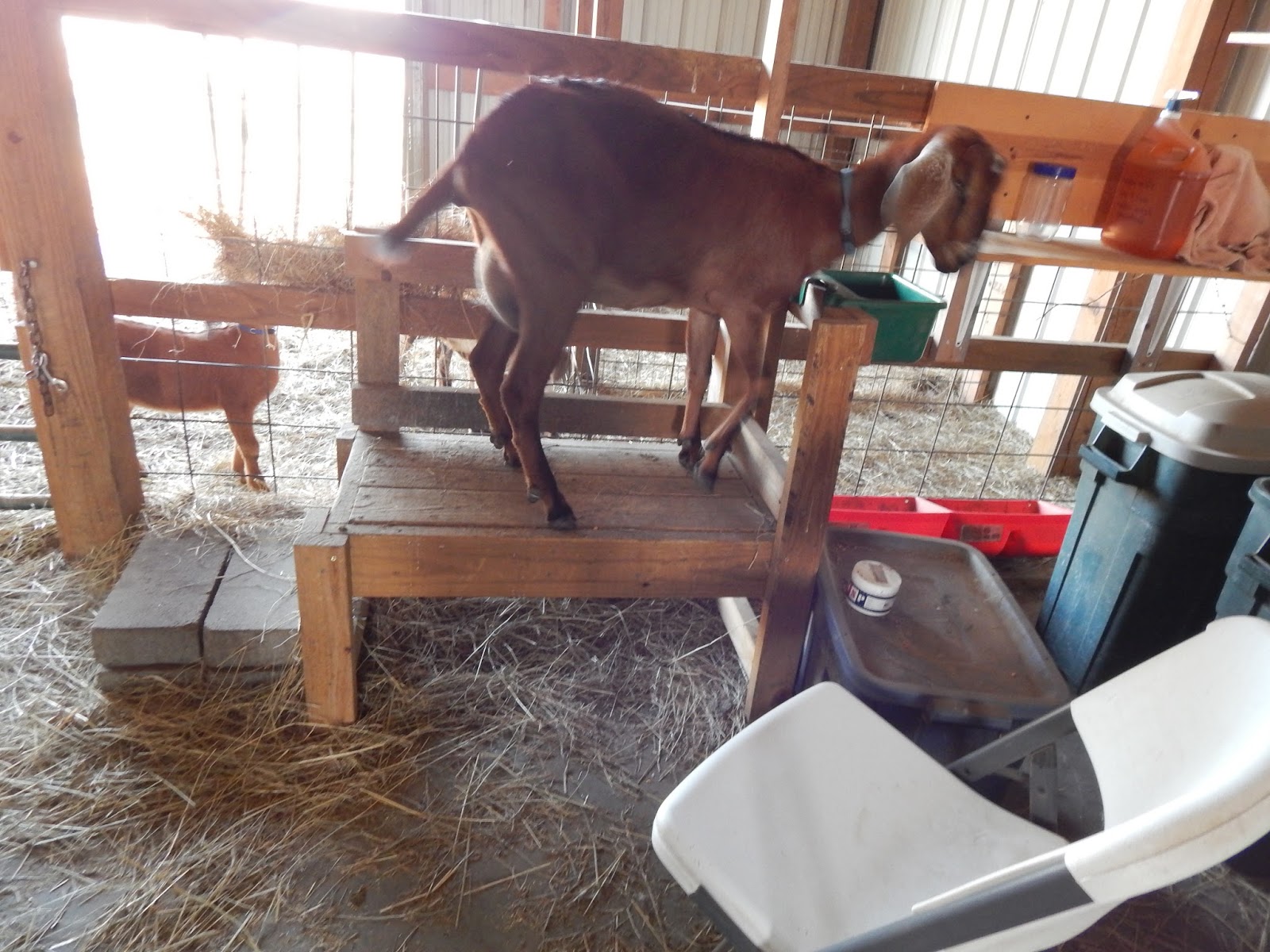
Copper is the only first freshener I have this year, so she is new to the milking routine. The great thing about training her to milk is that she is very, very tame. Compared to some of the other goats I have trained she has been a breeze. There are a few tricks I have learned along the way that I want to share with you.

Begin training early. Bring your first fresheners into the area where you will be milking when they are young or at least a few months before they are in milk. Use patience instead of force to get them up on the milk stand. 
In the past, I would take a goat by the collar and tail and force them up on the stand. That was a lot of work and frustration for both me and them. Now, I will take a bowl of feed and gradually coax them onto the stand a little at a time, trying to increase their comfort level each time. It doesn't hurt to use their tail to help them make that final jump up onto the platform when they're almost there but are still unsure. It will usually cause them to jump, then they find themselves on the stand right at the feed bowl. After they calm down a little and find out there is a reward of a meal for climbing on this platform thing, they don't mind it so much. I talk to them a lot during this process as a means of reassurance. Scratching their shoulder blades doesn't hurt any either, they really like that.

Once your goat is used to the milk stand, you are ready for them to give birth. After the kids are born, start milking the doe within 24 hours. I find that my does will produce a very large amount of milk during the first 48 hours after freshening. I will milk them out almost completely about 12 hours after the babies are born. One, it makes them more comfortable, and two, it makes
it easier for the babies to nurse when the teats are not enlarged with so much milk. To do this, I bring the does to the milk stand. Some of them are a little anxious about leaving their babies in the birthing pen, but they are ready to have that extra milk removed. There have been occasions that a doe was just too anxious about leaving her babies. Then I bring the babies with her to the milk stand and work around them. It only takes a time or two, then the doe is comfortable with leaving the kids for a short time. I think this is a sign of a good mother, so it doesn't bother me at all. I don't keep this milk for human consumption since it is full of colostrum. This is kept in old peanut butter jars to be given to the dog, cats and chickens. Five days after kidding, I will begin keeping the milk for us.

The first time I brought Copper in after she had given birth I expected her to fuss and kick a little. She just stood there like I had been milking her for years. I was amazed. Then I thought, this is just the honeymoon period and she will put up a protest later on. She never did. She has been the easiest goat to milk I have ever trained. I attribute this to two things. One, she was very, very tame to begin with and I have been handling her a lot since she was born. And two, she was a single that had no other kids to play with for over a month when she was born, so she played with us. She has always been very trusting of us and very easy to handle.

One of the things I train the does to do, that makes it easier for me to milk, is to move their right leg out and back a little. It gives me more room for the bucket and makes it easier to reach both sides of the udder for cleaning and milking.
This is not the natural position they care to stand in, but it is not uncomfortable either. It is more of the stance they take when their kids are nursing. To get them to stand this way I used to take hold of their ankle area and move their foot to the desired position.
Then they would move it back, then I would move it again, then they would move it back, and so on. This got old and frustrating at times. Now I gently push against the leg just above the joint to get them to move the leg back.
They usually hold their leg up for a bit, then gradually let it down and it ends up where I want it instead of where they want it. After a while, I can just nudge them on the flank and they move the leg out of the way for me.


Many of the tricks learned during milking are specific to the animal. There are just small differences that come with each different personality. Basic techniques are used with all of my does, but they each have their own preferences as well. Take getting on the milk stand for instance. One Stripe will pause on the cement blocks and get her footing just right before she jumps on up, and she doesn't like to be hurried through this process.


Copper, on the other hand, avoids the block steps altogether and just launches herself up from the side of the stand, usually after walking in a circle. 


Here Copper and Ivory are trading places. Each doe knows when it is their turn in line and will usually wait their turn. I always find that to be fascinating. When Ivory comes in, she will use the block steps and quickly jump right on the the stand. But if I don't walk in right behind her fast enough for her liking, she will turn around and come right back down the steps, turn around and come right back up again. Each has their own way of approaching the stand, but once they are there, the behavior is very similar.

Once a doe is on the stand, I walk by pat them on the flank or side, and talk to them. As I sit down to milk, I pat them on the underside of their stomach and talk to them. Even if I am not keeping the milk and only milking into a peanut butter jar, I will massage the udder a bit
to them know I am going to start milking, otherwise they jump a little. The best thing I can do for successful milking is to keep a routine. I don't always milk at the same time of day, which is a recommended practice. If I did, it would increase the does milk production. But I do usually perform the task of milking in a very routine manner, which seems to keep the does relaxed and agreeable.


I enjoy milking my goats and I think that adds to the atmosphere of this task. If I didn't enjoy it, there are many little things that I would probably find very frustrating and annoying. But I don't. Milking early in the morning is a very peaceful, relaxing chore for me. I get to spend time with my animals, observing their behavior to see if there are any needs we should address. I get to listen to the world wake up as the rooster starts to crow and the song birds sing to the morning. For many years I have considered the song of the birds to be a gift from God. He bathes us with these beautiful songs, telling us how much He loves us and gives us a gift of peace. Stop and enjoy them. Listen. Be still. You are blessed.

Until next time - Fern

Monday, April 14, 2014

Growin' Kids

The kids are growing like weeds. They have become used to being penned up at night on occasion to provide us with more milk. The horn buds that were burned are starting to come off and leave a nice smooth patch instead of the unwanted horns. Most of the kids are now very friendly. Ivory's twin girls are still rather stand offish, but I hope that improves with time. All of the kids have taken a liking to the new feed ration we are using and are grazing well with their moms. They are a great looking herd and we are pleased. 


We look forward to getting a new buck soon and will introduce you to him after he arrives. We will also show you how we manage a new animal before they are allowed to integrate into the herd. There are always new happenings when it comes to raising livestock. Stay tuned.

Until next time - Fern

Saturday, April 12, 2014

Follow the Yellow Brick Road? Not Me

What was it the wizard told Dorothy and her friends, once they finally made it to the Emerald City to get his advice, in the movie The Wizard of Oz? Something like, "Don't look behind the curtain! Don't pay any attention to the man behind the curtain!" Well, folks,the more I research and learn
for myself the composition of the things that surround us, that have been developed and marketed in the commercial arena, the more skeptical I get about the true motivation of the corporate entities in our country. I prefer my own path instead of dancing mindlessly down the yellow brick road, to the land of poison poppies that dull the senses and leave one neurologically impaired, to the point that one will take and do anything regardless of the cost to them, their families, or mankind.

I have written about GMO products before. Why have so many countries around the world banned all GMO seed production and growth from their borders? Is it because they understand and care about the dire consequences of feeding their people and livestock these products? Why are countries refusing shipments of grain exported from our country because of the GMO content of the shipment? Could it possibly be so it won't contaminate their crops and poison their people?

Sometimes Frank suffers with migraines, as do many other people. We were reading about MSG (monosodium glutamate) the other day and didn't know how many other 'names' it goes by. Here is a partial list of these other names according to truthinlabeling.org. Check the link to see the rest of the list, it is much longer than this one.
  • Glutamic acid, Glutamate
  • Monosodium glutamate
  • Monopotassium glutamate
  • Calcium glutamate
  • Monoammonium glutamate
  • Magnesium glutamate
  • Natrium glutamate
  • Anything “hydrolyzed”
  • Any “hydrolyzed protein”
  • Calcium caseinate,  Sodium caseinate
  • Gelatin
  • Soy sauce
  • Soy sauce extract 
Some of the common side effects of MSG are: headaches, nausea, dizziness, rapid or irregular heartbeat, flushing or excessive sweating, skin rash, numbness, intense thirst, lethargy or sleepiness, ringing ears and tingling in the mouth. Not all people suffer from the same side effects, but just reading about it makes me want to try to eliminate as much as possible from our diet.

Another item in our culture that has become very popular, to the point of ridicule if you don't use it, is hand sanitizer. Yes, hand sanitizer. Does it make you 'safe' from all of those unwanted germs, or does it lower your body's ability to protect itself by killing off the natural protection your skin provides? Here are a few excerpts from an article at The Health Site.
"In a study published in the Science Daily, carried out by the Northwestern Research Center found that a child’s immunity is seriously affected by the
use of hand sanitizers." And, "Some hand sanitizers don’t have alcohol content and use triclosan instead. Triclosan is an anti bacterial and anti fungal agent and is commonly used in a variety of soaps and cleaning agents. But, did you know that it is an active ingredient in pesticides? Another thing to consider is the fact that the compound has been widely touted as an agent that causes the formation of super bugs or antibiotic resistant bacteria.  Triclosan, as a component, is capable of quickly being absorbed into the skin and entering the blood stream, once there, it is known to cause various side effects like cancer, allergies, hormonal and neurological ill effects and muscle weakness. More importantly, it is known to cause infertility." This is just two of the possible side effects listed on this site. If you use hand sanitizer or antibacterial anything, please look into how it may affect you and yours. What you find may be very surprising.  Adequate use of soap and water will generally take care of any cleaning or disinfecting your hands may need.

Fresh air, we all love it, right? So, if the air is not fresh and sweet smelling, Madison Avenue will provide us with a way to freshen it up. From things you plug into the wall, to machines that 'freshen' the room at timed intervals, to the option of spraying away at your hearts content, we have been provided with every 'good' scent known to man right at our finger tips. According to Health Scams Exposed, "It may surprise you to know that the air fresheners you use don’t actually make the odor in your home go away. Your home smells good when you use them because they actually change the way your nose perceives odors. A chemical called p-dichlorobenzene deadens the nerve cells in your nose by coating your nostrils in a type of film." The article goes on to say, "The Centers for Disease Control classifies p-dichlorobenzene as a possible occupational carcinogen. It has also been reported to cause asthma, allergy attacks, eye irritation, liver disease, kidney malfunction, gastrointestinal problems, and skin rash." This site goes to include information about some of the chemicals included in air fresheners. Air fresheners may include the ingredients:
phthalates, a powerful endocrine disruptor; parabens, which are found in deodorant as well, are known carcinogens among other things; formaldehyde, which affects your respiratory tract and has been classified as a carcinogen for over 20 years; petrochemicals, which are also in pesticides, cause breathing problems, headaches and neurological dysfunction among other problems; and benzene, a flammable, sweet-smelling chemical that is a carcinogen, is linked to leukemia, and can affect the composition of your blood cells.

Frank has never been able to walk down the soap aisle at the store, through the tire store or by someone that has on way too much cheap perfume without getting an instant headache. It seems to him that the type
of people that wear cheap perfume think that the more they wear, the better it works. They wear so much you can taste it. Yuck! Obviously it has some kind of deadening agent in it as well, because it deadens the senses of the men around them, according to Frank. So what chemical scents are included in soaps, shampoos, laundry detergent or a wide variety of cleaners? Obviously there are many other chemicals that are released into the air and absorbed into our bodies. What affect they have on us is individualized depending upon our sensitivities, but the fact that they affect us all is undeniable.

And what about the clothes we buy? When you buy clothes at the store or order them online, have you ever noticed that chemical smell when you open the package or pick them up? According to Fibre2Fashion "Formaldehyde is commonly used in garments as an embalming fluid
to give a 'permanent press' look. Excessive content of this chemical in our clothes can cause irritation in eyes, skin, nose, and result in respiratory problems, and diseases like cancer. It can also result in headaches, skin rashes, nausea, and chronic fatigue. Just by simply touching those products, or breathing the formaldehyde they release into the air, can cause intense symptoms." So when it comes to formaldehyde, we eat it, breathe it, dress in it, all of which can and does cause serious health issues. Then after it kills us, they preserve us with it until they can get us in the ground. Amazing, huh? We always make sure to wash any new item of clothing, or anything made of cloth, before we use it just to try to eliminate as many of these added chemicals as possible.

How many other chemical agents are out there that include a deadening agent to get us to ingest it, breathe it, drink it or absorb it? I had no idea that the mechanism of delivery for scents was to numb the olfactory nerves so that the 'foul' odors are no longer detectable. That's amazing. Why have so many things been allowed to be 'innocently' sold to the public when there are documented ill affects to health? What is the planned outcome for putting all of the poisonous chemicals in food, water, air, clothes, houses, etc., etc.? Each one of these chemicals are individually tested and deemed 'safe' at so many part per million. But what about the combination of all of them together? Our government seems to think they are safe. Right? Would they lie to us? No, not our government, not Big Brother. 
Frank and I have talked about this many times. I truly believe at the onset, the ability to produce some chemical agents was for the benefit of mankind. Men, yes, men, are designed as problem solvers. As the industrial age came into full force, men wanted to design and create things that would make life easier for their families. The first wives to receive a washing machine from their husbands were very happy women indeed. So the creation of some chemicals provided a way to preserve food a little longer, made a plastic wrap that would keep the flies off of food and kept the moisture in, and just made life a little easier. When did things change from benefiting mankind to anything for a buck? When did profits and pleasing the stockholders take precedence over caring for the workers and customers? When did cold, calculating greed win? 

Some people think there are just too many people on our planet and these things have to happen just to provide for the ever growing demand for basic necessities and comforts. Some people think that if these harmful substances had not been implemented to begin with, the balance in
population vs. production would have taken care of itself. You know, supply and demand. When there are not enough rabbits to feed the coyotes the population density of the coyotes decline. But if artificial means are utilized to create an over abundance of rabbits, the coyote population will increase as well. What happens when the artificial means start impacting the health of the rabbits to the point where it produces an inferior specimen or causes lethal heath issues? In turn, how does
that impact the population of the coyote? Is this a sustainable system? No. Are we caught right in the middle of all of it? Yes, very sadly we are. So, now what? Frank and I both agree there is absolutely no way we can avoid all chemicals. Everything we eat, wear, breathe, drink, read and look at has been impacted by chemicals one way or another. What can we do? Research, learn and modify the way we do things as much as possible. Has much damage already been done to our bodies? Yes. Is it reversible? I don't know. Maybe some of it is. But I do know that God has given me this task to perform. Why, I do not know. I only know that I am supposed to learn as much as I can. Now. Not later. The choice is mine and I choose to live the best way I know how. What about you?

Until next time - Fern


Friday, April 11, 2014

Baby Chick Five Week Update

Hello, Frank here.

As of today, Friday, the baby chicks will be five weeks old. The last time we posted the birds were just a few days old. A little bit of food for thought. Sometimes things just don't work out the way you plan. After getting
the baby birds out of the house and into their temporary quarters, I developed an upper respiratory infection, or that's what the doctor called it anyway. But a side affect of that was, I could not tolerate any form of dust, which includes chicken dust. So, we had a problem and we needed a solution. I needed an industrial grade dust mask. I looked up a farm supply, a company called Gempler's, and ordered a couple of masks that are made for ammonia, but also come with a dust mask attachment. The chickens are scared to death of me. I'm not sure my cats will ever come back home, but my dog still loves me.


Okay, back to the chickens. The birds stayed in their temporary quarters a little longer than we had planned. They were well fed and watered, but when we moved them to their permanent quarters, the first hour or so they didn't walk like normal chickens. The reason being their height was constricted in their temporary quarters after they got so tall. But after a couple of hours they stretched their legs were fine.


Their diet. We started off with medicated chick starter, it's a crumble type product. After two weeks on the chick starter we went to regular laying crumbles. It's the same size feed, it's just made for bigger birds. This is what some people feed their birds on a daily basis. Now we switched to an all-purpose feed that we also give our goats. This is what we are feeding our adult chickens now, too. The change from chick starter, to laying crumbles, to the all-purpose blend we did very gradually. There is one difference between what we feed the goats and the chickens, we don't add alfalfa to the chicken blend. And here is that blend:
  • 6 parts rolled oats
  • 4 parts sweet feed
  • 1 part sunflower seed
  • 1 part wheat bran
  • And for the goats, 1 part alfalfa pellet
This is a well rounded blend with a solid protein level. Okay, that's the feed.


Water. For about the first week we also added a vitamin electrolyte solution to their drinking water. This just helps the birds get a good start in life. Now they are drinking regular water.

With time we've also changed what they eat and drink out of. Now I know the baby chicks feel really special because they are eating and drinking off the same dishes that the big birds eat and drink out of.
In the growing process, we lost a couple of baby birds. We had one die from a crusted vent. We had a couple die for unknown reasons. We had one bird that had a deformed beak, and he was put down. You ever notice when you have to put something down it's a he? Funny how that works, isn't it?


Housing. Before we could get the baby birds to their permanent housing we had to do some chicken home improvement. This has only been waiting about four years to get it done, and it took us probably three hours to do it. But now the big birds and the little birds are separate. 


Don't think that a little bird can't find a hole or a weak spot in your chicken fencing. The first day we put all of the baby birds in their new home, the next morning probably half of them were someplace other than where they were put the day before. I don't understand. But they can find a weak spot in your fencing. I guess it's basic animal behavior, to always want to be someplace other than where you are. You know, the grass is always greener on the other side type concept? If we hadn't caught the escaped babies early in the morning before sunrise, then the adult birds would probably have pecked them to death. But that didn't happen and we are thankful. Once a bird develops a pecking problem, there is no way to stop that behavior. Well, there is a way to stop that behavior, but you have to stop the bird, permanently. 
 
Adult birds checking out the new babies
 

Next on the agenda, believe it or not, is separating the young roosters from the young hens. I will pick out the two roosters I like the best, and at the age of 12 weeks, we will butcher all but two males. So, for the next few weeks, it's just feed, water, look for problems, make sure everybody is healthy and happy. It's fun to watch the birds grow as they start to take on their adult colors and shapes, because pretty soon, 12 weeks will be here. 

A little review here. We have about 46 to 50 baby birds. Half of those came from Murray McMurray Hatchery, and the other half of the birds I hatched. Now for the simplicity of math, I'm going to say we have 48 baby birds. If they're half and half male and female, then I will have 24 females and 24 males. So, that means I will be butchering 22 young males. Also, if I have 48 birds and 24 came from the hatchery, that means 24 of them I hatched. Of that 24, half of them came from friends of ours. So, that means 12 of the baby birds are pure Easter Egg chicken. The 12 from my friends, the rooster was an Easter Egg, but the hens are an assortment of heavy breeds, like Barred Rock, Buff Orpington, and some other heavy breeds. The 24 from the hatchery are Black Australorps. I am new to Black Australorps, this will be my first time with them. They are a dual purpose, heavy breed.

So, we're at five weeks, at 12 weeks we butcher the males. At five to six months they start laying and at one year we hatch their babies. Unless something comes along, the next time we talk chickens, should be in six to seven weeks. If you hatched some birds this year or you ordered some, please let me know how it's going. Email or comment would be appreciated. Just to let you know ahead of time, this year instead of freezing the males we butcher, we're going to can the meat instead. We've done this on a smaller scale before. That's the plan anyway.

We'll talk more later. Frank