The Road Home

The Road Home
There is no place like home.

Monday, September 8, 2014

Is Your Head Stuffy?

I do my best not to use medications for my stuffy sinuses. There are times that I'm okay, but many times my sinus cavities are just stuffy, and if I don't take care of them, I am very prone to sinus infections, even after surgery to decrease that problem. For a number of years I used over the counter medications such as Sudafed (before the clamp down because of use to make Methamphetamine), Muscinex (which works well, but affects my whole body), and Flonase (Fluticasone, generic prescription) which is a steroid nose spray. It was just easier to take a pill or inhale a mist than to try something different.

We had a great ENT (Ear, nose and throat doctor) in Alaska that introduced us to a sinus wash. The air in Alaska is very, very dry and that made us even more prone to sinus infections, since it tended to really dry out our nasal passages. Once we started using the sinus wash, it helped a lot. 

There are several different types of sinus wash techniques. The Neti Pot has been around for a long time. It's not something we have tried, even though for a while, Frank just used a bowl of saline in the shower. Once I got used to the really weird feeling of squirting water up my nose, I prefer a sinus wash bottle. It is simple, quick and effective.

The first sinus wash bottle we bought had individual packets to mix in each application. When we realized the contents were salt and baking soda, we started mixing our own. Before we used the last packet, we measured the contents. A slightly heaping 1/4 teaspoon works just fine. So now we fill a little bowl with salt and add a pinch of baking soda.

The directions for use are printed on the bottle. This is our backup, just in case the original one finally bites the dust. We have been using it for nine years. After each use, we rinse it with hot water. One thing we learned was to leave the bottle sitting upright with the lid off between uses, just for air circulation. Periodically, it can be cleaned with a vinegar solution. When cleaning, a narrow tube cleaning brush works on the straw portion and a regular bottle brush works well on the bottle.

A friend asked me if we used sterile water when we mixed up the solution. Our ENT indicated tap water is fine for this procedure, even following sinus surgery. I use warm water as close to body temperature as possible. Cold water just doesn't seem to work as well.

After we started using the sinus wash we found out that a young lady we knew swore by them. She was a very active, athletic young woman that had serious allergies and asthma. Once she discovered and started using a sinus wash, she had fewer asthma attacks and was able to decrease the medication she was taking for these two issues. She found that washing out the irritants that kicked up her allergies not only helped alleviate some of those symptoms, but in turn, decreased her asthma reactions as well. I don't know if this would be the case for others since I do not have any serious allergies, or suffer from asthma, but I did think it was very interesting.

Using a sinus wash instead of pills or nose spray, is a little more work and not always convenient. It is definitely easier to swallow a pill or squirt a mist in my nose. But in our efforts to decrease our chemical intake, this is a low-tech, no medication option. And along those lines, when the time comes when we don't have easy access to the plethora of over the counter medications, this may be a very important option. If we have access to water and salt, we can treat allergies, sinus congestion, colds and any other ailment that comes along to decrease the air flow in our nasal passages. Is it a cure all? No. Is it a sustainable way to help increase our health without bombarding our bodies with yet more chemicals? Yes. Happy breathing.

Until next time - Fern

Saturday, September 6, 2014

Around the Shack

Hello, Frank here.

Hi Everybody. Boy, I hope summer is over soon. Here in southeastern Oklahoma, it's not only hot, but it's humid. It's a very wet year, and outside feels like a perpetual sauna. And, for you folks up north, I am very happy. I'm happy that you're there and not here. Okay, so much for the weather and humor.


A couple of days back, Fern posted a picture on the header of the blog and I thought I would take this opportunity to talk about some of the radios. Also this week, I received an email from Dan Romanchik, KB6NU, the author of the No-Nonsense Study Guide manuals. I will include the entirety of his email and my response further down in this post. But for now, let's talk radio. Fern likes the picture, as did I. She kind of likes the pictures with the sunlight in the background and the rays coming through. I guess it kind of adds a feeling of freshness and purity. These are the things we deal with in life.

Starting at the top left. You can't see the entire radio, but it's my old 300 channel scanner. I say old, it's probably pushing around 20 years. It was made by Radio Shack, and it will scan all 300 channels in 1 second. It has 10 bands, 30 channels in each band, and each band has a priority channel. Which means, while scanning, it will go to each priority channel and see if any signal is there. So, if you're listening to the police scanner, and you have set up another frequency as a priority, and your buddy calls to tell you the football team just scored, then it will interrupt whatever you're listening to and bring you his message. It's an analog scanner, because there was no such thing as digital when it was made. It is a Radio Shack Pro-2050. It's a good little scanner. It's got some nice features.

Next on the list, right directly underneath the scanner, is a VHF/UHF radio. It is the Alinco DR-635T. It is a ham radio, but it's one of those ham radios that can be easily modified to broadcast on the frequencies that it advertises it will receive on. It's a good little radio.
It's respected in the ham world, but it is a ham radio. In the very near future, it is going to be replaced with an AnyTone AT-5888VU. The reason for this. The AnyTone is a commercial radio which will work fine on the ham frequencies, and it will also work on search and rescue frequencies, which, with permission, these frequencies are legal. It is not legal to use a modified ham radio on the search and rescue frequencies, even with permission. Are there many people out there using modified ham radios for search and rescue? You bet there are, lots of them. It's up to you.

Just to the right of the VHF/UHF, is my trusty CB radio. You see folks, I like CB radio. I know the talk can get a little trashy at times. In this case I have chosen the Galaxy 979. It is your standard 40 channel CB radio with SSB, single side band. It has no modifications, and it's pretty. It is a good solid performing CB/SSB radio. I have listened to and talked to people in various parts of our great nation with this CB radio. But you've taught, CB is line of sight. And it is. But if the atmospheric conditions are right, it will bounce off the atmosphere, just like any HF radio will. Because CB falls between the HF 10 and 12 meter bands. CB is sometimes referred to as 11 meter. If you're looking for a good CB with SSB, check out the Galaxy line.

Next. In the center we have an ICOM IC-718. It is an HF radio. It is considered in many circles to be the bottom of the line, but it is a solid performing radio. It will cover 160 meters to 10 meters with the proper antenna. Sitting on top of it is an LDG IT 100 tuner. The tuner matches the antenna to the radio without going into any great detail. Do you have to have it? In my case, yes. But, some people don't use them. On top of the tuner is an old Radio Shack speaker I have had for years. 

This 718 will listen, or receive, from 3kHz up to 30 MHz. That means, you can receive all of the HF ham frequencies. You can also receive all of the shortwave radio frequencies. And that also means you can listen to and receive the Citizens Band or CB frequencies, because right outside the CB frequencies, a lot of guys do Free Banding. This way they can avoid all of the traffic on the usual 40 CB frequencies. It's not a legal practice, people all over the country do it. If you modify your 718, then all of the frequencies I've just mentioned, you can also transmit on. Remember, it's not illegal to have a modified radio. Let's take 60 meters for example. This radio will not broadcast on 60 meters. Can you modify it to where it will? Yes. Is it legal to broadcast on 60 meters? Yes it is. But for this radio to broadcast on 60 meters, then it must be modified. When you make that modification, can you then broadcast with this radio on the CB frequencies? Yes, you can. Is it legal? No, because it has not been approved by the FCC to do so. Do people use these radios to broadcast on the CB frequencies? Yes, they do. There is a group of radios called 10 meter export radios. The vast majority of these radios are used to broadcast on CB frequencies. Are they legal to do so? No. But I'd bet half of the truckers in this country have 10 meter/Export radios in their trucks, and use them on the CB bands. Remember, to broadcast on any ham frequencies, you need a ham radio license.

On this 718 a couple of nights ago, I talked to a gentleman in Oregon on 17 meter. There was a contest going on, and I run the power that comes out of the radio, which is 90 watts. It'll actually run 100 watts, but I stay at 90. I know some of these boys out there run a whole lot more power than I do, but I got through. I heard him and he heard me. Then I listened to people talk to each other from Vermont to just north of L.A. on 17 meter, using my A99 CB antenna.

Okay. Speaking of antennas. Look just beneath the CB to the back wall. What you see are three sets of switches. Since my CB and my HF radio can use the same antennas, I have them both come in to the first switch on the right that you see. Coming into this switch is the A99, which is a CB type vertical antenna. Also coming into this switch is a dipole antenna rated 160 to 10 meter. I also have my first antenna, which is a 40 meter dipole, which I made out of 12 gauge house wire, coming in to this switch. So, there are three antennas going into this switch. The coax coming out of this switch and going to the one just to it's left, goes into the center of the switch. Out of that switch, the coax goes to my CB radio and to the HF radio. This way I have a choice of three different antennas, going to one of two radios. Kind of confusing, I know, but it works. These switches also help provide lightening protection. There is no 100% way to provide total lightening protection. These just help.

Last on the list is a little hand held radio, bottom right hand side. I did a post on this radio a short time back. It is an HT BaoFeng UV-5R+. It is a hand held VHF/UHF commercial radio, that costs less than $40.00. It's not a tremendously sophisticated radio, but it will provide you with a basic VHF/UHF full functioning radio. This particular radio comes in multiple colors, red, yellow, blue, black and camo. You say, "Why the different colors?" Some rural fire departments use these little radios, and it's a whole lot easier to find a bright yellow dropped radio, than it is to find a black dropped radio. Fire sights have a tendency to be a little wet, hoses leak, tankers leak, and it's easier to find a yellow radio than it is to find a black radio. You notice, mine are camo. Great little radio for the price.

New Alinco commercial radio
So, these are the basic radios that are in my shack today. As mentioned above, I will be trading out the VHF/UHF for an easier to operate commercial model. An editors note here. I have already bought the AnyTone radios to replace the Alincos. But I noticed a couple of days ago that Alinco has now come out with a VHF/UHF commercial radio. They have it at Universal Radio's site. Check it out. 

So, these are the radios I use daily, well, almost daily. I keep my scanner going most of the time. I use a CB maybe once or twice a week, just for fun. And that's about the same amount of time I spend on the HF rig, two or three nights a week, maybe 30 minutes to an hour. If you'd like more information, check out some of the previous articles and I think you'll find some interesting information. As I've said before, there is something in radio for about everybody. If you're the competitive type, there is contesting. There is search and rescue for those that like to get out and play in the dirt. There is shortwave listening. You can spend lots and lots of money, or you can do search and rescue with a $40.00 radio. I do radio for survival practice, because I think I can see what is coming. None of my equipment is high dollar, but it all does the job. If you want to buy high dollar stuff, it'll work too. I hope you enjoyed the little tour. You might have noticed that I don't use a computer doing ham radio. Can you? You bet you can. It's just one of those things that if you choose to use a computer, you can.

Now, next on the list, I'd like for you to read an email from Dan Romanchik, KB6NU. And then, I'd like for you to read my response. 
~~~~~~~~~~~~~~~~~~~~~~~~~~~~~~~~~~~~~~~~~~~~~~~~~~~~~~~~
Thu, Sep 4, 2014

Hi, Frank:

Thanks for plugging my study guides on your blog. I wonder if you could make a couple of changes, though:

1. I like to refer to my study guides as KB6NU's No-Nonsense study guides. KB6NU is a lot easier to remember than Romanchik. :)
2. Please use the link http://www.kb6nu.com/tech-manual instead of linking directly to the PDF file. That link has links to all my other study guides as well as the Tech manual.

Thanks & 73!

Dan KB6NU
~~~~~~~~~~~~~~~~~~~~~~~~~~~~~~~~~~~~~~~~~~~~~~~~~~~~~~~~
Dan,

Thank you for your manuals. I know when I first investigated ham radio, I was introduced to your manual and used it extensively along with QRZ to get my Technician's license. I am in the process of working on my Extra, and I have purchased your No-Nonsense manual for the extra class. I'm also using the ARRL Extra book, and HamTestOnline.com. Hopefully, in the near future, I will be able to enjoy all of the bands.

It was an oversight on my part to not include your webpage. As a general rule, on many of the posts where I have mentioned your manual, we not only include the pdf to the manual, but also a link to your webpage. Everybody I know just calls you Romanchik, or some variation of that. (-:  I will certainly make the change to your call sign in my next mention, which will be very soon.

I personally want to thank you for the time and effort you have spent in writing your manuals. I do not know of anyone that has not used your Technician and General manual. Again, I thank you.


73s,
Frank
~~~~~~~~~~~~~~~~~~~~~~~~~~~~~~~~~~~~~~~~~~~~~~~~~~~

Ladies and Gentlemen, it is my pleasure to be able to write these articles, I hope you find them enlightening, a little bit challenging, motivational to a certain extent, because this is what I do. Radio is a part of my life, it's a part of my preparations for the future. If somehow it fits into your scheme, then please use any information provided here. We're all in this thing together, and when it rains, it rains on all of us. So, take time to get ready. I hope you find a place for communications in your process of getting ready, because folks those dark clouds are getting closer and closer every day.

We'll talk more later. 73, Frank


Friday, September 5, 2014

Our New Battery Powered Propane Cookstove

Frank has told you before about the problems we were having with our propane cookstove. The electronic panel that controls the oven, timer and clock kept going out. The cooktop burners still worked fine, but the oven would not heat to the indicated temperature, or keep an even heat, or would heat way past the indicated temperature. We were always told it was the electronic control panel. So we replaced it instead of buying a new stove, after all, we bought this stove new in 2008, and it should last a long time, right? Not right. After replacing the control panel for the third time at $150.00 each, the third replacement didn't work for over a week. Time's up. We needed a new stove, but after the experience we had, we didn't want a stove with an electronic control panel. 

Do you know how hard it is to find a new stove without an electronic panel? Almost as hard as trying to find a washer that doesn't decide how much water you need to wash your clothes. Almost, but not quite, because we did find one, even though it may be the last one. We had chosen a particular model and asked our local appliance store if they could order one, they tried, and it had been discontinued. So, we found another one and asked the same question. They had one left in the regional warehouse, and that was it. This model has also been discontinued. We don't know if they are still available anywhere else, or if a new similar model will be built. Even so, we wanted to show you this stove and explain why we chose it.

 
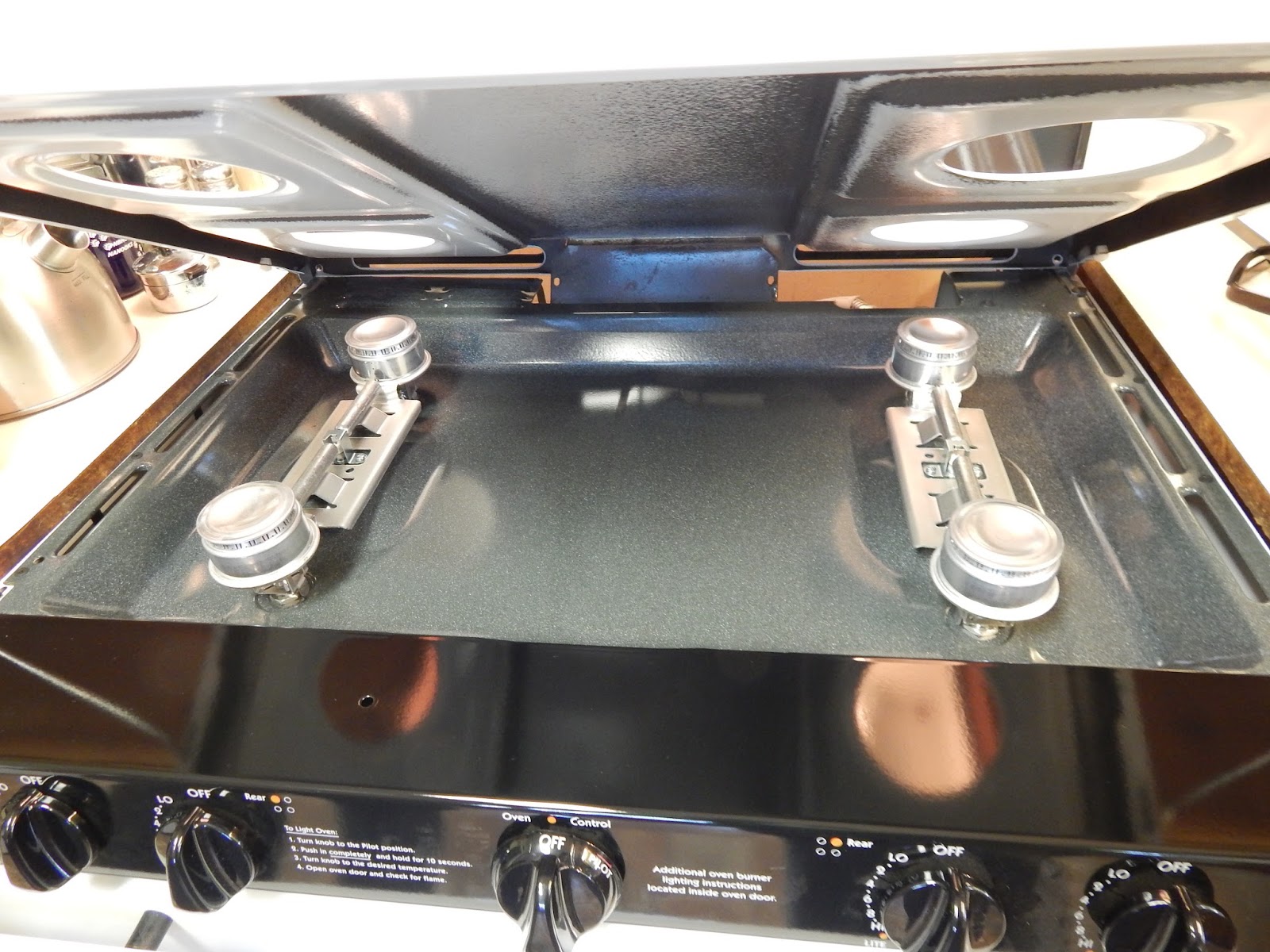
This is not a top of the line stove. In fact, most people would consider it to be on the other end of the scale. But, you know what? I am just tickled pink. It is plain, simple and battery operated. No, it doesn't have any moving parts or talk or flash or even beep. But if the power goes out, I can still cook and bake to my heart's
content, all because of this 9 volt battery. The ignition strikers all work off of this battery, even the oven. Yea! I have always wanted an oven that would work when the power is off. Now I have one, and I consider it to be a very important part of our preparations for the hard times ahead. Yes, I know that most cooktops will light with a match when the power is out, but very few ovens will. I feel fortunate to have one of the few ovens that will light when the power is off, very fortunate.


Here is a tour of the stove. It is a Hotpoint. All four burners have the same BTU output. The burners are not sealed, but the top is easy to remove and clean.


The oven lights similar to one in a travel trailer or camper. You hold the knob in for 10 seconds then set the temperature and make sure it lights.

Rechargeable battery


Battery charger

All of the burners and the oven can be lit with a match if the battery dies and there is not a replacement. The battery compartment description indicates the use of an alkaline battery, so we stocked up on a few. The manual indicates the battery will last two to three years. We would rather use rechargeable batteries, but when Frank contacted the manufacturer, he was told to only use alkaline batteries. The reason is that an alkaline is 9 volts VDC, and a rechargeable 9 volt is actually 8.4 VDC. Our battery charger will work off of a regular wall plug in, but transforms the power to 12 VDC. We operate ours directly from Frank's radio power supply, which is 13.8 volts or 12 volts. Using rechargeable batteries will extend the length of time we are able to use battery power for many different things if the electricity is down for any length of time, including the stove. Yes, Frank's power supply is 110 volts, but we also have a 12 volt solar system for the long term. And, yes, the stove works fine off of the rechargeable battery. Another yea!


I've been waiting for this stove for a long time. Frank's back surgery slowed things down a little bit, but it is here, it is working, and it's exactly what we have wanted for a long, long time. I have not tried to bake anything yet, since it just arrived this morning. If there are any problems with the oven I will let you know, because tomorrow is Saturday, and Saturday is biscuit day. I look forward to not wondering when they will be done and if they will be gooey or burnt. And besides that, Frank really enjoys our Saturday morning biscuit tradition, and I enjoy providing them for him. It's all part of the blessings of marriage and family traditions. He spoils me rotten with the things I want, like this stove, but in return, I get to spoil him with biscuits. Isn't life grand?

Until next time - Fern

Wednesday, September 3, 2014

Things of Concern

There are so many things happening in the world, it's hard to keep up with it all. Again, there are events that are definite causes for concern that we wanted to share with you. As Frank and I were discussing some of these events recently, he had some very wise council. It does no good for us to fret about things we cannot change. Wise indeed. But we do believe that it is very important to be informed and prepared. With that in mind, here are some headlines worth taking note of.


Friends and Neighbors, there is a lot going on. I know most of these events you are familiar with; everyday it's a new crisis. Someday I'm afraid the crisis is going to be in our backyards. I guess in many ways, we have multiple crises going on as we speak. The slow gradual decay of church and church values, of long-term deterioration of our schools, the unemployment and welfare crisis gets bigger everyday, a direct correlation to that is the artfully hidden financial crisis that is upon us, and the list goes on and on. So, we are in a crisis, by the innate nature of the definition. When is the big one, the really big one going to happen? The one that is going to cause the house of cards to cascade to a level plateau? Help your neighbors; help your friends, if you can. But you must take care of your own first. If you have recommendations for articles to read, please share them in a comment. Things get scarier every day. Stay close to your loved ones, don't draw attention to yourself, avoid crowds and always have an exit plan.

Frank & Fern
 

Monday, September 1, 2014

Grape Juice

Our grape vines were loaded with grapes this year. So much so, that I think the grapes took all of the moisture and left little for the leaves. Either that, or there is something making the leaves turn brown and die off. I really don't know much at all about grapes. Last year we tried to process the ones we got, but that was a great fiasco. So this year, I wanted to try something different.

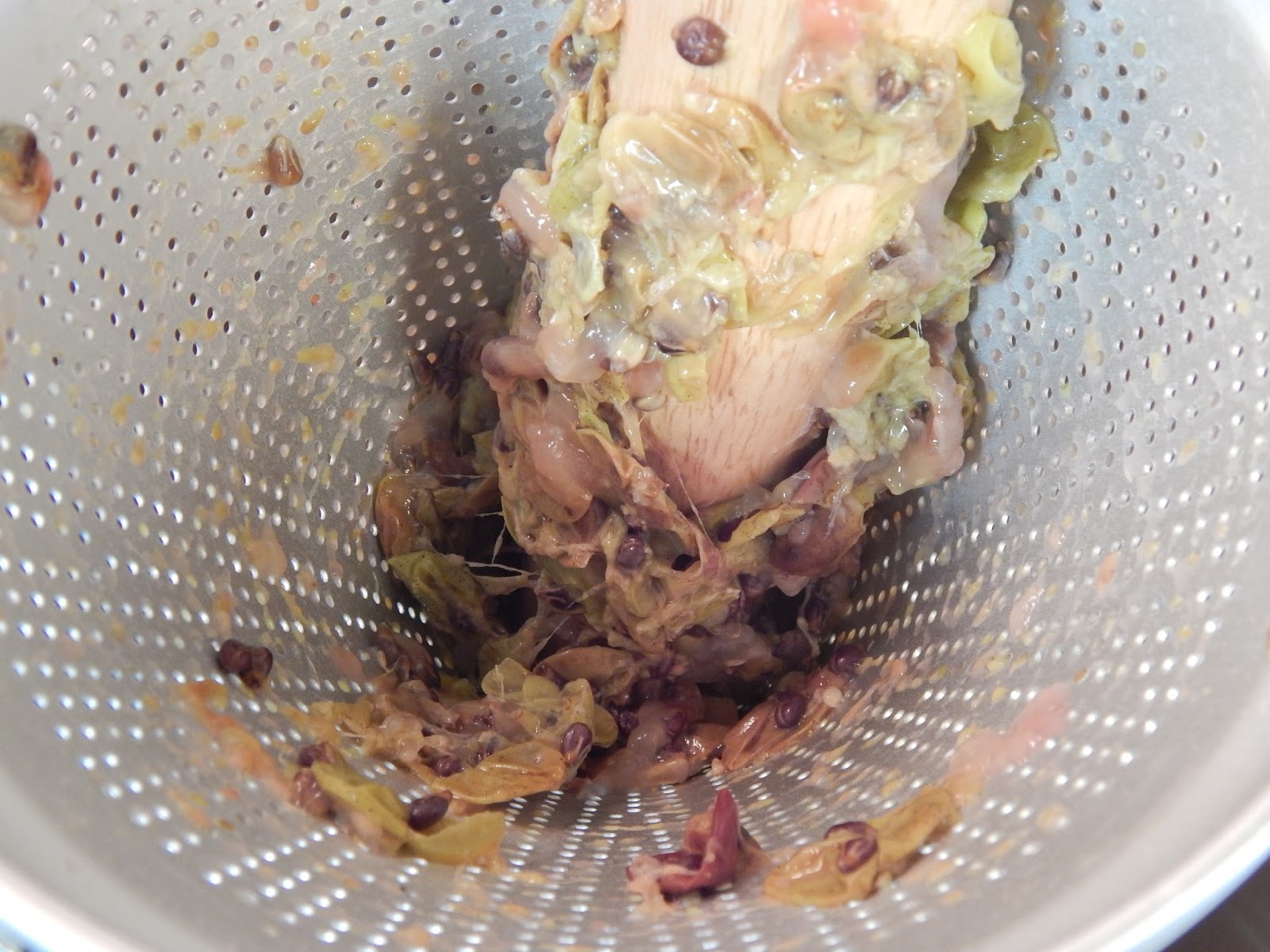
A while back, I found a strainer/colander like my mom and I used a long, long time ago. It is very simple and works great with little effort and easy cleanup. Much simpler than the seeder/strainer attachment on the KitchenAid we tried last year.

I picked about half of the grapes, leaving the others to ripen a little longer. I was surprised at how many there were. I rinsed them off outside first to get rid of the tiny little crawling critters and discourage the small cloud of gnats that accompanied them to the house. Then I picked off all of the usable grapes and rinsed them again.


The directions say to cover them with boiling water and simmer until soft. I think next time I will use less water. It seemed to really dilute the juice.


 After they were soft, I used the colander strainer to remove the skins and seeds from the pulp and juice. Like I said, it was very easy, quick and a breeze to clean up.

 
Now, to leave the juice in the frig for 24 to 48 hours before straining with a cheese cloth. We now interrupt this process. It was during this time frame that my brother had his accident. I'm not actually sure how long the juice set. I think I got back to it before the 48 hours was up, but I'm not sure.

I tried filtering the juice through three layers of cheese cloth, as the book described, but it just wouldn't go through after a very short period of time. I kept having to rinse the cloth to get anymore through. So, by the end of the juice, I was down to one thickness of cheese cloth.

After the juice set for another day there was a little pulp residue in the bottom of the jar, but it tasted okay. Rather tart, but okay. I was initially thinking to leave all of the pulp in the juice, but the book indicated that it would give the juice an off flavor that was very unpleasant, so I didn't.


This morning we poured up a glass of juice and added a heaping teaspoon of sugar to cut the tartness. It was still pretty tart, but we plan to drink it over the next week or so instead of preserving it. I originally planned to pick the rest of the grapes and get them processed, then take all of the juice and can or freeze it to use over time. This was one of those times that things didn't go as planned. I haven't even checked on the remaining grapes out on the vine. I may get back to them, but I may not.

This has been an interesting spring and summer. It has been an abnormal year and now abnormal has become the normal for us. I am grateful that we have been led to prepare for hard times. We are still comfortable with the stores in our pantry, so I am not stressing over how much of the garden or grapes we are not getting preserved. There will be other harvests and other times. For now, we are taking things slowly as they come. Frank is healing nicely and is able to do more everyday. My brother is doing well, all things considered. We are blessed.

Until next time - Fern