We have practiced pasture rotation for many years as a means of increasing the health of our goats and our pastures. Pasture rotation can be handled in many different ways. This is the how and why of ours.
Our acreage is divided into four different pastures for the goats. Each pasture is connected to the corral which is connected to the barn, so the does and kids always have access to the barn.
The buck and wethers only have access to the barn when the herd is all together during breeding season. The rest of the time the 'boys' have a small shed in their area that they can use for sleep or to get out of the weather.
When we want to move the animals to a new pasture, we
worm them, wait three days, then 'move' them by closing one gate and
opening another.
The three day waiting period is to let the worms and their eggs pass. There will always be some exposure to the same ground in the corral and barn, but it is minimal and not much of a grazing area.
We try to let at least two of our pastures rest and regrow for a minimum of two months before the goats have access to them again. It doesn't always work out that way, but it is a goal. The life cycle of most worms that affect goats lasts 21 days. So if we can wait at least one month, the worms that hatch will not have a host to infect and will die.
Our largest pasture is the one we call our standing hay.
We call it standing hay because we let it grow up all summer then leave
it - it is our uncut hay. It is excellent winter browse for the goats
and it is natural. Some of it still grows a little most of the winter if
it doesn't get too cold. The last two years we have had a serious
drought and extreme heat. None of our pastures grew very well before
everything died in the heat so we didn't have much standing hay to speak
of. This year has been much better and our standing hay pasture has
grown wonderfully.

Many people that have pasture for cows would think our weedy pasture is in poor condition, but it is great for the goats. They prefer to browse and need more fibrous plant materials than grass provides, so this pasture is great. We will turn them in here around November or December and leave them there until March. That will give the pastures they have been on this summer the chance to rest and be ready when we need them. Once we have a good growth started in the spring, we will move them to a new pasture once again.
Since we have been rotating pastures for several years now, we don't have to worm our goats as often. We always worm the does
after they kid, and the kids as they are growing. There are plants that help deter worms in goats, like honey suckle that grows wild here that we can use if there comes a time that we cannot buy commercial wormers. We have a start of wormwood growing that can also be used for that purpose.
I have been reading about growing plants to provide the goats with the minerals they need over at 5 Acres and a Dream. Leigh has done a lot of research about the nutritional value of different plants and how they can meet those needs for their goats and chickens. This has really started me thinking even more about ways to cut back on or eliminate commercial feed for our animals.
We don't use any commercial herbicides, pesticides or fertilizers on our pastures. We do brush hog occasionally, maybe every two years, and then not always the whole pasture. It is mainly to keep the briars to a manageable level for goat traffic. They love the leaves from the briars, so we are not trying to eliminate them altogether.
Pasture rotation is a simple, easy way to increase the health of your animals and your land. Once you make the investment in the fencing and housing, it will pay dividends in improved health and performance of your livestock for years to come.
Until next time - Fern
Today we were going to post about starting to plant the fall garden. We started some of our seeds last week on the porch and it is time to start planting. The weather is really hot. It is supposed to be about 95 degrees with the
heat index around 105. Thinking about a fall garden should make us feel cooler while we work, right? It didn't work. It is really, really hot.
First we tilled in the area where the corn was.....
then, where we grew the potatoes.......
 But on one of the last swaths we "found" the grey water line with the tiller on the tractor. Arrrggghhh! It goes right across the garden where this hoe is laying.
We have some beautiful pine trees that were planted here about 35 years ago. We always thought they were so pretty, until we moved to a place that had old ones. The roots play havoc with water and drain lines.
The plumbing in our house is all connected to this grey water line, except for the toilet. This line has to be cleaned out about once a year because it doesn't drain quite right. When we got here every time the washing machine drained the sinks would gurgle. It took a while to locate all of the lines and figure out how the system was put together. The tree roots have been a nuisance for the water and drain lines off and on since we arrived. Today is no different.
So, with some spare parts we have around and a piece of rubber gasket from some friends of ours (thank you!), we finangled a fix. It always pays to stock up on spare parts. Think in terms of what you might need if you have no store to go to.
Otherwise, it would mean a 60 mile round trip to town for parts. Not something we were planning this morning. We were already hot, sweaty and stinky and not in the mood for shopping.
After we had put everything together, we realized it would leak more than we wanted. We thought we might put some black plastic around it with duct tape, but Frank came up with a better idea.
 Duct tape the joints together, then add the rubber gasket and hose clamps. Isn't duct tape wonderful? It is one thing we will really miss if we ever run out of it and can't get any more.
This is not a long-term fix, but it will get us through the gardening season and into cooler weather. It is one of those projects we just keep putting off. We need to dig up the whole line and replace it since we have had to work on it off and on for several years. It's another thing on our long to-do list.
By the time we finished this repair it was 1:00pm, 97 degrees, with an even higher heat index, and time for lunch. The winter squash will have to wait until tomorrow. It is definitely ready to be put in the ground. So we came in, cooled down and had lunch. Now Frank is going to rest and recover from over-heating. On afternoons like this, we hibernate under the air conditioning.
Until next time - Fern
We were introduced to squash relish a few years ago and have made a batch every summer since then. A lot of folks have said they like it with beans or crackers. We mix it with canned salmon, kind of like tuna salad, or have it with cheese, crackers and fruit for lunch. It is good, versatile and easy.
If you have plenty of squash this summer, this will give you another way to use it up. That will save the neighbors pulling the shades and refusing to answer the door when you come walking up with yet another bag of squash to give away.
 Squash Relish
16 medium squash
4 medium onions
6 green peppers
4 jalapeno peppers
Even some of your 'too big' squash will work in this relish. The white ones are our mutant volunteers that came up this year.

 Finely chop squash, onions and peppers (one gallon). Add 3 trays of ice cubes and leave for 3 hours.
That gives you time to take the green beans out of the canner, or work on your other projects.
At the end of three hours, drain the relish.
 While it is draining, boil:
3 cups vinegar
1 tbsp. salt
1 1/2 cups sugar
(the original recipe called
 for 3 cups sugar)
2 tsp. pickling spices
I tie my pickling spices up in a piece of cheese cloth.
It's time yet again, to wash up more jars, rings and lids .
Frank's feet are tired. It's been a long day. We have already canned green beans, made cheese and frozen corn.
Bring the relish to a good boil, ladle it into hot jars, wipe the rims, put on lids and rings tightly, place under a heavy towel to cool slowly. Then listen for that wonderful pinging sound as they seal.
This batch made nine pints. It will do for this year. We still have a few jars from last year that we are finishing up. And we can't seem to be able to give any more away...............
Until next time - Fern
We have saved a variety of seeds over the past few years, but we haven't been very diligent about it. So this year we are trying to save several different kinds that we haven't tried before. We only save seeds that are from non-hybrid or heirloom plants. This insures an accurate reproduction of the original plant.
These are the cucumbers we let go to seed. This is also a great book - The Seed-Starter's Handbook by Nancy Bubel. It is another of my old books with a copyright of 1978.
There are two options for drying cucumber seeds. One is to take out the pulp and wash off the seeds as best you can.
Frank is being the funny photographer while I am trying to figure out what to do. He has always been able to make me laugh. That is a wonderful attribute after 30+ years.
The other option is to scoop out the pulp and let it ferment for a few days.
So we did.


We left the jar sitting on the shelf for a few days and
watched the pulp liquify like described in the book. But then it got to
smelling so bad it had to migrate to the porch.

 I used a colander and the garden hose to rinse out the pulp and fragrant liquid.

The lighter or less viable seeds floated to the top (just like the book described) and I was able to pour them off.
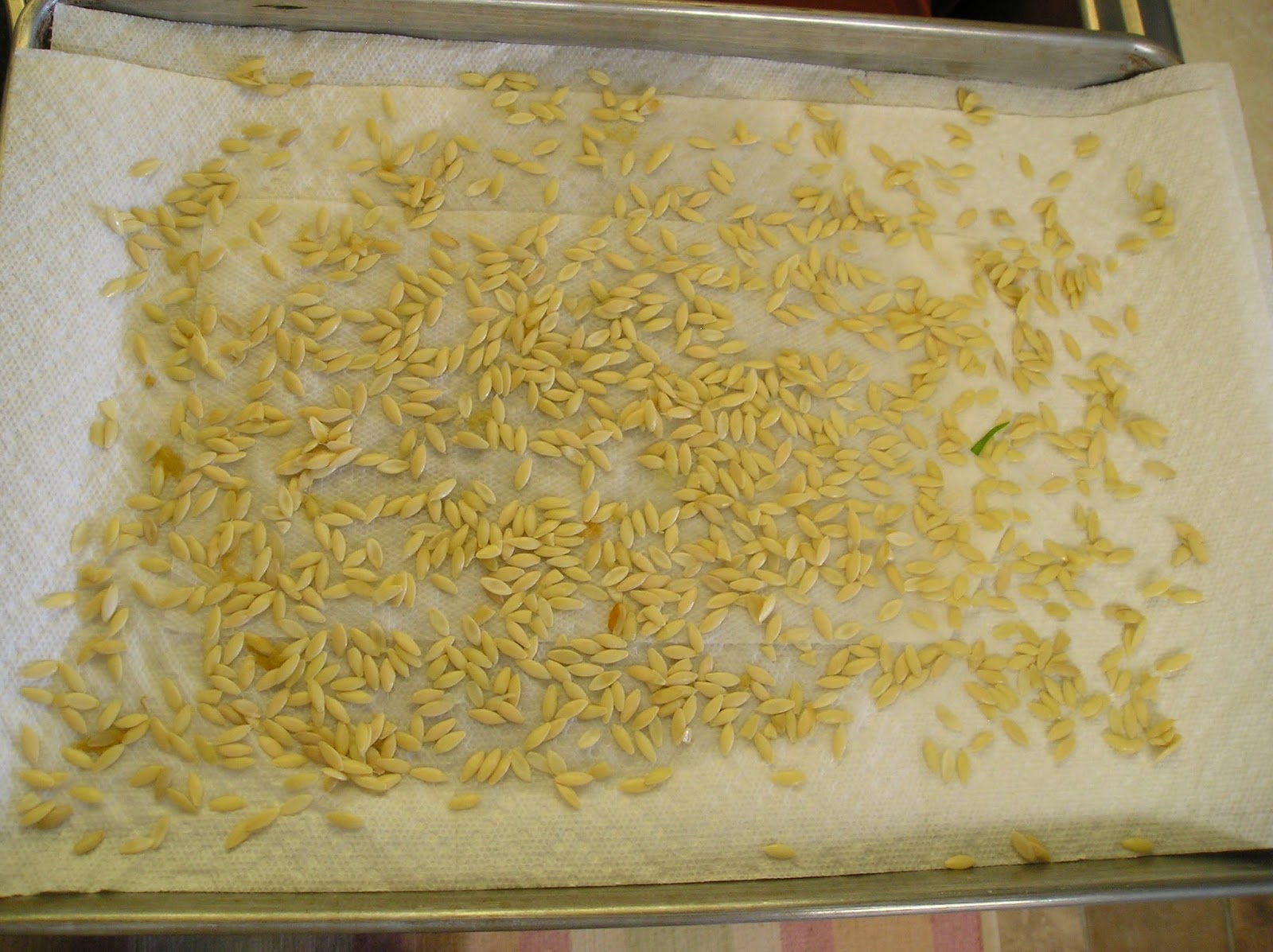
 I poured the seeds onto a few layers of paper
towels to absorb most of the moisture before spreading them out on a
cookie sheet to dry.
We have also saved some purple hull pea seeds along the way. We let them mature, shell them and put them in this bowl to dry. I shake them around a few times each day as I walk by.
 We didn't save any corn seed this year because we planted two varieties together which would cross pollinate, making the seed not reliable for replanting. We wanted to use up the last of our oldest seed, but it wasn't enough, so we added another kind to the patch.
We went flower seed picking a few days ago. We had many, many zinnia volunteers come up this year in the garden which was wonderful. The hummingbirds love them and they help deter destructive insect pests. We have also planted more zinnias and marigolds this year throughout the garden. I hope we have many more volunteers next year. But to supplement them we are harvesting some seeds along the way.
Another first this year is sunflowers. You know those beautiful pictures you see of sunflowers lining someone's garden fence? I have always wanted to try growing them, but have never taken the time. Well, this year I poked a few seeds in the ground here and there in the garden, and you know what? They grew! And they are beautiful! Then one day I walked by and looked at some of them and they were dead. I wondered what was wrong until I tilted
the flower head up and saw sunflower seeds. Well, that is what they are supposed to do, right? That was a very fun discovery. So now I have 3 seed heads drying. Life is so great and rewarding!
We plan to save more seeds this summer, so we will keep you posted. We do this because there might come a day when we can't get any more seeds. What are you saving this year?
Until next time - Fern
Hello, Frank here.
Let's talk about scanners. Back a few years ago, there was only one type of scanner - the type you set on your desk at home. Then with the mobility of man, and wanting to spend time in his car, mobile scanners came along. As technology improved, and electronic parts kept getting smaller and smaller, they developed a scanner you can carry around in your hand - a handheld scanner.
Scanners are for listening only. So it is okay to listen to aircraft
landing, because you don't have to worry about sitting on a microphone. These are sometimes called police scanners, but actually that refers to any scanner. You can use these radios to listen to aircraft, police, fire, rescue, VHF/UHF ham frequencies, heaven forbid, I almost forgot NASCAR. You can listen to GMRS, FRS, MURS and of course, the weather frequencies. Some scanners are S.A.M.E. capable. Some scanners will receive local AM/FM commercial radio. Some will cover the CB frequencies, 26-27 MHz. Some will tell you your GPS location.
So, what do you want a scanner for? Most people use a scanner to listen to police and fire calls, monitor a few local VHF ham radio repeaters, that kind of thing. But mostly police, fire and ambulance.
A legal issue here. I have read in some states it is illegal to have a scanner in your vehicle. This is something you need to check out. Here where I live, we don't have those kind of laws. So if you want to put a scanner in your vehicle, know what you are doing. Ignorance of the law is no excuse.
If you want to put a scanner in your house, most come with a little plug-in antenna that sticks in the back. Most base stations come with a power connection for AC. That's all you need. If you live a distance away from a city, you might want to put an external antenna up. A basic discone antenna works fine.
Remember, this is receive only. This will also work pretty good for FM radio reception and your weather alert radio. Some discone antennas you can even transmit on, but that is a different story.
Some base station radios are conveniently powered by 12 volts DC. If
you have a 12 volt power system, or if you are already operating off of
a 30 amp 12 volt power supply, or if you are lucky enough to have a 12 volt
solar system, then you have power for your base station scanner and hopefully every radio that you power. Discone, power supply, radio - you can listen to just
about anything you want to listen to that is above about 27 MHz. So this
antenna does not service shortwave or HF ham frequencies.
 A mobile scanner is made to operate in your vehicle. Again, you will need a power supply. If you install it in your car, you have a 12 volt supply. If you put it in your house then you will need to have a power supply. A magnet mount antenna is what most folks use for a mobile scanner in their vehicle. If you choose to use this radio in your home, then the above mentioned discone antenna will work fine.
Handheld scanners are fairly popular now days. Most of them will scan frequencies from 30 MHz upward, which leaves out the CB frequencies.
A lot of people use these scanners in their automobiles in place of a mobile and they use a device that holds a cell phone so they can see it readily. Some people use these at home also instead of a base radio. A difference here, though, is that few handheld scanners use 12 volt power. Some are 9 volt, some are 6 volt, but most will come with the appropriate adapter that plugs into an AC power supply or regular wall outlet. So, for mobile, home use or handheld use, the handheld radio will do the job for any situation. You can still hook it up to an outside antenna, whether mobile or base. But the power supply for mobile becomes a little more tricky.
Some but not all handhelds, operate off of AA or AAA batteries. If it does operate off of batteries, then great, you can just change out the batteries when you need fresh power. Some you can recharge rechargeable batteries in from the power supply, so when you disconnect from your AC source, you will always have charged batteries. Newer handhelds are also powered by a USB connection from your computer or a cigar type plug-in that will attach to your automobile power port. Then you can power your radio with the USB connection from your automobile power port. Many newer vehicles have a USB port as part of the power supply. This power coming from your USB is either 5 VDC or 5.5 VDC, either one will work to power these scanners. In some of these scanners you can insert AA or AAA rechargeable batteries and they will recharge via the USB power connection.
A side note here. I have recently added USB connections to my 12 volt power supply. This way I can charge my cell phone, or a cell phone headset and a couple of my new battery operated lanterns. It's always good to upgrade.
Now, something we have not talked about before. Adapters and connectors. My weather radio and my old scanner both use a RCA type connector for the external antenna. My newer old scanner uses
a BNC connector for the external antenna. Sometimes you are going
to need to connect a PL259 plug to an RCA connector, so the antenna signal will be compatible with your radio connector. I have included a link that has all kinds of adapters and connectors. Don't be intimidated by it. It's just adapts a square peg so it will fit into a round hole. This page is a great page. I would bookmark it.
But a little bit of teaching here. An RCA plug is the type of plug that you use to connect your stereo together. Your F adapter is what your cable TV comes in with. Don't let this get to you. It's just one more step in the educational process. When you are looking at these scanners and you go to the sites and you're trying to figure out what you want, read the reviews. If you want a scanner that will monitor CB frequencies then your average scanner will not meet your need. If you want one to carry in your shirt pocket, or in your backpack, then a base station or mobile will not work. There is no perfect scanner.
Now. One more issue. A few years ago, police and fire departments started changing to a digital frequency. Some departments have changed, some departments have not. You are going to have to
check with your local emergency office to see whether they broadcast on a digital or analog frequency. Where I live, all signals are analog. So, about any scanner would work just fine. Some towns have gone to all digital. An analog scanner will NOT receive digital signals. This is not the same as when TV signals went digital a few years ago. They are not related. Where I live nobody uses digital, but some places do. Also look for this when you are considering a scanner. I've included two articles on analog and digital. In most cases an analog scanner will do you fine. But in some cases it won't.
Some of the digital scanners, and for that matter, analog scanners, are very difficult to program. I have a base station scanner that I thought was difficult to program until I bought a Uniden handheld scanner that I now never use. It's one of those cases, that if you don't use it on a regular, regular basis, you will not know how to operate it. And I bought two of those cute little handhelds that I never use, because they are too difficult for me to operate. But for the right person, they would be excellent scanners.
Play around. Look around. You will see that many of the things you have learned before are coming into shape. Antennas, power supplies, connectors, adapters - some are just for fun, some are life saving. This is all part of communication.
We'll talk more later. 73, Frank