As spring has come on, I've been thinking more and more about being able to grow natural wormer for our goats. For now, we still administer Fenbendazole (Safeguard) and Cydectin, and since it's been an exceptionally wet spring, we have prime conditions for a heavy worm infestation. We allow a five day withdrawal period before we keep any milk for human consumption, but we do continue to milk, then feed it to the cats, dog and chickens. I didn't want to experiment with all natural wormers only to have the goats become ill from worms, so this year we're doing both.
The Complete Herbal Handbook for Farm and Stable by Juliette di Bairacli Levy is an amazing source of information if you want to learn how to treat most farm animal ailments naturally. I have spent much time reading and re-reading about many different herbs and plants, especially pertaining to worms. I would highly recommend this book if you are interested in herbal remedies for farm animals. As I read through this book, I began making lists of plants that are good for goats.
This little notebook contains the beginnings of my
research, with ideas for several categories including: plants for feed,
plants for overall health, plants for worms and plants to increase milk
production.
 Now as I head out in the morning to do the chores, not only do I take a bucket to pick slugs and weeds from the garden for the chickens, I take a bucket for some goat pickings as well. The amount and variety of things I pick has grown since I took this picture, but it gives you an idea. Here is a tour of my morning wanderings as I pick for the goats.
 I usually start off with comfrey, with anywhere from three to five leaves per goat each day. I am having to limit how much I pick for now until the plants are really at full production. Because of that, the chickens don't get comfrey very often for now. Comfrey is a highly nutritious fodder plant for animals of all kinds.
 Once the cabbage plants got big enough, I started picking leaves from the Michilli cabbage for the goats. It's a very good source of sulfur and other vitamins. It turns out cabbage is good for lice, as well. Each time I introduce something new, it may take the goats a day or two to get used to it, cabbage was one of those things, but now they really like it.
I have also started including a few mustard leaves in the last few days, which helps to expel worms. Some of the goats seem to really like them, but some of them don't. It's always interesting to see how they will react.
Once the cabbage plants got big enough, I started picking leaves from the Michilli cabbage for the goats. It's a very good source of sulfur and other vitamins. It turns out cabbage is good for lice, as well. Each time I introduce something new, it may take the goats a day or two to get used to it, cabbage was one of those things, but now they really like it.
I have also started including a few mustard leaves in the last few days, which helps to expel worms. Some of the goats seem to really like them, but some of them don't. It's always interesting to see how they will react.
 Next to the mustard is the dandelion patch. I always try to have at least a handful of leaves for each animal. Dandelion leaves are good for overall health as well as expelling worms.
 I usually alternate between lemon balm and marjoram, which are both good for overall health. I want the plants to continue developing well for our own use, so the goats only get a few sprigs. They probably wouldn't eat much more than that anyway. It's part of the browsing nature of a goat.
 Next comes garlic leaves which are high in sulfur and is an effective worm deterent. The goats won't eat much, but they will eat some. I have started to include just a little each day. Behind the garlic is a patch of honeysuckle.
I have a couple of healthy chive plants that I have started picking small handfuls from as well. They are also effective against worms.
Next comes garlic leaves which are high in sulfur and is an effective worm deterent. The goats won't eat much, but they will eat some. I have started to include just a little each day. Behind the garlic is a patch of honeysuckle.
I have a couple of healthy chive plants that I have started picking small handfuls from as well. They are also effective against worms.
 |
| Honeysuckle |
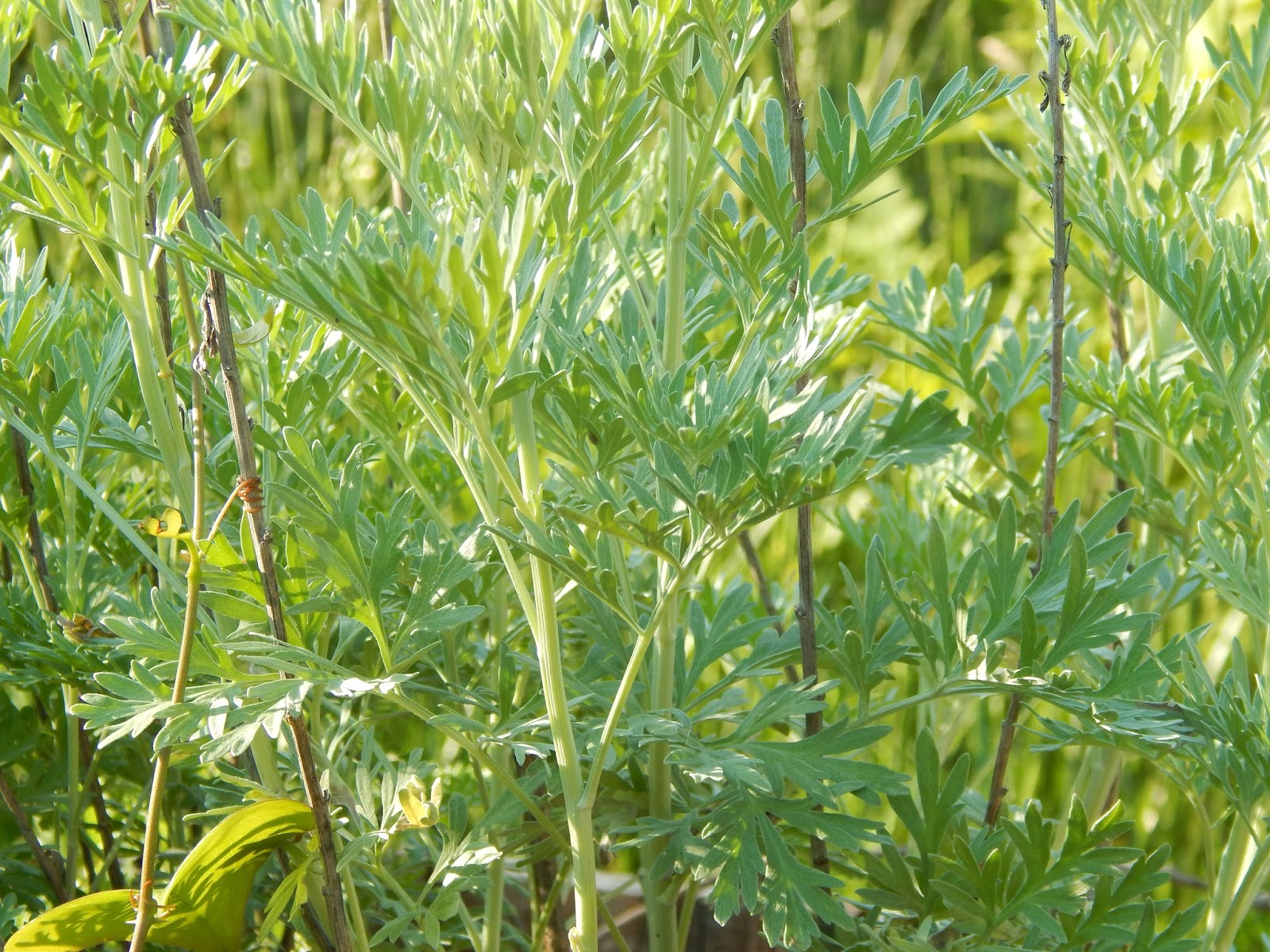
On Saturdays, I also pick a big handful of honeysuckle along with around four or five wormwood leaves for each goat. These two plants are especially good for expelling worms. One thing I have observed that I find to be very interesting is how the goats choose to consume them, or not. I have found that if I walk out into the barn with a large handful of honeysuckle vines, the does will gather around and heartily begin to strip the leaves from the vines. Until they are finished. Not until the leaves are gone, but until they are finished. My theory is, once a goat has eaten enough of a certain plant, they stop. Too much is not a good thing. And enough for one goat, may not be enough for another. They each stop eating the honeysuckle at their own timing. And the wormwood? Sometimes they will eat it and sometimes they won't. Last week I wormed One Stripe and Copper with the commercial wormers on a Monday. Saturday when I brought up the honeysuckle and wormwood, neither one of them would eat them, even though they always did on the preceding days I had brought them. As I wondered why, I realized that they didn't need the plants because I had just recently wormed them. Interesting, huh? Since tomorrow is Saturday, one week later, it will be interesting to see if they will eat these two plants tomorrow.
 I started this wormwood from seed several years ago in this large wooden barrel. Now that I know it will continue to grow and have started using it, it's time to move it back into the fringes of the herb bed. Many other plants don't get along with wormwood too well, so it will be out on the edge of the bed next to the camphor wormwood I planted last year. It really does smell like camphor, and I haven't quite decided what I would like to make out of it. I don't use the camphor for the goats, though.
 Since I recently read that blackberry leaves are good for goat feed, I stop at this patch of wild berries on the way to the barn and add a good handful of leaves to my bucket.
Last week when the vet came to disbud our youngest baby goats, we found out they had lice. As far as I know, we have never had a lice problem on our goats before. The vet said our extremely wet spring has created prime conditions for lice. I got out my Herbal Handbook again and looked up lice. It turns out that sulfur is a good natural remedy and you can add a teaspoon of sulfur to the goat feed. Well, that wouldn't work for the young babies that needed treating, so we put a little Sevin dust on them, and the teenage goats that are being weaned. But I needed a natural remedy for the does I am milking. It turns out garlic and cabbage contain sulfur. I was already feeding the cabbage leaves, so I increased the amount each doe was getting. That's when I added in the garlic leaves. They ate more of them the first day, but since then, they will only eat a limited amount. But so far, I haven't seen any lice on the does, so I hope this works.
Since I recently read that blackberry leaves are good for goat feed, I stop at this patch of wild berries on the way to the barn and add a good handful of leaves to my bucket.
Last week when the vet came to disbud our youngest baby goats, we found out they had lice. As far as I know, we have never had a lice problem on our goats before. The vet said our extremely wet spring has created prime conditions for lice. I got out my Herbal Handbook again and looked up lice. It turns out that sulfur is a good natural remedy and you can add a teaspoon of sulfur to the goat feed. Well, that wouldn't work for the young babies that needed treating, so we put a little Sevin dust on them, and the teenage goats that are being weaned. But I needed a natural remedy for the does I am milking. It turns out garlic and cabbage contain sulfur. I was already feeding the cabbage leaves, so I increased the amount each doe was getting. That's when I added in the garlic leaves. They ate more of them the first day, but since then, they will only eat a limited amount. But so far, I haven't seen any lice on the does, so I hope this works.

So what do I do with all of these leaves? I dump my bucket on top of the big round bale of hay by the milk stand and sort everything out. I want to make sure each doe gets a portion of the harvest I have brought. And I only do this for the does I am milking, not the babies or the billy and wethers. As each doe comes to the milk stand, I give them their grain ration, then pile all of the leaves I have brought right on top of it. At first they seemed to be a little irritated with me, but now they just dig around the leaves, eat their grain, then usually have the leaves for desert. It's rather comical. But if I took all of these leaves out to the feeder and spread them out for the goats to eat, they would just turn up their noses and go graze in the pasture. I'm not sure why they will eat them from the stand, but not from the feeder. It's like it's a treat or something.

I am hoping that feeding the goats plants that we have growing here will eventually be enough to keep them healthy and somewhat worm free. I don't want to experiment to the detriment of their health, but I do want to try to eliminate the commercial wormers. I know there are companies that sell a natural wormer, but if I am going to change over to natural, I would like to see if growing our own plants will work. Only time will tell. It may take a year or more to really see what the outcome will be. I'll let you know.
For the off season when the plants aren't growing, I plan to dry the herbs. But, with nature, worms generally aren't a problem in the winter months since the worms go dormant, some in the ground, some in the goat. There are other techniques for controlling worms, pasture rotation, short or tall grass and others.
This brings us to another question. If the time comes when we are dependent upon ourselves, and we get worms, will these remedies work on us as well? Many of these plants are a common part of our diet and I have read that wormwood can be used with humans. But that is a whole different research project. Just food, pun intended, for thought.
Until next time - Fern
It appears that this will be the year I get the herb bed really established. I found a new company, Companion Plants, that I really like. They ship a good quality product with reasonable shipping. This means I have added many new plants to my herb bed. This is the beginning of the herb bed I have always dreamed of. I hope in the next few years it will mature and be self-sustaining. We have future plans to increase some of these plants in larger patches in other locations. Here is the tour with a brief description of each.
Comfrey. I had already obtained five new roots, but I added a couple more. Now I have eight established comfrey plants to harvest for animal feed supplement, as well as medicinal uses.
Marshmallow. Tender leaves can be used in spring salads. Roots, flowers, dried or fresh.
Wild yams. Fresh or dried root decoction.
 Camphor wormwood. Insect repellent and animal wormer. It also doesn't get along with other plants very well, so it needs a corner of it's own.
Bergamot (monarda fistulosa) and Bee Balm (monarda didyma). Leaves and flowers, fresh, cooked or dried for tea. Attracts pollinators.
Anise hyssop. Seeds whole or crushed. Leaves for salad
Uva ursi. Leaves, berries for infusions.
Butterflyweed. Just because it's pretty. Attracts pollinators.
Angelica. Roots, stems or leaves, dried or fresh.
English lavender. Flowers and leaves for infusions or oils.
Mexican marigold. Leaves, fresh or dried, flowers for dye.
Wild ginger. Roots, dried or fresh.
Ground nuts (apios americana). Tuber, protein, starch, isoflavones
 The old and new hops now have another permanent home. I had originally put them on the west side of the old shed. When Frank tore it down, I dug up the old plant and put it in a pot on the porch for a while. I ordered two more plants, and now all three are residing on the west side of this shed and doing well. They have been joined by a clematis that needed a new home as well.
Sweet, edible bamboo in it's new location. Some of it died while it was in a pot on the porch during the winter, but it's started sending up new shoots again. This should be a good spot for it to spread and grow.
Our new batch of sun chokes, or Jerusalem artichokes. They are doing very well.
Our old patch of sun chokes are also growing well this year. They need to lose a few weeds and pesky scrub growth, but that will have to wait for another day.
The meadowsweet we planted back in the winter is doing well beside the branch here. I've tried to locate a few companions for this plant, but haven't found any yet. I have some seeds as well, but haven't had the time to start any seedlings lately.
The old and new hops now have another permanent home. I had originally put them on the west side of the old shed. When Frank tore it down, I dug up the old plant and put it in a pot on the porch for a while. I ordered two more plants, and now all three are residing on the west side of this shed and doing well. They have been joined by a clematis that needed a new home as well.
Sweet, edible bamboo in it's new location. Some of it died while it was in a pot on the porch during the winter, but it's started sending up new shoots again. This should be a good spot for it to spread and grow.
Our new batch of sun chokes, or Jerusalem artichokes. They are doing very well.
Our old patch of sun chokes are also growing well this year. They need to lose a few weeds and pesky scrub growth, but that will have to wait for another day.
The meadowsweet we planted back in the winter is doing well beside the branch here. I've tried to locate a few companions for this plant, but haven't found any yet. I have some seeds as well, but haven't had the time to start any seedlings lately.
 Roses. I had some in a pot on the porch for a while, and finally decided where to put them. In the meantime, I found a good sale and ordered more. So far, so good. If they're going to be very picky, they won't make it. Most plants have to be pretty hardy to make it around here. I like to call it loving neglect. I love to have them around, but they have to stand some neglect.
I grow all of these things for specific reasons. If you are interested in any of them, or curious why I grow them, do some research and see what they can be used for. I have spent many hours reading and researching. Some of these plants may never be used for my intended purpose, but they are here if I want them. Using herbs for anything except culinary purposes is frowned upon in many circles. If you choose to use them, research them thoroughly first. Make wise, informed decisions about your own health and the health of your family. Along the way I will share some of the things we are doing, like feeding comfrey to the chickens and goats. The rest is up to you.
Roses. I had some in a pot on the porch for a while, and finally decided where to put them. In the meantime, I found a good sale and ordered more. So far, so good. If they're going to be very picky, they won't make it. Most plants have to be pretty hardy to make it around here. I like to call it loving neglect. I love to have them around, but they have to stand some neglect.
I grow all of these things for specific reasons. If you are interested in any of them, or curious why I grow them, do some research and see what they can be used for. I have spent many hours reading and researching. Some of these plants may never be used for my intended purpose, but they are here if I want them. Using herbs for anything except culinary purposes is frowned upon in many circles. If you choose to use them, research them thoroughly first. Make wise, informed decisions about your own health and the health of your family. Along the way I will share some of the things we are doing, like feeding comfrey to the chickens and goats. The rest is up to you.

There are many different things we can grow that are fairly self-sustaining, even if they are somewhat neglected. We try to find ways to tuck in some plants that will produce in spite of us. They may provide a source of food, nutrients and/or possible medicine if the time comes that they are needed. And besides all that, it makes for another spot of beauty that surrounds us. Learn about and work at whatever needs doing around your place. It is time that is never wasted.
Until next time - Fern
We want to introduce you to our new buck, Bill E Goat. Get it? I'm sorry, but we love to laugh and this is just one of those moments. But, really, his name is Bill.
After we read about the goat, we made contact with the folks that had him. These folks are very privacy oriented, as are we, so we met them at a big box hardware store a couple of hours away from our house. It sounds like something out of a spy novel, doesn't it? But, we respect people's privacy, and we're glad when people respect ours. They were nice folks and we appreciate their willingness to meet us and save us a few miles.
When we bring a new animal to our place they spend the first week in isolation. This is accomplished in our stock trailer, which is very convenient. We pull it into the barn to provide shade, protection from weather and have the new animal in close proximity to the herd.
Bill was not very happy to be alone for the first two nights. The second day he was here we wormed him with Cydectin, then the third day we used Safeguard which is fenbendazole. At this time, we are still using chemical wormers for the goats. We don't use them very often, usually no more than twice a year, and some day we hope to eliminate them altogether. We have honeysuckle, wormwood and garlic growing which will deter or cause worms to expel from the goats, but haven't learned enough to use them effectively yet. The key word there is yet. That will come in time.

The third evening Bill was joined in the stock trailer by One Stripe's two adopted nine week old boys, which began their weaning process. Now we had three crying babies in the trailer. But at least Bill had company now. We continued to watch Bill for any signs of ill health. The previous owners provided us with a bag of feed for him. We gradually used this up while getting him accustomed to our feed ration. He had a good appetite for the hay, grain and water we gave him and appears to be a strong, healthy animal.

One week later, Bill and the boys joined the older wethers out in the 'boys' pasture. Bill seems small now, but we expect him to grow and fill out quickly since he is already four months old. We will feed him, and the other boys, everyday for a while. Bill's first breeding duties will come about mid June when we plan to breed One Stripe. We would like for her to have babies about Thanksgiving to keep us in milk through the winter. We will breed the other does around November 1st for April babies next spring. So Bill will not be full grown before he will be put to work. He still calls for his mom and his old herd sometimes, but he is enjoying all of the new growth of the pasture. He should work out just fine.
Until next time - Fern


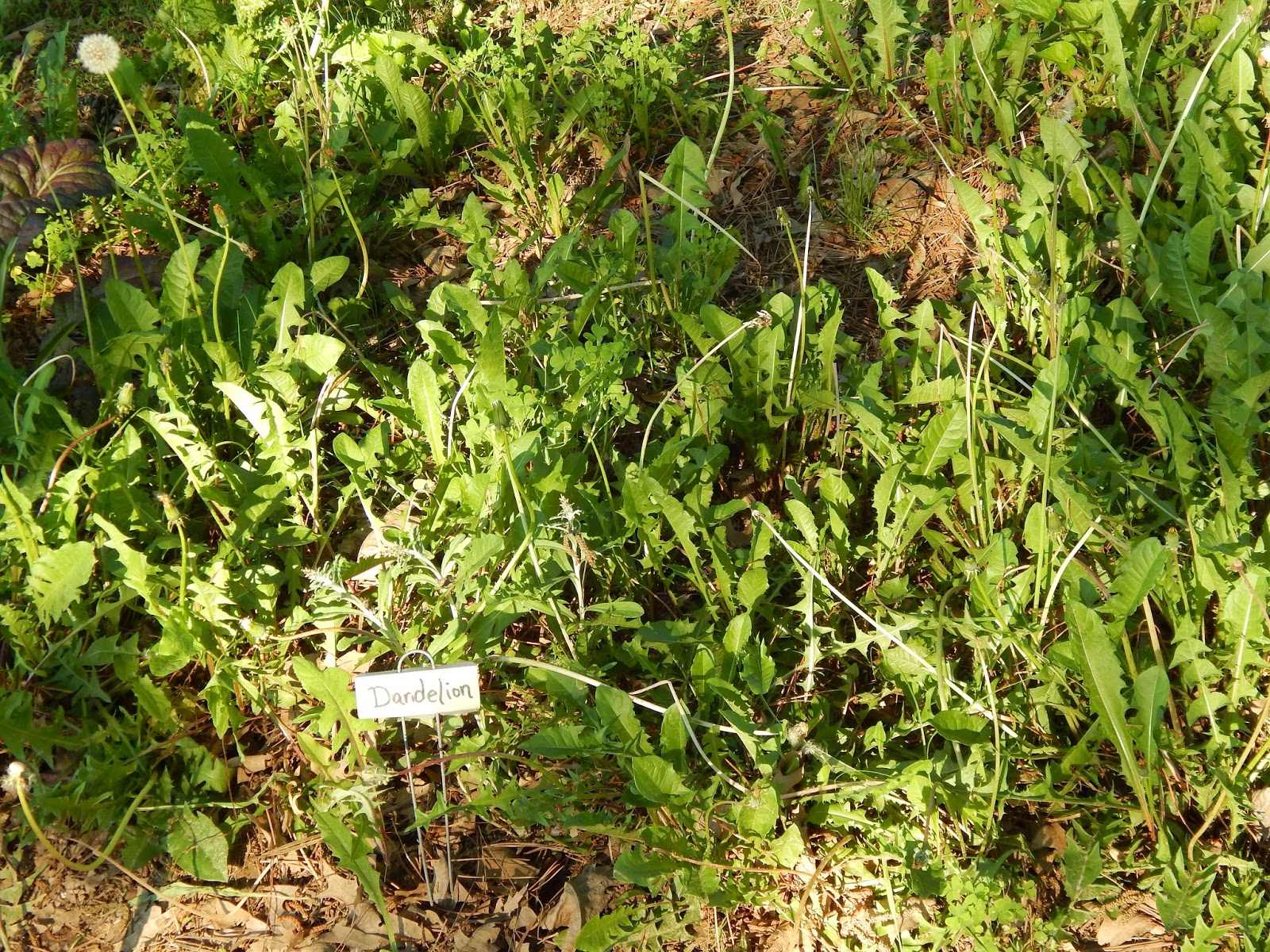 Next to the mustard is the dandelion patch. I always try to have at least a handful of leaves for each animal. Dandelion leaves are good for overall health as well as expelling worms.