The Road Home

The Road Home
There is no place like home.
Showing posts with label iodine. Show all posts

Monday, February 9, 2015

Meet Patch, And More Goat Lore

We had a very pleasant surprise yesterday! One Stripe had lively, healthy twins. We had a little concern, since according to my records 150 days of her gestation would fall on Tuesday, February 9th. Most goat books I have read indicate that kidding before the 150th day can mean there is a problem, unless the doe has triplets or quadruplets. As I posted before, One Stripe had attained her classic waddle, but remained very healthy and active, to the point of still trying to trot, she was too big to run, in from the pasture when I showed up at the barn.


Friday night when we went up to feed, everything was normal. One Stripe came into the barn and got up on the milk stand to eat. Saturday morning, she came into the barn, put her front feet up on the blocks to get on the milk stand, then just stopped and looked at me. She obviously wanted to eat, but wouldn't attempt to go any further. After a little coaxing, I realized something was up, but I figured she was just getting too heavy, so I put her feed in a bowl on the floor and she ate just fine. But, after I turned her out I realized her walk had changed. She didn't go far before stopping and it appeared that one of the babies had moved back to the point One Stripe almost had to swing her back legs out and around the baby just to take a step. It now took her much longer just to go out to the pasture, with many stops, and she no longer kept up with the herd. I hoped this wasn't an indication of pre-delivery problems.


After watching her for a bit, I radioed Frank to tell him we needed to get the birthing pens set up and ready, that we might be having babies today (Saturday) instead of Tuesday like predicted. So, we got in gear, cleaned out the barn and got everything set up. We put hay in the back of the pens, so the does wouldn't stick their heads through to eat it, washed out the water buckets and checked the tote with the birthing supplies one more time. Then I went out in the pasture to bring in the girls. It took One Stripe about 10 minutes, with many stops, to walk the distance she usually covers in less than a minute. She didn't appear to be sick or stressed accept that she didn't take too many steps before pausing for a break, some longer than others.


When we got to the barn and I opened the gate to her birthing pen, she just walked right in, right at home. This has been her routine for the last six years, so she knows what is going on and is very comfortable there. That is very nice. No stress for her, no having to make her go in, no hollering for the other goats, just peaceful readiness for babies. By the way, the other does that fought tooth and nail against going in and bellowed from the time they were put in, have gone on to other pastures. That is part of the way we maintain a calm, peaceful, easy-to-handle herd. It is part of breeding in the characteristics of what we want in a goat, or cat, or dog, or chicken. We only keep those animals that meet our requirements, and One Stripe is an excellent example of a great goat.

 
Saturday night came and went with no babies, which was good. That would be day number 147 in my books, and just too early. Then came Sunday, day number 148. After her breakfast, I let One Stripe out of the pen for a bit, and pulled up a chair. She didn't go far at all, just across the barn and back. I could tell by how hollow her hips and tailbone were, along with a very small amount of discharge, that this would be the day for babies. But since it was only day number 148, I wondered if she would have triplets. It also occurred to me that if I had caught her breeding activity at the end of her 24 hour standing heat cycle, that my estimation could be about 24 hours off, which would put her at 149 days, but still a day early. The other factor is One Stripe's age. She will be seven in May, which is older for a breeding, producing doe. Most folks would have already sold her off as an older doe. But, for those of you that haven't read about my plans for One Stripe already, she will be staying here all the days of her life. She is one of those special goats that is calm and gentle, a great mom, a good milker, and has stole my heart. I can't claim that with any of the others, but I can with her. So, here she stays, all of her days.


One Stripe was nice enough to have her babies in the middle of the afternoon, on a sunny, 75* February day. It was short sleeve weather with no worries about cold babies, a picture perfect day. We have two friends that are interested in goats and the birthing process that I contacted when I knew for sure we had babies coming. Faith [a pseudonym] arrived in time to see the second baby born. She is hoping to buy Penny after her kids are born and I train her to milk, so she is wanting all the firsthand experiences she can get under her belt before she takes her first goat home. After the kids were born Grace [another pseudonym] and her husband came over to see them. So we ended up with a barn full of talking a laughter. Another plus on this fine February day. Plus, Frank and I got to share some of our experience and knowledge which we always enjoy. One Stripe had no difficulty birthing at all. Just like always. She started 'talking' to her stomach after a while, like she was telling the babies to hurry up and come out. That made me laugh.

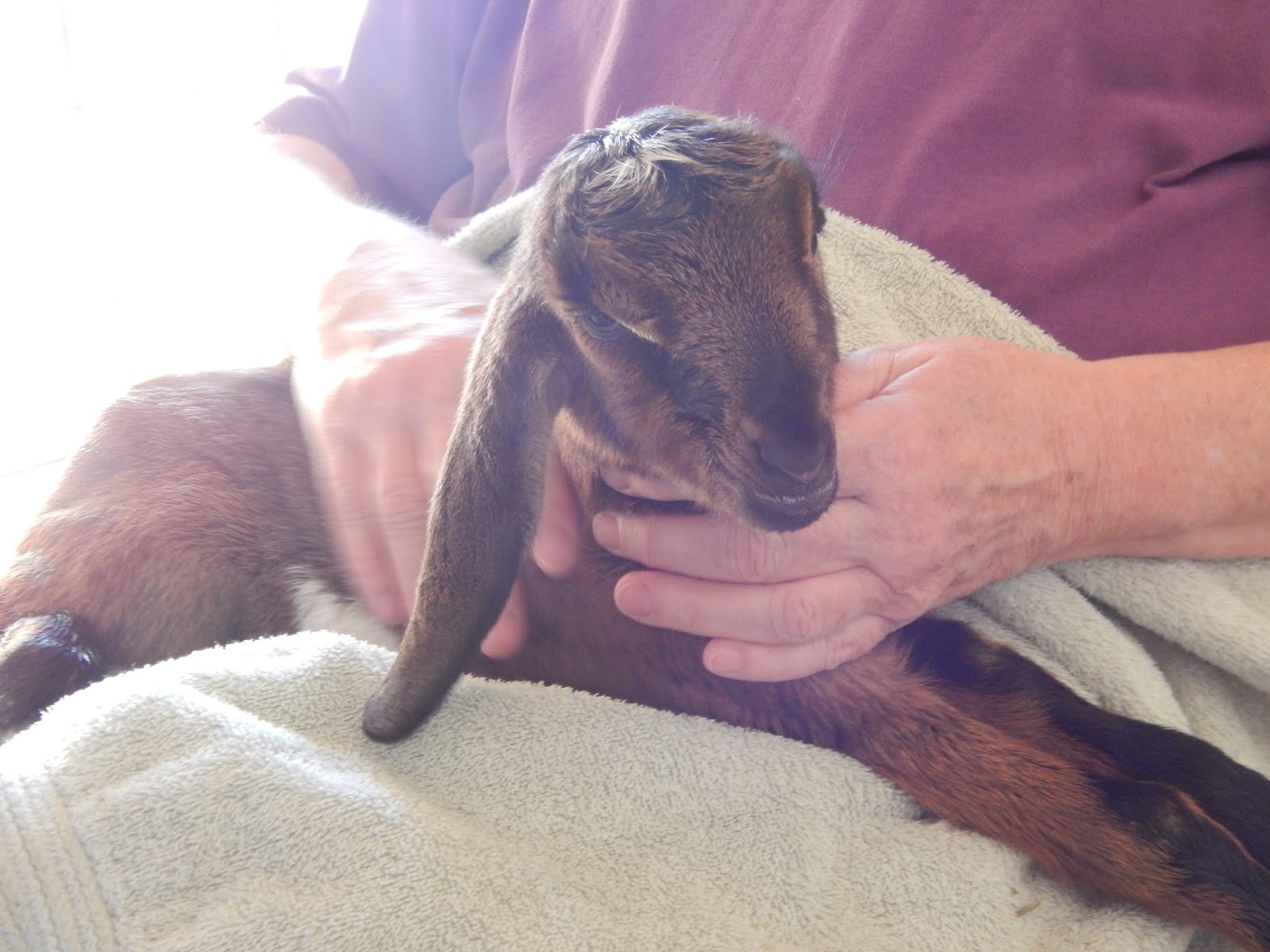
Patch was born first in the classic, front feet, nose, head position. In less than two hours, Patch was trying to jump around, like baby goats do. But then she would fall over, making me laugh. That is when Grace told me that Frank and I have a great life. She is right. It is a great life, and we are very blessed. Patch is a very active, vigorous baby girl, with beautiful dark brown ears, which Frank likes. We may just have to keep her.


Breakfast, yes, we named her brother breakfast because that is what he will be, was born back feet first. When the amniotic sack appeared and stayed unbroken, I thought something looked odd and kept trying to see if the head was following the feet. It didn't take long for him to be born, and my only concern was that final push or two when most of his body was out, but his head was not. I wanted to make sure he was out and able to breathe well. But he came out fine and all was well.


When the kids are born, if I get to be there, I swipe the mucous from their mouths so they can start coughing and breathing well. Depending on the temperature, I may dry them off some with a towel. Since the weather was so nice yesterday, I didn't dry them, but left them to their mother's attention. Another huge benefit of having tame, easy to handle animals is that they don't mind having you in the birthing pen with them when the time comes. We have had does that ran to the back of the pen like cornered animals, or does that tried to ram and run out of the gate when I went in, especially first fresheners. We did not keep them. It makes it much harder to help the kids if they need it or make sure they are nursing. It also makes for wilder kids that are difficult to handle as well.


It wasn't long before both kids were dry and fed. We clipped their umbilical cords and applied a strong 7% iodine to cauterize and sterilize them. While all of this was going on, Faith described markings on the first baby, a girl, and said something like, "That white square looks like a patch. That would make a good name." And it stuck. So, meet Patch.


Upon discovering the second kid was a boy, Frank said to Faith, "His name is Breakfast." We have a running joke that all bucks born here have the name of Breakfast, Lunch or Dinner. Some folks think that's funny and some don't, but all males born here are destined to be meat for our table, unless by chance, someone comes by that needs a new billy goat. But that doesn't happen very often. We had chevron patties for supper last night, but it wasn't Breakfast. It tastes great.

Faith and Patch


I milked out about a quart of colostrum from One Stripe last night. It makes it easier for the babies to nurse, and begins the stimulation for One Stripe to produce more milk. This morning I brought her in on the milk stand to eat. It gives her some movement, lets her eat in a normal location, and makes it much easier for me to milk her, sitting in a chair instead of kneeling in a crowded birthing pen.
 
Copper with her ears out

It was a great day. Easy birth, great weather, good company and beautiful babies. It doesn't always go that way, and since One Stripe aborted last year, she had many prayers for a successful pregnancy this year. Now, to wait a few more days for Copper to kid. Yesterday afternoon as she lay out in the corral, I noticed her ears were out. That is usually a sign of listening, but at this stage, it is also a sign of discomfort. According to my records she will reach 150 days on Wednesday, two days from now. But we watched her closely because we have had does go into labor right after another one gave birth. Something about the sight, sounds and smells of birth can bring on labor in another animal that is close to her due date. For the farmer it can mean turning around to help another goat for a few hours, just when you thought you were finished for the day. We had that happen once about 10:30 at night. Just finishing up and making sure babies and mother were all settled and doing well, only to realize the goat in the next pen was laying down pushing. That was a long night indeed.

One Stripe is doing great this morning.

This morning Copper hasn't shown any signs of birthing. But the day is young, we will see what it brings. Today is forecast to be sunny, 65* and light winds. Another great day to have more baby goats. But then, for me, just about any day is another great day to have baby goats.

Good morning, Breakfast.

Good morning, Patch.

We look forward to having some fresh milk in a few days. We will wait until Friday to start keeping the milk for ourselves. In the meantime, I will be milking One Stripe, and Copper after she kids, twice a day. This milk will go to the chickens, cats and dog. Later on when Cricket, Lady Bug and Penny birth and I am training them to be milkers, we hope to have some pigs that can benefit from some extra milk as well. By then the garden will be half planted and spring will be well on the way. The seasons change, and this time of year brings new life on the homestead and blessings to our lives.

Until next time - Fern

Tuesday, January 21, 2014

A Strange Goat Abscess

A few days ago I noticed this lumpy place on Copper's side. The odd thing about it was the location. It was on her right side toward her back leg. I decided to watch it for a few days. My concern was that she is due to kid March 7th and I wondered if this could be a hernia or something that would be affected by her pregnancy or the process of kidding.


After a few days we realized it wasn't going away, in fact the lumps appeared to be getting harder. We didn't want to take any chances, so we called our vet. And since we didn't want to transport her this close to kidding, we asked him to come out. This is a more expensive endeavor, since we have to pay mileage, but we felt it was necessary this time.


When he arrived and examined her, he ruled out any herniation because he could pull the lumps out away from the muscles of her body cavity and surround them with his fingers. Thank goodness. Next, he got out his portable ultra sound. I'm sorry, I didn't get any pictures, I was too busy watching. I did ask his permission to take these pictures. The ultra sound was interesting. He thought the image displayed looked like an abscess so his next step was to see what would happen when he poked it with a syringe. He poked around on it for a while, but couldn't pull anything out of it. But after he took the needle out and squirted the syringe, out came the characteristic pus that comes from an abscess. He wanted to make sure that was what it was before he lanced the lumps.


For some of the other abscesses our goat occasionally get, we usually let them come to a head and start to crack open on their own. This is shown in another post here. This time, due to the location and the timing of Copper's pregnancy, we wanted these abscesses, there were two right next to each other, dealt with now so they could heal before she goes into labor. We felt she had gotten into some of the thorny bushes we have growing around here and poked herself a couple of times, causing these abscesses.


She wasn't real happy about this process. We put her up on the milk stand to make it easier for us to work and to distract her with a little grain. First the doc swabbed her side with alcohol swabs and iodine scrub, which is about 3% strength.


Then he lanced the abscesses open and began to squeeze out the pus.


He continued to work on them until he felt like he had most of the pus out.


Then he used a hemostat to pull out some of the skin that formed the pocket around the abscess. He called this the plug and described it as the skin that encases the abscess, walling it off from the tissue around it. He said if you can puncture, or pull out this plug then the body is able to quickly heal itself. After he finished cleaning out the abscess he infused it with a cephalosporin antibiotic, gave Copper an antibiotic shot and a shot to deal with pain and swelling, insuring me that none of this would harm her babies. 


We consider this another investment in our learning process. I told Frank, sometimes you have to pay to go to school. This was one of those cases. And, of course, while the vet was here we had a nice visit about a variety of other things that we can add to our arsenal of knowledge. Every little bit helps and you never know when it will come in handy. Take advantage of every learning opportunity that comes your way, even if it involves pus and scalpels. Sometimes these lessons present themselves in unexpected ways. Learn all you can, everyday, in every way.


Until next time - Fern 


Wednesday, November 27, 2013

Preparing For Baby Goats

Your goat is getting bigger and bigger and bigger everyday. She looks like she is just about to pop and waddles worse than a duck. When she lays down she makes these strange little sounds because she is so full of kids, it's hard to breathe. She is obviously ready to be done with it all. Are you?


This is another take on being prepared. When you sign on to be the steward of other living things you accept the responsibilities that come with it. This is also another instance of there are just about as many ways to take care of animals as there are people.

The first time your goats kid, you will be nervous and worried. Actually, you will be a little nervous and worried every time. Isn't that encouraging?? Even when you have a proven doe that has easy births and is a great mom, you still want everything to go just right. The vast majority of the time it does. But not always. I have learned to pull kids that are not making it out on their own, usually because more than one is trying to be born at once. I really hope that doesn't happen this year, but if it does we will try to get some pictures. It is a rather busy time with all hands on deck, but maybe we can...if it happens....which I hope it doesn't.


One of the first things I always do is get out my goat books and read about kidding. Really, no kidding (sorry, I just couldn't resist). I read all of these books over and over, every year. I always find it interesting that all authors don't agree on everything. And then sometimes on some points, I don't agree with any of them. That goes back to the different ways people do things. There is always something to be learned from others, some things I don't want to do and some things are very valuable to know.

I used to take just about everything I thought I might need to the barn when I was expecting kids. Now, I take what I know I will always need. If there is something else that is needed there will be time to get it and bring it to the barn later.


Here is my tote and the extra towels I keep in the barn. They are dirty and the tote has extra stuff in it I don't need. Since One Stripe will be kidding soon, it's time to get things in order.


I brought the fly spray we use on the dog to the house so it won't freeze. We won't be needing it for a while. We also have a mixture of 1 part Betadine to 2 parts water in this old Ivory Liquid bottle. We used it on some hot spots the dog had in the summer. It could come in handy for disinfecting my hands if I need to pull any kids.


I always keep some strong 7% Iodine on hand in the barn for all kinds of things, like spraying hooves if I trim them too short. It is the type of iodine needed to put on the kid's umbilical cords shortly after birth. It is very strong and will close off the cord and prevent bacteria and germs from entering the newborn. This is not the type of iodine you use on many things. It is very strong and not appropriate for regular wounds, yet we have been known to spray it on minor cuts we get while working in the barn. It will cauterize according to the vet. Mineral oil is kept in the birthing tote in case I have to pull or rearrange the kids during birth. I use it to lubricate my hands.

We keep a few syringes and needles in marked ziplock bags in this tote. There is also a medicine dropper. It works great for dribbling colostrum into the mouths of weak newborn kids. We will need the scissors to cut the umbilical cords.

We get the vast majority of our animal supplies from Jeffer's Livestock and Pet online. They carry everything from animal wormer (dog, cats, chickens, goats, etc.), Pick No More for chickens, needles, syringes, pet vitamins, electrolytes we use for baby chicks, antibiotics and most everything you would use for pets and livestock. We have used them for a long time.


The tote itself is a dirty mess. It has a fine coating of 'barn dust', better known as pulverized goat poop on it, and needs a good washing.


Since it's a cold day outside, I chose to wash it out in the bathtub. Isn't nice, hot running water great?


There. Clean and packed with the normal necessities for a regular, run-of-the-mill birth: mineral oil, iodine, betadine solution, scissors, syringes, medicine dropper and old towels. I just hope I'm there when it happens. I really like to see the whole process. I set up my chair in the peanut gallery and talk to the does and the dog and the cats and anyone that happens to come visit. Most folks don't find sitting in a cold barn watching goats being born very exciting or entertaining, but I do. I'll keep you posted.


Until next time - Fern

Wednesday, November 20, 2013

Hoof Trimming 101

Keeping the hooves on our goats trimmed is one thing I do very poorly. It doesn't get done near often enough. We have never had a case of hoof rot, but our goats would be much better off if their hooves were trimmed more often. Then again, so would I, because by the time I get around to it, it wouldn't be such a chore. That being said, here is a hoof trimming session.


I started off with One Stripe because she will be kidding sometime in the next month, or so my guess-timate says.


To trim the hooves, I bring the doe to the milk stand. This elevates the animal so I don't have to kneel down to reach their hooves. It also gives them a familiar place and some food to distract them while I work. Some of our does don't mind this as much as others. The first time I trimmed Copper's hooves she cried the whole time like I was torturing her. It was so loud, it was almost funny.


In the past, we have used bypass pruning shears for this job. They work pretty well and aren't near as dangerous as regular hoof shears. I have difficulty holding them at the right angle to get a good cut, but it can be done quite successfully.


Last year I bought some regular hoof shears. The first time I used them I thought they worked great! That is until I got to the last foot. The goat jerked her foot away, which they always do, and I cut my finger deeply. So much for that. I haven't used them since....until today. Needless to say, these shears work exceptionally well, but you have to be extremely careful or you will end up with a serious injury.


If you are learning how to trim hooves the best thing you can do is find someone to teach you. Books are great and have some good drawings in them, but it is hard to get a feel for what you should do without watching it. You need to see what a hoof should look like after it is trimmed. This will give you something to shoot for. The base of the hoof should end up parallel with the top of the hoof where the hair starts, not slanted down at the front or curved up in the back.


It is better to take off small pieces than a big chunk. You don't want to cut them too short and make them bleed. It's not a major problem if they do, but I always feel really bad when that happens. If it does, spray the hoof with iodine, and it will be fine. Do keep an eye on the goat for a day to two to make sure no complications occur.


She is asking me if I am finished yet. One Stripe is very tame and easy to handle, but she is ready for me to quit lifting her feet up. One of the things we have discovered along the way is that it is easier to trim hooves when it has been raining or the ground is wet. The hooves are much more pliable then. I have tried trimming hooves in the summer when it is hot and dry and it was like trying to cut a rock. I had to give up and wait until wet weather came and softened them up some.


It is bad enough that I grab her back feet, but I have never met a goat yet that likes to have their front feet lifted up.


This is what happens, making it a little more difficult to get to her hoof. We always clip the goat's collar to the leash that is attached to the fence by the milk stand to help keep the goat in place.


These hooves are pretty long. If I take care of them right, I should trim them again in a month or so to get them back in better shape. Then I can wait about three months before they will need attention again. Frank is stronger than I am and it is easier for him to trim the hooves. Another thing we have discovered is the goats are more at ease if I do the trimming. We figure it is because I milk them and handle them much more than he does, therefore they aren't as nervous or skittish. Just another observation.


Sometimes the heel area will need to be trimmed and sometimes it won't. There are some goats that have a hard area grow in between the two hoof sections. It is difficult to get to and I am always worried about cutting them up between their 'toes'. It seems to run in families. One Stripe doesn't have that problem, but Ivory does and her mother Katie did.


One Stripe is more than ready to be finished and so am I. This will hold her until after her kids are born. Did I tell you that I can't wait? That I love baby goats? I do!

Here are a couple of sites that give pretty good explanations or depictions of how to trim hooves: Onion Creek Ranch and How To Trim a Goats Hooves for Dummies. I would recommend acquiring several 'goat books' if you have not already done so.


There are several YouTube videos that you can watch about trimming hooves. I found a few where people lay the goat on it's back. This video shows some of the things I tried to explain. If you can find someone that will show you and give you a chance to practice, it would make it easier for you to learn. It will be nerve racking the first time you try it and you will make one of them bleed, but hopefully not yourself. This is one of those instances, kind of like milking, that takes practice to increase your skill and confidence.


Trimming hooves is one of those chores that needs to be done regularly, not just sometimes when it is overdue. It's kind of like cutting your toenails. Sometimes you just keep putting it off and the next thing you know you have a hole in your sock. If there are things you know you need to prepare, don't keep putting them off. There may come a day when that last bit of preparing you did will keep you on your feet. But if you continue to put it off for another day, you may come up lame.

Until next time - Fern