We thought we would give you an update on some of the ways we have tried to improve our health in the last year or so. We have intentionally eliminated a number of things from our bodies and feel we are much healthier because of those choices.
In March, 2014, I decided to stop using commercial hair care products. I am happy to report that I am still very satisfied with my routine of baking soda and water for shampoo, with apple cider vinegar and water for a rinse and conditioner 17 months later.
We still use baking soda for toothpaste, and make our own simple lotion and lip balm. By the way, that small batch of lip balm we made one year ago today is not gone yet. We would have used many tubes of commercial lip balm by this time. It truly is amazing.
 |
| Lip balm |
I still use the same reusable food wraps and panty liners we wrote about last year. There are so many simple things we can make for ourselves that are less expensive, last longer and eliminate more chemicals from our bodies.
We told you about Frank's difficulty getting off of Zyrtec, and recently we weaned ourselves off of low dose aspirin as well. The more we learn about how synthetically made ingredients affect our bodies, the less likely we are to consume them.
 We have added fermented vegetables like sauerkraut and peppers to our diet. We continue to make sourdough bread with our fresh ground whole wheat flour, but we have eliminated all white flour and sugar. Our diet consists of foods high in nutrients, low in carbohydrates along with quality protein and fats. We continue to
make and consume kefir everyday, even though Frank would tell you he could go the rest of his life without kefir. We feel the probiotics we get from the fermentation process in making sauerkraut, sourdough and kefir help our bodies absorb and use nutrients in a much more efficient and effective way.
A little over a year ago, Frank and I chose to change our lives by changing the way we eat. In doing so, we have now each lost over 50 pounds. We are definitely healthier and accomplish much more than we ever did while carrying around the equivalent of a sack of animal feed all the time.
Something we have not done yet, but will someday, hopefully soon, is make lye soap. We have everything we need, but have yet to carve out the time to do it. Our friend, Grace has made her first batch of soap, so now it is our turn.
We have added fermented vegetables like sauerkraut and peppers to our diet. We continue to make sourdough bread with our fresh ground whole wheat flour, but we have eliminated all white flour and sugar. Our diet consists of foods high in nutrients, low in carbohydrates along with quality protein and fats. We continue to
make and consume kefir everyday, even though Frank would tell you he could go the rest of his life without kefir. We feel the probiotics we get from the fermentation process in making sauerkraut, sourdough and kefir help our bodies absorb and use nutrients in a much more efficient and effective way.
A little over a year ago, Frank and I chose to change our lives by changing the way we eat. In doing so, we have now each lost over 50 pounds. We are definitely healthier and accomplish much more than we ever did while carrying around the equivalent of a sack of animal feed all the time.
Something we have not done yet, but will someday, hopefully soon, is make lye soap. We have everything we need, but have yet to carve out the time to do it. Our friend, Grace has made her first batch of soap, so now it is our turn.
 The older we get, the more we learn about natural ways to care for our bodies. Our modern world has much to offer in the way of conveniences and comfort, but what it has to offer is not always the best thing for our health, in fact, some of what it has to offer is down right deadly. A new year has dawned, make the most of it. Take care of your health, for you will need it to be ready for what is coming.
Until next time - Fern
You know how it is when you read about someone trying something new, but never hear how it worked out? It can leave you wondering if it was a success or a flop. So I thought I would let you know about a few projects we've written about recently.
First up are the reusable food wraps. I love them. They work great on bowls of stuff. I have yet to try wrapping food in them without using a bowl, but my main goal was a way to cover bowls of things in the frig without using plastic wrap or a plastic lid. I've used them to cover fish, ground meat, coleslaw, onions, herb cheese, and I don't remember what else. The first time I put it over
a bowl of salmon I really wondered if the wrap would
stink. Nope. It still smelled like beeswax. The next stinky test was the
onion. I  was glad to find out that the wrap will not absorb the odor of the food item it is covering. Clean up is an easy rinse with lukewarm water, dry
thoroughly, fold up and store for next time. I'm glad I made the smaller
wraps while I had the beeswax out making lip balm. I use these smaller
wraps the most.
They do get creases where they are bent or folded, and I haven't done anything to cover them up yet. But, from what I have read, you can use hot water and your hands to smooth out the wax on either side of the crease and cover it back up. I am very happy to be using something besides plastic lids or plastic wrap. These appear to be very durable, are quick and easy to make, and are made with more natural products than plastic.
Next, are the reusable panty liners. I am still very pleased with the design I came up with. They are effective for my use, comfortable, easy to make and care for. I haven't made any more yet, we have been doing a major clean up and organizing task. But I will make about a dozen more before long, probably on one of the next cold, yucky winter days. If you have a sewing machine and a need, I would highly recommend making your own. If not, there are many vendors that make a good, quality products. It's an easy way to eliminate the many detrimental chemicals that are so easily absorbed by women's bodies.
was glad to find out that the wrap will not absorb the odor of the food item it is covering. Clean up is an easy rinse with lukewarm water, dry
thoroughly, fold up and store for next time. I'm glad I made the smaller
wraps while I had the beeswax out making lip balm. I use these smaller
wraps the most.
They do get creases where they are bent or folded, and I haven't done anything to cover them up yet. But, from what I have read, you can use hot water and your hands to smooth out the wax on either side of the crease and cover it back up. I am very happy to be using something besides plastic lids or plastic wrap. These appear to be very durable, are quick and easy to make, and are made with more natural products than plastic.
Next, are the reusable panty liners. I am still very pleased with the design I came up with. They are effective for my use, comfortable, easy to make and care for. I haven't made any more yet, we have been doing a major clean up and organizing task. But I will make about a dozen more before long, probably on one of the next cold, yucky winter days. If you have a sewing machine and a need, I would highly recommend making your own. If not, there are many vendors that make a good, quality products. It's an easy way to eliminate the many detrimental chemicals that are so easily absorbed by women's bodies.

The lip balm we made is great. We really like knowing exactly what we are using, and again, eliminating more chemicals from our daily routine. I have used Carmex, and Frank Chapstick, for many years. One thing I found out when I switched to our lip balm is that I seemed to have a kind of withdrawal. I know, withdrawal from Carmex? I never considered it before we switched to our lip balm. My lips got pretty chapped for about 10 days. During that time we had some really cold weather with strong north winds that may have contributed some, but I really think most of it had to do with a Carmex 'withdrawal' period. It didn't occur to me at first, but as time went by, I began to notice an improvement. So, at first, I used our lip balm many times a day to deal with the chapped lips. Now, I only use it a few times, similar to how I used the Carmex. We are both very pleased. I have infused some olive oil with lemon balm and peppermint that I picked from the herb bed for our next batch. We'll let you know how that goes.

One thing I have not written about, nor did I take any pictures of the process, was the simple lotion I made. It is only beeswax, olive oil and herbal tea made from some of the lemon balm and peppermint I picked. Very simple. The recipe called for mixing with a blender, which I do not have, so I used a slotted spoon. Obviously, the spoon did not do the mixing job a blender would do, and sometimes there is a couple of droplets of water on top of the lotion. But it doesn't bother us at all. We really like this lotion. I will take pictures and write about the next batch. I'm going to try using the KitchenAid with the whipping hook on it to see if it will mix it up better.

When I first started using the lotion, I only used it on my hands. My skin is very sensitive to a lot of things. For many, many years the only hand lotion I could use is the original, plain Vaseline Intensive Care. It's a good lotion and worked fine. I cannot use any soap or cleansers on my face at all. They break me out in fine little red bumps. So, I wash my face with water and use Eucerin lotion and nothing else. But, after I used our lotion on my hands and it didn't break them out, I tried it on my arms for a few days. That went okay, so after about a week I got brave and tried it on my face. No little red bumps. I was very happy. But the same kind of dried out reaction happened to my hands, arms and face that happened to my lips. I wondered if it was the quality of moisturizing components of our lotion compared to the chemicalized store bought version. You know, those chemicals we can't pronounce? Things like isopropyl myristate, PEG-40 sorbitan perolrate, glyceryl lanolate, sorbitol, propylene glycol, cetyl palmitate, stearic acid, magnesium sulfate, aluminum stearate, lanolin alcohol, BHT, methychloroisothiazolinone, and methylisothiazolinone. I have no idea what these ingredients are, or what they do to my body. But, you know what? I really think our bodies are so accustomed to, and almost addicted to, all of the chemicals we put on them every single day, that we have withdrawals. When I first thought of that, I thought it sounded kind of weird, but the longer I used our non-chemicalized products, the more I think it is true. I have long considered these two lotions to be good quality products, but until now, I have never read the ingredients. Or tried to, anyway.

Now, I know that the olive oil I have is processed. And the beeswax is processed. And the lard we bought to use in the lip balm has preservatives in it and the pigs it came from were fed highly chemicalized feed. But at least we were able to eliminate many of the man made chemicals that are the basic components of lip balm and lotion. That's one more small step we were able to make. We really hope in the near future we will be able to render our own lard and harvest our own beeswax. That will be wonderful.
One of the things we are excited about is making lye soap. We have researched and gathered the necessary ingredients for a basic lye soap. When time allows, and a few other projects are completed, we will give it a try and share the results. We haven't experimented with many projects that could be dangerous to our health, but making lye soap is one of them. Remember, safety first.
We will continue to learn and experiment with eliminating more chemicals from our lives. We really feel that the more naturally we can live now, before we have no choice, the better off we will be. If we can learn how to make our own natural care products with minimal, hopefully renewable ingredients for the most part, then when the stores are empty, we won't miss them as much. Don't slow down and let a life of learning pass you by. There is so much to learn and do, the journey is a never ending process. It will keep you young and ticking.
Until next time - Fern
This subject may interest women more than men, but research about the ingredients and the effects of the chemical composition of feminine napkins and tampons should be of concern for everyone. Men, in caring for the health and well-being of the women in your life, please research this information together. It can make a difference.
I came across the information about reusable items for feminine hygiene about the same time I found the information for reusable food wraps. There is an amazing plethora of information out there about reusable everything if you take the time to look. Well, after I made the food wraps, I got motivated to make reusable panty liners. I have had this in mind for quite some time.
There are quite a few places to purchase these items that make good, quality products. I have been sewing for over 40 years and knew I could make my own, but to start out, I bought a few from Glad Rags. They make a very good, quality product that I would recommend to anyone. I wasn't sure if I would like wearing them or not, but I do. Now, to clarify the purpose I have for these. I am not using them as menstrual pads, only as a panty liner for light urinary incontinence. It's not something I generally talk about with strangers, let alone my friends, but it is something that affects many women. And in my quest to eliminate as many chemicals from my body as possible, this is definitely a step in the right direction.
My initial plan for making my own panty liners was to follow the pattern of my Glad Rags liners. But I wanted them to be a little narrower and longer. So I went online and started looking for other folks that made their own panty liners or menstrual pads. There are many! Some of the sites I ran across have done a great job of covering the chemicals included in commercial feminine hygiene products and I strongly encourage you to read them. It will convince you to make a change in your life as well. The chemical absorption rate of the female body when using commercial, chemically laden hygiene products is astounding. It's just one more area where it is simple and easy to eliminate the amount of chemicals we expose ourselves to daily.
While I was in the midst of trying to make panty liners, Patrice Lewis over at Rural Revolution published this article, Product review: Naturally Cozy feminine hygiene. She included great pictures which gave me even more ideas as I made adjustments to my initial efforts. Patrice gives a great review of this company, and personally recommends their products.
Here is my journey at making panty liners that fit and absorb just the way I like them. It took about a month of trial and error before I was satisfied with my design and their performance.
I started off with my original purchase from Glad Rags. I wanted to make something a little longer than these, and not quite as wide. I found they tended to buckle a little in the middle when worn. So this is what I tried the first time.
I trimmed down the sealed sides of a commercial panty liner to get the approximate width and length I wanted, and used it as well as my original reusable to figure out my measurements.
I decided to try two different ways to determine how much and what kind of fabric would provide the best absorption. One, I made with two layers of flannel. The other I made with two layers of flannel and one layer of terry cloth from an old bath towel. To this I added the strap, from two layers of flannel, that wraps around the underwear.
I used a contrasting color of thread to show you how I stitched these together. It looks kind of tacky, I think, but when I finalize my preferences, I will use matching thread.
I have had this snap wrench for many, many years, I think since the 1970's when I was in high school. I had to find some new snaps to go with it, but it still works just fine.
Here is version #1.
I quickly found out that these were just not adequate. They were too narrow, the strap did not hold them in place, and they were too thin. There was a tendency to move back and forth, which defeats the purpose. After I made this version, Patrice posted her review of the products from Naturally Cozy. This gave me more ideas to work with, as well as the other sites I listed above.
On to version #2. This time I decided to make an all in one piece instead of having the wrap around strap a separate piece. I was hoping it would hold in place better. At the same time, I wanted more layers of fabric to provide more absorption, without being too bulky and uncomfortable.
I made the body of the liner out of two layers of flannel, while adding two more layers of flannel in the shape of the commercial liner in the middle.
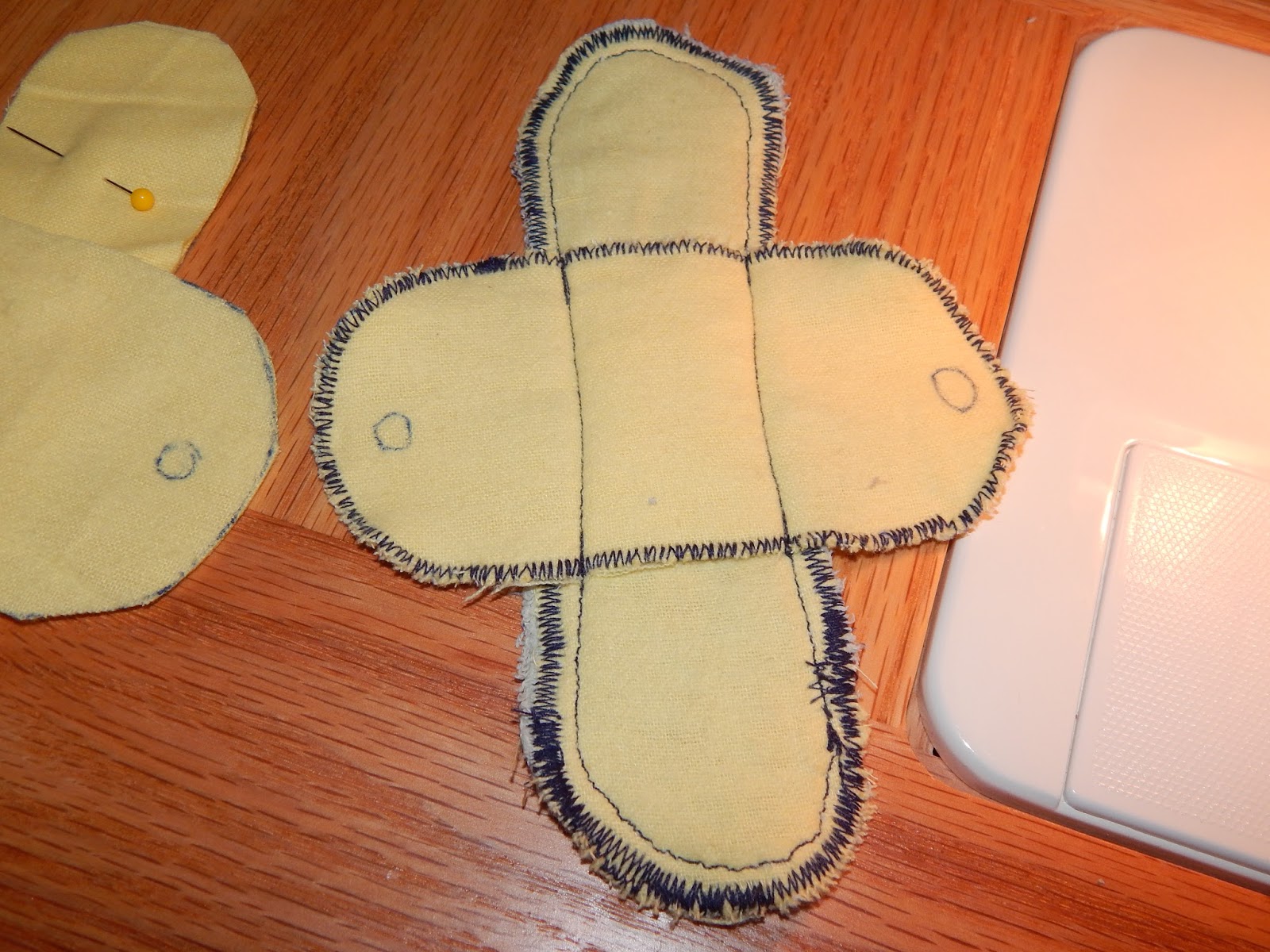
I stitched the inner layers in place on one side of the outer body, before stitching along the same lines on the other side of the outer body to hold everything in place. I hope the pictures help explain this step.
I zigzagged around the outside of the body, then went back and straight stitched along the inside of the zigzag. This works well for keeping everything nice and flat and finished, and doesn't add any bulk or discomfort.
These liners worked much better than version one. They stayed in place better, but not as well as I would like. And they were more comfortable. I think it is because of the way they wrap around the underwear. But, I wasn't satisfied with the absorption rate. They were very comfortable, though. If absorption of liquid is not an issue, and just light protection were the goal, these would work very well.
So, on to version #3.
This version is almost the same as version #2 with a slight variation. I made one end of the body of the liner just a little longer so the wrap around snap would be just off center. The goal here was to hold the liner in place a little better. I also made them just a little bit longer overall than version #2. Here are the measurements of the final version.
 |
| length |
 |
| width |
 |
| inner liner length |
 |
| inner liner width |
The other change I made was to make one with four layers of flannel for the inside liner, with two more layers for the body, making this liner six layers thick overall.
The second type I made had two layers of flannel and one layer of terry cloth for the liner, with two more layers of flannel for the body, making this liner four layers of flannel and one layer of terry cloth. This time I used matching thread, and they look much, much better.
I am very satisfied with version #3. Either thickness will provide the absorption rate I want. If I have a cold with a cough or sneezing, the terry cloth version will hold out much better. Both types, flannel or terry cloth with flannel, are comfortable and effective. This design could easily be adjusted to accommodate a menstrual cycle.
Now that I am finished with my trial and error period, I will make up about a dozen of these, which will last long time. I am so grateful for a mother that taught me to sew by making my clothes when I was a little girl. I sat by her side and got to get the 'wheel' started for her sometimes. It was great. Share a skill with your family that will last a life time. It will mean more to them than you will ever know.
Please share any ideas or things you do to increase your self-reliance and health. We are all in this together and the more we can share and learn from each other, the better off we are. There are many different ways to teach and learn, and this is only one of them. All of us have something to teach. Everyone has something they can share with others. Your input is very welcome here.
In our efforts to become more self-reliant, we have learned so many new things. Things that will increase our safety, like radio communications. Things that will provide us with food, like gardening and canning. Things that will increase our physical health by eliminating chemicals and dead food from our bodies, like no shampoo and panty liners. This project is just one more step toward living life the way we want to, and not the way society dictates to us that we should. And while we still have the freedom to do so, we will continue to learn and do for ourselves the way we see fit. I pray you do the same.
Until next time - Fern


 The older we get, the more we learn about natural ways to care for our bodies. Our modern world has much to offer in the way of conveniences and comfort, but what it has to offer is not always the best thing for our health, in fact, some of what it has to offer is down right deadly. A new year has dawned, make the most of it. Take care of your health, for you will need it to be ready for what is coming.