The Road Home

The Road Home
There is no place like home.
Showing posts with label goat milk. Show all posts

Friday, April 5, 2019

Homestead News, Volume 20

We just got back from Frank's checkup, his second cataract surgery was yesterday and everything is going well. He has some physical limitations for a few more days, so we'll be taking it easy. It's supposed to rain over the weekend too, so another reason for a slow couple of days.


We have added the last of the fertilizer from the chicken house to the garden and tilled it again. Planting will begin sometime next week, weather and mud will help determine the timing. This year will be one of the latest starts on planting the garden. We didn't put in any cold weather crops this spring, they just haven't produced well for us, so we didn't expend the time and effort. We decided to try some time lapse photos of the garden through the season, so here is step one. Dirt.


The seedlings are doing well in the greenhouse, all except the carrots who are suffering from a case of aphids. They moved outside and have been through a few frosty mornings. Maybe that killed off a few of the little buggers.

Beets

Tomatoes

Peppers with basil in the middle smaller pots

Tubs of lettuce, almost ready for lunch


Carrots outside


Nasturtiums

Part of the bed out back, sometimes known as the herb bed, will be used for the perpetual turnip bed. I started to do an article on the nutrition of turnips and turnip greens since we had a lot of interest in them recently, but then realized I had already written one. 


We have simplified the goat herd, quite a bit actually. We had 14 baby goats this year. It's always easy to keep a few young does, they're young, cute and have potential to be good does. At first we were going to keep one, then two, then three. What did we end up with? None. And that was a good decision. We also sold three adult does. What do we have left? One Stripe, our 11 year old, 'old lady goat' that is no longer a producer. 


Her four year old daughter Patch that had a serious illness with a retained placenta this year that led to mastitis on one side of her udder. Her six year old sister Copper, who we sold, help raise her triplets along with her own. Patch is still losing hair in some places and I'm still working on her udder, but her health appears to be much better. I'm actually hoping she goes into heat and breeds, then maybe her udder will function on both sides and she can provide us with milk this coming winter.

Two of our young does had their first kids this year and are doing well on the milk stand. I'll write a Goat Tail sometime soon and give you more details on their progress.


Our chicks have hatched and more arrived in the mail, but that tale will wait for one of Frank's chicken stories.


It's spring, almost time to mow the yard, rains are here and the temperatures are rising. What's not to like about spring? Unfortunately, the temperatures appear to be rising in more ways than one across our country. There are those in power that will never cease fomenting hatred and unrest in our country. They care not one wit for your welfare, well being or contentment with life, liberty and the pursuit of happiness. They will never be satisfied. Ever. Until everything is either under their boot or destroyed down to the last man, woman and child.


I relish the sunshine, the awakening of spring and the quiet solitude of our rural, country life. But I am not unrealistic about how quickly the peace can be shattered in an explosion of violence and hatred. Even here. Do not be led to believe that all is well in the land of the free and the home of the brave. It is not. Do what you can in whatever environment you find yourself in, there are always opportunities available.

Until next time - Fern
 

Friday, May 15, 2015

They're Here....The Pigs That Is

This has been a long day. It started off at 6:00am with a phone call telling us that another relative was in ICU with a heart condition. We would appreciate prayers on behalf of our two relatives that are facing medical challenges at this time.

The trip to pick up our piglets took about seven hours. It took us through some beautiful countryside in eastern Oklahoma and western Arkansas. We had one fairly heavy rain on the way there, but none on the way back, which was good since we transported the pigs in an extra large pet carrier in the back of the truck.


I caught my first pig today. It would have been pretty comical if I could have stood back and watched, because after I caught it I wasn't quite sure what to do with it until the breeder told me to carry him by his back legs. There was one of the boars that REALLY wanted to get out as we were loading the others. We hope he doesn't keep that behavior up, or we may a nice small roast sooner than we plan.
 
3 scared little boars
4 piglets now that the gilt has joined us


After seeing the tusks on one of the adult boars, the father of our boars, and talking to the breeder, we have scheduled our vet to come out next week and cut the teeth of our piglets. The boars tend to cut each other if they are fighting over food or something and we would like to prevent that if possible.


The piglets will be staying in the stock trailer in the barn for several days. We have severe weather forecast for the weekend and this will keep them nice and dry. It will also give them the opportunity to get used to the sights and sounds of their new home.


They sound funny. It is a new sound to our homestead. Pearl, our Great Pyrenees, got to meet them while they were still in the pet carrier, but they were quiet then. After we let the pigs out in the trailer, Pearl kept walking around trying to see what was making that funny noise.

Little girl peeking through the boys


The piglets were happy to eat some grain, fresh squeezed goat milk and some fresh cut grass and weeds. I was able to barely scratch a couple of shoulders while they ate. Before we loaded up the gilt, Frank was able to scratch her back several times. I am hopeful it won't be long before they have settled down and are comfortable with us. But then again, there has been more than once today that we thought we were crazy for bringing home pigs. 
 
The little gilt has a while spot on her back right foot.


You may have noticed that we came home with four pigs instead of three. We decided to bring home an extra boar for a little more meat on the hoof. So now we have a herd of pigs. Do you call pigs a herd? It has been a long day. Let's see. A flock of chickens, a herd of goats, a pride of felines, one lone dog and a couple of humans. These are the intentional animals that inhabit our homestead. For now. We'll let you know how our little piglets work out.

Until next time - Fern

Saturday, April 25, 2015

Effects of A1 vs. A2 Milk

This past winter we drank regular store bought, whole milk for about four or five months, because all of the goats were pregnant and not producing milk. After a few months, Frank and both started having more and more head congestion, drainage and ick in our throats. Frank also developed a mild, daily cough of sorts, especially in the mornings. I was constantly having to clear the mucous from my throat, worse in the mornings, but it lasted all day long.


After a few months I really began to wonder if we were developing some kind of allergy, but I couldn't figure out what it would be. Then one day I remembered that there are many people that react to milk with allergic type symptoms, and I began doing more research on A1 vs. A2 milk. I wrote an article explaining the A1 vs. A2 milk controversy a year ago. If you're not familiar with this information, I encourage you to stop here and read the old article to provide a knowledge base. This will help the rest of this article make more sense.

As I began researching more and more about A1, or most regular, store bought milk, I came to the conclusion that our consumption of this milk was probably the cause of our symptoms. This made me even more anxious for the goats to have their babies and start producing enough milk for us to drink. I want to stop here and share some of the information I read as part of my research. Each quote contains a link to the source I found. 

~~~~~~~~~~~~~~~~~~~~~~~~~~~~~~~~~~~~~~~~~~~~~~~~~~~~~~~~

 I used to think I digested A1 milk as well as the A2 milk, but I have been rethinking this recently. In just the past couple of weeks we switched from milking our A1/A2 Blossom (who is my favorite cow) to our A2/A2 Emma Lou. I have noticed two things:
  1. My lower back has not been as stiff in the mornings.
  2. I used to avoid drinking milk in the evenings because it would make my legs jerky. I have consumed A2/A2 milk in the evening several times and that has not happened. The other night I had symptoms again and thought that maybe it is not the A1 after all. Then I remembered that I had feta cheese on my salad that was made from A1 milk.
~~~~~~~~~~~~~~~~~~~~~~~~~~~~~~~~~~~~~~~~~~~~~~~~~~~~~~~~

The inflammation from A1 casein causes lymphatic congestion, metabolic suppression, and weight gain. A1 milk can worsen acne, eczema, upper respiratory infections, asthma and allergies.
It causes digestive problems, and not because of the lactose. Because of the massive histamine release from casomorphin.

~~~~~~~~~~~~~~~~~~~~~~~~~~~~~~~~~~~~~~~~~~~~~~~~~~~~~~~~

My family and I all took cautious sips and waited. [of A2 milk] Amazingly, no symptoms! No mucous or congestion for my husband. No lactose intolerance for my daughter, who couldn’t have even one tablespoon of regular milk. My son, whom we used to tease if he ate dairy today he went to work with his dad tomorrow (as he would become very much like a bear, and not a fuzzy sweet one), did not react to the raw milk at all.
Not only did we not react adversely, but we felt so much better and more satisfied once we started consuming raw milk on a regular basis. My daughter, who in spite of almost no sugar and frequent brushing could not get her cavities under control, has not had one new cavity in the eight years she’s been drinking raw milk.

~~~~~~~~~~~~~~~~~~~~~~~~~~~~~~~~~~~~~~~~~~~~~~~~~~~~~~~~

When my in-laws moved from India to the United States some 35 years ago, they couldn't believe the low cost and abundance of our milk—until they developed digestive problems. They'll now tell you the same thing I've heard a lot of immigrants say: American milk will make you sick.

~~~~~~~~~~~~~~~~~~~~~~~~~~~~~~~~~~~~~~~~~~~~~~~~~~~~~~~~

Milks containing mostly A2 proteins are often said to be better for ‘allergies’ (such as gut, skin rashes, hayfever, cough). There is also research to suggest that A1 beta casein may be associated with serious health conditions such as heart disease, diabetes type 1 and autism.  

~~~~~~~~~~~~~~~~~~~~~~~~~~~~~~~~~~~~~~~~~~~~~~~~~~~~~~~~

Although it may be inconclusive as to the exact dangers of A1 milk and the resulting BCM7, we feel the precautionary principle should be invoked. Humans have been consuming cow milk for 10,000 years, but A1 milk and the BMC7 that comes with it are a relatively recent development. Only in very modern times with the supremacy of the Holstein breed in US Dairy (accounting for more than 90% of all dairy cows today) has so much A1 milk been consumed. Realistically fluid milk is a minor concern compared to A1 cheese where the lactose carbohydrate and whey protein components have been removed and the casein proteins are further concentrated. Imagine how this has become even worse in our ‘fat is bad’ culture where even the fat is also removed in low and no-fat cheeses leaving only the casein. For example 2 slices of fat-free American singles made from A1 dominant Holstein milk would likely have nearly 3g of A1 beta casein or more than 2.5 times the amount found in a cup of our raw milk.

~~~~~~~~~~~~~~~~~~~~~~~~~~~~~~~~~~~~~~~~~~~~~~~~~~~~~~~~

I have been dairy free for several months, but decided to give the raw A2 milk a try.  I have been drinking it daily for two weeks now and have actually noticed some improvements in my autoimmune symptoms.  This gives me a lot of hope.  I still consider myself dairy free when we are out and about and I’m not eating cheese or anything pasteurized, but so far the raw A2 milk has done me a body of good (literally!). 

~~~~~~~~~~~~~~~~~~~~~~~~~~~~~~~~~~~~~~~~~~~~~~~~~~~~~~~~

Interesting, huh? Now that Frank and I have been drinking our raw, fresh, A2 goat milk for around two months, our symptoms are gone. Frank no longer coughs at all. I still get a little drainage sometimes, but it comes when there is a change in the weather. We have also had a tremendous amount of rain this year with constant standing puddles everywhere. 


Can I say conclusively that our symptoms were caused by consuming A1 milk? No. Can I say conclusively that no longer consuming A1 milk alleviated our symptoms? No. I do not have any specific testing or scientific proof, so keep that in mind. But what I can tell you, is that we feel much better and our symptoms are gone. I find this to be unscientifically conclusive based on personal experience. That doesn't mean everyone will react the same, or react at all. The articles and experiences of the people I quoted above are very good examples of that. If you find this interesting, I would encourage you to read the original article, it has more links that help explain what A1 and A2 milks are, and the differences.


There are so many things that we consume or are exposed to everyday that man has altered or created for ease and profit, that we have no idea of the impact upon our bodies. If you have read here for very long, you know we are trying to eliminate as many chemicals from our bodies as possible, whether ingested or topical. I have no doubt that everything we need to be healthy human beings was created and place here for our use, we just need to figure out how to use them wisely. 

I find this information to be just fascinating. Now, I wonder what we will discover next? There are times we discover new information that makes us wonder why we didn't see/learn/discover it sooner. There just aren't enough hours in the day or years of my life to learn everything I would like to learn. I truly hope I am able to continue to learn everyday that I am given. Now, on to the next great adventure.

Until next time - Fern

Wednesday, March 25, 2015

The Sounds of a Peaceful Morning Milking

I've told you before how much I enjoy milking in the mornings. Listening to the birds, the goats, and just watching the world wake up for the day. Well, recently I took the camera with me and recorded a few more short videos. Just for you. So, without further ado, A Peaceful Morning Milking.

You will notice a metalic kind of sound in this video. I have just begun to milk, and the bucket is empty. Copper fusses at me every morning because she has to wait and be second in line. She just doesn't see any reason she should have to wait for her mother, One Stripe, to be milked first. If you milk more than one doe, and are consistent with your line up, you will find that they figure out their place in line, although at first the goats new to the milking routine will try to cut line. 


Now the sounds of milking have changed and Copper is on the stand. I was surprised at how well the sounds came out while taking these videos with my camera. Interesting. By the time I am about half way through milking Copper, the babies start to get restless because they know that they will get to have breakfast soon.


This was the first morning I noticed one of the kids up on their 'dog house' playing. This was originally our Great Pyrenees, Pearl's, doghouse when she was a puppy. Now we use it for the kids when we pen them up away from their moms at night. The first fresheners are still fussing at me because I didn't feed them out in the feed trough like I do on most mornings. This morning, I brought them in on the milk stand to eat individually. I have been doing this off and on for a few weeks now.


This video shows the kids 'escaping' the pen for breakfast. It's a little shaky here and there, but shows you the routine.


Now I have Lady Bug on the stand and I'm showing you how I feel the babies kicking. You can usually, but not always, feel the babies moving around when the does are about three months into their gestation. At first the babies are higher up on the side and up closer to the rib cage. Since all of the young does are due next week, their babies have dropped down and moved back closer to the udder. All of their tail bone ligaments are very loose, and their udders are growing out nicely. I handle the does a lot when they are on the stand. I want them to be comfortable so when it comes time to be milked, that will be the only new thing added to this routine. I show you how I get them comfortable standing with a little wider stance. This gives more room for the milk bucket and for me to comfortably reach their teats to milk. It is a matter of patience and repetition. After a while they will be comfortable and not resist the repositioning of their leg. 


This is Cricket. Here I show you how much I handle the does. At first they kind of cringe with all of this attention since they are a little skittish about being on the stand at all. But by this time they know they will get to eat while I mess with them. I've also trimmed their hooves once since I started bringing them in. It's much easier for me to have the milk stand hold the goat, and I don't have to bend over as much making it easier on my back.


Now for the switch over. I will take Cricket out and let Penny in. Penny is the most hesitant to come in to the stand, so sometimes I have to bring her in, but she's doing better. At first when these young does left the stand they were kind of lost and didn't know which way to go, but now they have figured it out for the most part. Penny is also like her mother, Copper. She will usually come in, turn in a circle, then jump up on the stand. It's funny how that runs in families.


I had to find an application to shorten the videos I had originally taken before Blogger would upload them. First I had to learn how to do the video on my camera, now I am having to learn how to alter them to fit into the blog format. You know, if we had never started this blog, we wouldn't have bought a new camera a year ago, and I wouldn't be learning any of this stuff. So, thank you for encouraging us in our blogging endeavors. We continue to learn much all of the time.


As I try to think of the things we do and have learned about goats so I can share them with you, it helps me to really think through everything. I guess that can go for just about anything we do. We have felt all along that the purpose of this blog is to share what we have learned so that it might benefit others in some way. I hope that is the case.

Until next time - Fern

Saturday, March 14, 2015

What's Happening

Hello Everybody, Frank here.

Last week we had an exceptional amount of snow and ice for this area. This week we've had rain just about every day. But the good news is, next week, we have a day and a half that is forecast to be partly sunny. Then the weather forecast shows us going back into another rainy period for the foreseeable future. 


Needless to say the garden has not been worked, and it will probably will not be worked for at least two weeks. We had planned on having seedlings in the ground a week or so back. Things like cabbage, broccoli, cole type crops. But that's just not going to happen any time in the immediate future. Where I'm going with this line of thought, is that outside of planning and getting a varied assortment of seeds up to the sprout and seedling stage, there's just not much happening in the garden.


Our baby goats are doing good, they're out grazing with the big girls now. They're eating grain and seem to enjoy it greatly. For the most part we don't have to chase them down to go into the pen at night any more. I think the grain has a lot to do with that. 
 
First mozzarella of the season

We're getting about three quarts of milk a day, from only milking once a day right now. With the babies penned up overnight, we take all of the available milk before they get their breakfast. 


Our three first fresheners are coming along well. We're expecting their babies around April 2nd. That will also be about the same time that we wean the current batch of babies. So, that's the update for the goats.


Our chickens are doing good for the most part. We need to get rid of a couple of roosters. There is a good chance one of them may grace us at our dinner table tomorrow night. We're still not getting the egg production we want. We have 19 hens, and we're probably getting on average about 12 eggs a day. That's just not quite enough for our needs. But we are giving thought to what we're going to hatch around June 1st, so we can start that 6, 12, 18 month cycle. This will provide us with friers and replacement hens for the flock. So, that cycle continues also. I just wish we were getting more eggs. You see we feed the eggs to not only us, but to the dog and the cats.


The kittens are healthy and it's about time to get them spayed and neutered. And it's also time to ban the little boy goats. You probably remember them as Breakfast and Lunch.

We've been working on getting our garage cleaned out and organized. It just seems like every time you clear out an empty space, there is always something to take it's place.


We tried some fermented cabbage the other day, and we've been having a couple of bites of it each day for the last two or three days. For us it is definitely, let me say that again, definitely, an acquired taste. So, we'll have to wait and see how the fermented cabbage works out.


There's not much going on around the farm except everyday business as usual stuff. Our taxes are completed for the year. We have plans to butcher a couple of our older wethers, and tomorrow we're going to make some fresh pressed herb cheese. Or, we could go out in the garden and make mud angels. Now wouldn't that be fun? I've only put to or three loads of goat and chicken manure on the garden this year. Nah, we're not going to be making any mud angels. That's a tad bit immature. How about if we make mud pies and give them to our neighbors? Nah, because then they would expect pies every year. Well, as you can tell, things are a little slow around here right now. Hope you're having a good day. Take care. Bye-bye.

We'll talk more later, Frank
 

Wednesday, February 18, 2015

Preparing to Make Soap

We have wanted to make soap for over 20 years. It appears that this dream will finally be coming true very soon, and we are both very excited. In preparation for this venture, we have done a lot of research. This research resulted in a list of things we needed to be able to successfully and safely make soap. Over the past several weeks we have gradually accumulated those things we need, and now it is just a matter of time, and I will admit, courage. 

In compiling information about making soap, I have read numerous websites and a couple of books. I want to link a few sites that provided some very useful information. Some of them deal with lye, and some outline the techniques used during the process.

One of the first things you will read on any site is how important it is to handle lye in a safe manner. And rightly so. Here is a video  that specifically deals with handling lye safely.

One of the difficulties I had in my research is finding a recipe and appropriate techniques that match the ingredients we are going to use. You see, our soap will only have three ingredients: goat milk, lard and lye. That's it. There are a gazillion sites that make soap, but the vast, vast majority of them use other oils, liquids and fragrances. We're not. Why? For a couple of reasons. One, if we are going to make soap, we want
it to be as pure and simple as possible. Two, if need be, we will be able to produce these three ingredients ourselves. We will be getting the milk from our goats. We plan to be able to render our own lard from the pigs that will be arriving here in the next few months. For now, we are using store bought lard. We can also make lye from wood ashes, but again, we are using purchased, food grade lye for now. And speaking of wood ashes and lye, I found this video to be really fascinating. We have read many things about making lye water, then using it to make soap, but my question has always been, how do you know how strong your lye is? I know you can float an egg or potato just right, but lye is a caustic and I'm not sure I would trust my skin to this technique. This video gave us a different option. Instead of lye water, make lye crystals.

I'm going to list some other videos and sites that I used to learn about the steps for making soap, even though none of them use the recipe we are going to try, I still learned a lot from them.

  • This is the first video I watched on actually making soap, and it is very informative. Becky uses water instead of milk, but this is a basic lard soap. She also uses the lard she rendered from her own pigs.

Once we completed all of this research, we realized there was some equipment we needed to get before we could dive in making soap. I had one book on making soap that I have probably had for more than 20 years, that's how long we've had this in mind. I ended up ordering two more books, but they are mostly geared to recipes that don't involve goat milk and do involve a lot of other ingredients we are not going to use. 

We already had some aprons and rubber gloves on hand. And I have a number of thermometers I have accumulated for making cheese. We decided to acquire what I call a point and shoot thermometer that can be used for soap or people.

We have a manual scale that is used to weigh out produce for canning. But the emphasis on being able to weigh out soap ingredients to the ounce, prompted us to invest in a digital scale that can be easily zeroed out after your bowl or container is placed upon it.

Then there was the question of mixing the oils, milk and lye until it comes to trace. Trace, a new vocabulary word for us. We'll get into that much more throughout the process. Most folks I read or watched used a stick blender or mixer. Everyone had the admonition of not running the mixer too long so the motor wouldn't overheat or burn out. Well, we don't have a stick blender, and really didn't see a need for one. Instead we searched for a while and found a mixer whip that would fit in the chuck of an electric hand drill, in this case battery operated. Sound funny? It probably is, but it is what we are going to use. I think it will be more durable, and we won't worry about it overheating or burning out. And if the battery dies before the soap goes to trace, we have extras that we can use. We ordered a couple of different types of whisks, whips and beaters to try in the drill. I'm sure once we make the first batch of soap, we will figure out which one works the best. 

I have seen where some people use plastic to mix their ingredients and some use stainless steel. Most will tell you to only use soap equipment to make soap and nothing else. The first video I watched where the lye and water were mixed in an old butter tub surprised me. Especially when they discussed how hot the liquid will get when it interacts with the lye.
My question was, what keeps the chemicals in the plastic from leaching into the lye solution? If the temperature of the mixture gets really hot, won't that release some of the chemicals of the plastic? And, since lye is a very caustic substance that will pit the surface of the plastic, won't that release some of the chemicals of the plastic? I didn't find any definitive answers to these questions, but they have lead us to use stainless steel. We had these two extra 13 quart bowls in storage waiting for something to come along, and think they will work fine. I had also purchased some silicone spatulas a while back to replace the rubber ones I'm using now when they wear out, so now they will be assigned soap making duties.

We debated and thought long and hard about soap molds. There are a million and one different molds out there people use. Specialty shops sell all kinds of molds, and some folks use cardboard boxes with a trash bag liner. Silicone seems to be a favorite of many folks, and we ordered one loaf pan just to see how it does. We're also going to line a regular loaf pan and see how it works as well. I seldom use this loaf pans anymore since I started using cast iron loaf pans for bread, so this pan has been volunteered for the job.

There is also a wide variety of mechanisms used to cut the soap into bars. Some contraptions are quite sophisticated, some use a wide cutter blade specifically made for cutting soap, and some are as simple as a knife. We are going to try out this cleaver and see how it works.

As you can see, it has taken time and effort to research and acquire the needed materials and equipment for this project. We have already learned a tremendous amount and we haven't even started making soap yet. I have the distinct feeling that the learning has just begun. And you know what? I'm glad. It's great to learn something totally new and be so much closer to another dream come true. We don't know anyone that has ever made soap from only goat milk, lard and lye. I can only think of one person I know that has ever made soap period. Just like most other things in our lives, what we know and do, we basically teach ourselves. This time we have the blessing of the internet which has allowed us to do a lot of research, and even watch videos of demonstrations. 


Our next soap post will be a demonstration of our first attempt. We will cover much more detail about the equipment we use, and especially the safety aspects involved in making soap. Never take safety for granted. I know there are a lot of folks out there that have been making soap for years. Any advice you can share before we get started will be greatly appreciated. Keep in mind, we are set on our ingredients. I know there are many other things that can be added to soap and for good reasons. But we want to make a soap that can be replicated in a sustainable fashion if we can never order or buy anything else besides what we can raise and make on our own. It is another giant step for our continued sustainable life style. And we're excited!

Until next time - Fern
 

Monday, February 9, 2015

Meet Patch, And More Goat Lore

We had a very pleasant surprise yesterday! One Stripe had lively, healthy twins. We had a little concern, since according to my records 150 days of her gestation would fall on Tuesday, February 9th. Most goat books I have read indicate that kidding before the 150th day can mean there is a problem, unless the doe has triplets or quadruplets. As I posted before, One Stripe had attained her classic waddle, but remained very healthy and active, to the point of still trying to trot, she was too big to run, in from the pasture when I showed up at the barn.


Friday night when we went up to feed, everything was normal. One Stripe came into the barn and got up on the milk stand to eat. Saturday morning, she came into the barn, put her front feet up on the blocks to get on the milk stand, then just stopped and looked at me. She obviously wanted to eat, but wouldn't attempt to go any further. After a little coaxing, I realized something was up, but I figured she was just getting too heavy, so I put her feed in a bowl on the floor and she ate just fine. But, after I turned her out I realized her walk had changed. She didn't go far before stopping and it appeared that one of the babies had moved back to the point One Stripe almost had to swing her back legs out and around the baby just to take a step. It now took her much longer just to go out to the pasture, with many stops, and she no longer kept up with the herd. I hoped this wasn't an indication of pre-delivery problems.


After watching her for a bit, I radioed Frank to tell him we needed to get the birthing pens set up and ready, that we might be having babies today (Saturday) instead of Tuesday like predicted. So, we got in gear, cleaned out the barn and got everything set up. We put hay in the back of the pens, so the does wouldn't stick their heads through to eat it, washed out the water buckets and checked the tote with the birthing supplies one more time. Then I went out in the pasture to bring in the girls. It took One Stripe about 10 minutes, with many stops, to walk the distance she usually covers in less than a minute. She didn't appear to be sick or stressed accept that she didn't take too many steps before pausing for a break, some longer than others.


When we got to the barn and I opened the gate to her birthing pen, she just walked right in, right at home. This has been her routine for the last six years, so she knows what is going on and is very comfortable there. That is very nice. No stress for her, no having to make her go in, no hollering for the other goats, just peaceful readiness for babies. By the way, the other does that fought tooth and nail against going in and bellowed from the time they were put in, have gone on to other pastures. That is part of the way we maintain a calm, peaceful, easy-to-handle herd. It is part of breeding in the characteristics of what we want in a goat, or cat, or dog, or chicken. We only keep those animals that meet our requirements, and One Stripe is an excellent example of a great goat.

 
Saturday night came and went with no babies, which was good. That would be day number 147 in my books, and just too early. Then came Sunday, day number 148. After her breakfast, I let One Stripe out of the pen for a bit, and pulled up a chair. She didn't go far at all, just across the barn and back. I could tell by how hollow her hips and tailbone were, along with a very small amount of discharge, that this would be the day for babies. But since it was only day number 148, I wondered if she would have triplets. It also occurred to me that if I had caught her breeding activity at the end of her 24 hour standing heat cycle, that my estimation could be about 24 hours off, which would put her at 149 days, but still a day early. The other factor is One Stripe's age. She will be seven in May, which is older for a breeding, producing doe. Most folks would have already sold her off as an older doe. But, for those of you that haven't read about my plans for One Stripe already, she will be staying here all the days of her life. She is one of those special goats that is calm and gentle, a great mom, a good milker, and has stole my heart. I can't claim that with any of the others, but I can with her. So, here she stays, all of her days.


One Stripe was nice enough to have her babies in the middle of the afternoon, on a sunny, 75* February day. It was short sleeve weather with no worries about cold babies, a picture perfect day. We have two friends that are interested in goats and the birthing process that I contacted when I knew for sure we had babies coming. Faith [a pseudonym] arrived in time to see the second baby born. She is hoping to buy Penny after her kids are born and I train her to milk, so she is wanting all the firsthand experiences she can get under her belt before she takes her first goat home. After the kids were born Grace [another pseudonym] and her husband came over to see them. So we ended up with a barn full of talking a laughter. Another plus on this fine February day. Plus, Frank and I got to share some of our experience and knowledge which we always enjoy. One Stripe had no difficulty birthing at all. Just like always. She started 'talking' to her stomach after a while, like she was telling the babies to hurry up and come out. That made me laugh.

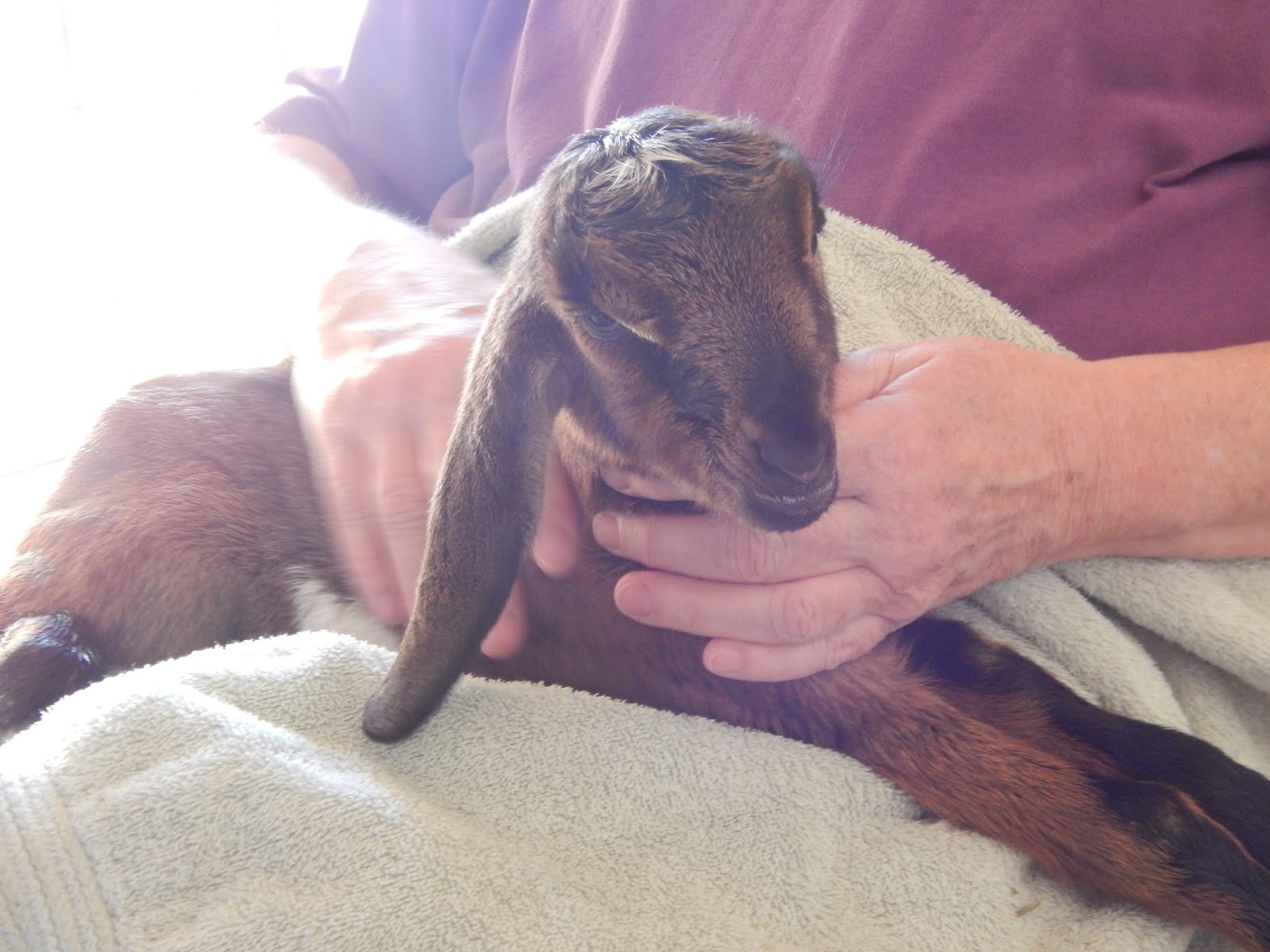
Patch was born first in the classic, front feet, nose, head position. In less than two hours, Patch was trying to jump around, like baby goats do. But then she would fall over, making me laugh. That is when Grace told me that Frank and I have a great life. She is right. It is a great life, and we are very blessed. Patch is a very active, vigorous baby girl, with beautiful dark brown ears, which Frank likes. We may just have to keep her.


Breakfast, yes, we named her brother breakfast because that is what he will be, was born back feet first. When the amniotic sack appeared and stayed unbroken, I thought something looked odd and kept trying to see if the head was following the feet. It didn't take long for him to be born, and my only concern was that final push or two when most of his body was out, but his head was not. I wanted to make sure he was out and able to breathe well. But he came out fine and all was well.


When the kids are born, if I get to be there, I swipe the mucous from their mouths so they can start coughing and breathing well. Depending on the temperature, I may dry them off some with a towel. Since the weather was so nice yesterday, I didn't dry them, but left them to their mother's attention. Another huge benefit of having tame, easy to handle animals is that they don't mind having you in the birthing pen with them when the time comes. We have had does that ran to the back of the pen like cornered animals, or does that tried to ram and run out of the gate when I went in, especially first fresheners. We did not keep them. It makes it much harder to help the kids if they need it or make sure they are nursing. It also makes for wilder kids that are difficult to handle as well.


It wasn't long before both kids were dry and fed. We clipped their umbilical cords and applied a strong 7% iodine to cauterize and sterilize them. While all of this was going on, Faith described markings on the first baby, a girl, and said something like, "That white square looks like a patch. That would make a good name." And it stuck. So, meet Patch.


Upon discovering the second kid was a boy, Frank said to Faith, "His name is Breakfast." We have a running joke that all bucks born here have the name of Breakfast, Lunch or Dinner. Some folks think that's funny and some don't, but all males born here are destined to be meat for our table, unless by chance, someone comes by that needs a new billy goat. But that doesn't happen very often. We had chevron patties for supper last night, but it wasn't Breakfast. It tastes great.

Faith and Patch


I milked out about a quart of colostrum from One Stripe last night. It makes it easier for the babies to nurse, and begins the stimulation for One Stripe to produce more milk. This morning I brought her in on the milk stand to eat. It gives her some movement, lets her eat in a normal location, and makes it much easier for me to milk her, sitting in a chair instead of kneeling in a crowded birthing pen.
 
Copper with her ears out

It was a great day. Easy birth, great weather, good company and beautiful babies. It doesn't always go that way, and since One Stripe aborted last year, she had many prayers for a successful pregnancy this year. Now, to wait a few more days for Copper to kid. Yesterday afternoon as she lay out in the corral, I noticed her ears were out. That is usually a sign of listening, but at this stage, it is also a sign of discomfort. According to my records she will reach 150 days on Wednesday, two days from now. But we watched her closely because we have had does go into labor right after another one gave birth. Something about the sight, sounds and smells of birth can bring on labor in another animal that is close to her due date. For the farmer it can mean turning around to help another goat for a few hours, just when you thought you were finished for the day. We had that happen once about 10:30 at night. Just finishing up and making sure babies and mother were all settled and doing well, only to realize the goat in the next pen was laying down pushing. That was a long night indeed.

One Stripe is doing great this morning.

This morning Copper hasn't shown any signs of birthing. But the day is young, we will see what it brings. Today is forecast to be sunny, 65* and light winds. Another great day to have more baby goats. But then, for me, just about any day is another great day to have baby goats.

Good morning, Breakfast.

Good morning, Patch.

We look forward to having some fresh milk in a few days. We will wait until Friday to start keeping the milk for ourselves. In the meantime, I will be milking One Stripe, and Copper after she kids, twice a day. This milk will go to the chickens, cats and dog. Later on when Cricket, Lady Bug and Penny birth and I am training them to be milkers, we hope to have some pigs that can benefit from some extra milk as well. By then the garden will be half planted and spring will be well on the way. The seasons change, and this time of year brings new life on the homestead and blessings to our lives.

Until next time - Fern