The Road Home

The Road Home
There is no place like home.
Showing posts with label Alinco. Show all posts

Wednesday, April 2, 2014

Radio - Basic Equipment & Start Up

Hello, Frank here.

I've had a couple of requests lately about entry level basic equipment and getting started. For those of you working on your General, I hope you're well into whatever program you are using. I believe next in our studies is antennas, which is where we will continue. But tonight, will be a different topic.

Okay. Entry level equipment. First, you will need your Technician's license. That will give you transmitting privileges from 30 MHz up, which includes VHF and UHF. Now, remember, this is just my opinion and recommendation, and this is the very minimum. I'm not going to cover HT's (walkie talkies) here.

You will need a radio, an antenna, coax cable and a power supply. Radio. Alinco DR-635T. This radio covers your VHF/UHF ham bands, and if you have the desire to open up or modify this radio, it is very easy to do. This will allow you to transmit on MURS, GMRS/FRS frequencies, and if you're really stupid, it will allow you to transmit on police and fire frequencies, too. This radio is not approved for broadcast on the modified frequencies. There are commercial radios made that will accommodate this need. This radio will work both in your car and as a base station.

For your automobile you now have your radio, your battery is your power supply. You will need an antenna. My recommendation is the Comet M-24M. That for your automobile is your complete kit. You will need to attach the radio to the battery for power, or you can use the cigarette lighter plug. The battery is first choice.


For your base station. Same radio. You will need a base
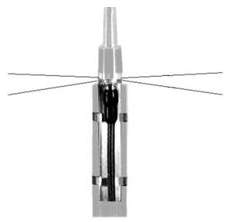
antenna. I am going to recommend a Comet CA-2x4SR. Yes, this is a mobile antenna. If you choose to modify your radio, this antenna will work for all of the frequencies mentioned above. With this you will also need a ground plane kit. Make sure both the antenna and the ground plane kit have UHF connections. Now, you will need some kind of pole to put this up on. Top rail fencing from your local lumber yard works great. Two 10' pieces, with one bracket attached to the highest part of your house, normally the ridge. Put this antenna and ground plane kit at the very top. Now you will need some coax. For VHF/UHF short length and low power, use RG8X. If you're going to run more than 50' then a higher quality cable is needed. For your base station, you will need a power supply. Here is my recommendation for a small power supply, MFJ-4125. This will power your radio needs for years to come. That's all you need for your base station. You have a radio, an antenna and ground plane, coax cable and a power supply. You need to have a way to get your antenna into your house. I drilled a hole
through my wall, used a PVC pipe, a 45 degree angle and ran it through that way. To keep out bugs, I use stainless steel scrubbing pads on both sides and spray heavily twice a year with bug spray. You will also need a grounding rod connected to the base of your antenna pole and connections between the pole and the grounding rod. Speaking of this antenna pole, this is the horizontal pipe that goes along the top of a chain link fence, it's called top rail. One end is slightly crimped to allow the next piece to slide over it. Cut off one of these crimped pieces, about 3', drive the non-crimped end into the ground, with the crimped part sticking above ground surface. Now slide the rest of your pole over the piece in the ground, align it with your bracket attached to the side of your ridge, of course, make sure it's straight up and down. Now you have a good, solid pole. Some lumber yards carry 21' lengths of this top rail and some don't. Lowe's carries it, but you will have to special order it. And if you do that, get the thicker gauge metal.

Okay, that's your VHF and UHF mobile and base station. This is as basic as you can get. No switches, no power strips, that's it. For lightening protection, unplug your power supply and disconnect your coax cable from the back of your radio. Put that piece of coax that you just disconnected into a glass jar
laying sideways. If you want to know what your SWR is for your radio, you will need an SWR meter. A very basic one is the MFJ-842. You'll also need a coax jumper, RG8X will do fine. Footnote: all jumpers and coax should be PL-259 to PL-259. Okay that will do you for VHF/UHF.

I'm not going to discuss HF for mobile use. For most people it's just not practical. There is a small portion of 10 meter that a Technician can use. For the other parts, you will need your General license. So, here goes. For your base station radio, let me reiterate, this is just one man's opinion. My recommendation is the ICOM IC-718. You will need an antenna tuner. You do not have to
have an antenna tuner, but I highly recommend it, and my recommendation is the LDG IT-100. For this you will also need a jumper, RG8X will work just fine. Next you will need an antenna, for this my recommendation is a dipole antenna. If you only choose to operate one band, then a simple dipole will work great. If you choose to operate
multiple bands, here is a pretty good selection. These are made by Alpha Delta and they are all good dipole antennas. This dipole antenna, like most antennas, the higher the better it operates. Metal roofs and power lines will take away greatly from it's performance. But you can mount it on the same pole as your VHF antenna. Come down about one foot from your VHF antenna, drill a hole through the pole, attach an eye hook and a light weight pulley. This is how you will attach your dipole at the center. Each end of the dipole is up to you. Again, the higher the better. For your coax use RG8X. You will also need an SWR meter and for this radio an MFJ-860 will work fine. You will also need one more jumper. This
radio operates off of the same power supply as the Alinco base station.
Lightening applies the same with this radio. During a lightening storm unplug your outside antennas coming in and your power supply. 

Again, this is your very basic operating equipment. By the way, these are the radios that I use and the antennas that I use and the meters that I use. What I didn't mention here is that it is not required that you have the following pieces of equipment. Power pole connectors make life very handy. Power strips come in real handy if you're operating multiple 12 volt DC devices. A more professional tower comes in handy. All you need is a radio, an antenna, a power supply, coax cable, a meter, a couple of jumpers, a way to hold your antenna in the air and you need to ground the antennas attached to the pole by grounding the pole. Remember, always follow basic safety rules, it will pay off in the long run.

The reason for this post is because of the following email. All the equipment I mentioned here is new, and don't forget, the HF radio is also an excellent shortwave receiver. The writer addresses time on the radio. There is no requirement for any time at all, just what you choose. Also remember I do radio from a survival perspective. I do not contest, but if you choose to, you certainly can. 98% of my radio time is listening.

I would like to start with Ham radio, but what has stopped me is the expense. Maybe you can write some posts for the lowest common denominator. Ham radio for the lowest of budgets. That would be helpful. Usually when people write about Ham radio operations it is just too much information, just like people who write about solar power. I got started with solar by watching a 2 minute or less video. The person broke it down and made it super easy. I was able to get started with less then $300 and it is enough power to run a laptop, light and modem and router for hours. By putting the few pieces together I learned what it took to do solar. That simple tutorial that showed a small setup hooked up and running was more valuable to me then all those complicated books and articles that I read about solar power!
I think if you write for the 'haven't started but would like to start' crowd that would be a great service and it would get more people involved in Ham radio. In most people's mind it seems too complicated and too much of a commitment - people have a lot on their plate. Economy is on everyone's minds. Show how to start simple with just the basics so we can get the idea. People can always upgrade as their budget allows. It would be nice to have excellent equipment but that is not always possible for everyone. Having a small setup to communicate with is better then not having anything at all.  And then there is the subject of how much time does a person need to spend on the air?  That could be a show stopper for many.  I have a busy schedule with all my homemaking and homesteading duties and do not want to spend a gillion hours on the radio but want to have the abilities and skills should the occasion arise.


The person below has requested vendors which I have included with each item discussed. There are vendors that are cheaper and some that are more expensive. The items that I have listed can be found for less from some other vendors. I like Universal Radio, but I also buy from many other good folks out there. Hope this information helps.
 
I would like to buy a ham radio and antenna, but do not know what I should buy.  I am a  beginner, so I am not interested in a radio with lots of bells and whistles.  Just a basic get the job done type of radio.  Also looking for a good vendor to purchase said radio and antenna.  Also need to know how to properly install and set up antenna for best reception.
Also, where to get the study guides to get licensed.  In the future a license probably won't be too important, but the knowledge on how to properly operate a radio using approved standards will be critical.
Any information you can give me will be great. 

Please remember, these are just my recommendations and opinions. Many people will disagree and say you have to have this and you have to have this. If you want to get started, this will get you there. Both of these radios are good, solid pieces of equipment. Many veteran ham operators use this same equipment everyday. Again, this is just my opinion. I will remind you that I am of the persuasion that someday we are going to face some type of collapse. Radio may be one of your only means of communication. I also use solar power. Please take the above statements with a grain of salt, because it is also, my opinion.

We'll talk more later. 73, Frank


Friday, July 12, 2013

The Shack


Hello, Frank here.

I've had a few questions about the equipment I use and why I use it. I want to thank you for the comments that I can post and for the comments that I can't post. 

The gear that I use is simple. I recently started off with a Kenwood VHF/UHF radio and it was a first class piece of equipment, but for me it was too complicated to operate. Yes, I do read the manuals, but I don't practice everyday using all the different gizmo thing-os that a radio will do. So, I traded it for an easier to use radio. I have a scanner that is the same way and if I don't play with the buttons often, then I am not going to be able to use it. So for me, I prefer a good, quality piece of equipment that easy to operate and simple.

First, my power supply. It is real simple. I can't remember where I bought it, but I have added a site that sells them. I haven't bought anything from them, so I can't say anything pro or con. I am going to buy a backup for the one I have and this company sells theirs for about $50. It runs a  continuous 30 amps and is pretty inexpensive. The voltage output is adjustable and it has absolutely zero bells and whistles. But it works. That power, I run to a power strip which I think is made and sold by MFJ. Everything that comes out of the power supply is13.8 volts. It's easy to use and handy. For low power
devices I put three or four devices together and put them on one pole - like handheld commercial radios, GMRS radios, battery chargers, clock and I have two three outlet power ports (cigarette charger type) that I use to charge temporary devices with cigar type plugs. Soon I'm going to add an addition to the power strip that allows for the connection of power pole connectors and a couple of USB connectors. There will be more on that later. The power from the power supply goes straight to the power strip, and from there goes to all of the radios, scanners, battery chargers, my clock and everything that I use 
right here in my little corner of the world. What I refer to as my little corner of the world in the ham world and CB world is referred to as a shack. Many people literally have a separate building or small travel trailer, but I prefer to have it inside my house so my wife (YL) can keep an eye on me.

First on the list is my little 16 channel Uniden Bearcat scanner. It is probably 25 years old and scans the VHF and UHF spectrums. In the scanner world, it is a dinosaur. But I use it for a small group of selected frequencies that I want to monitor.

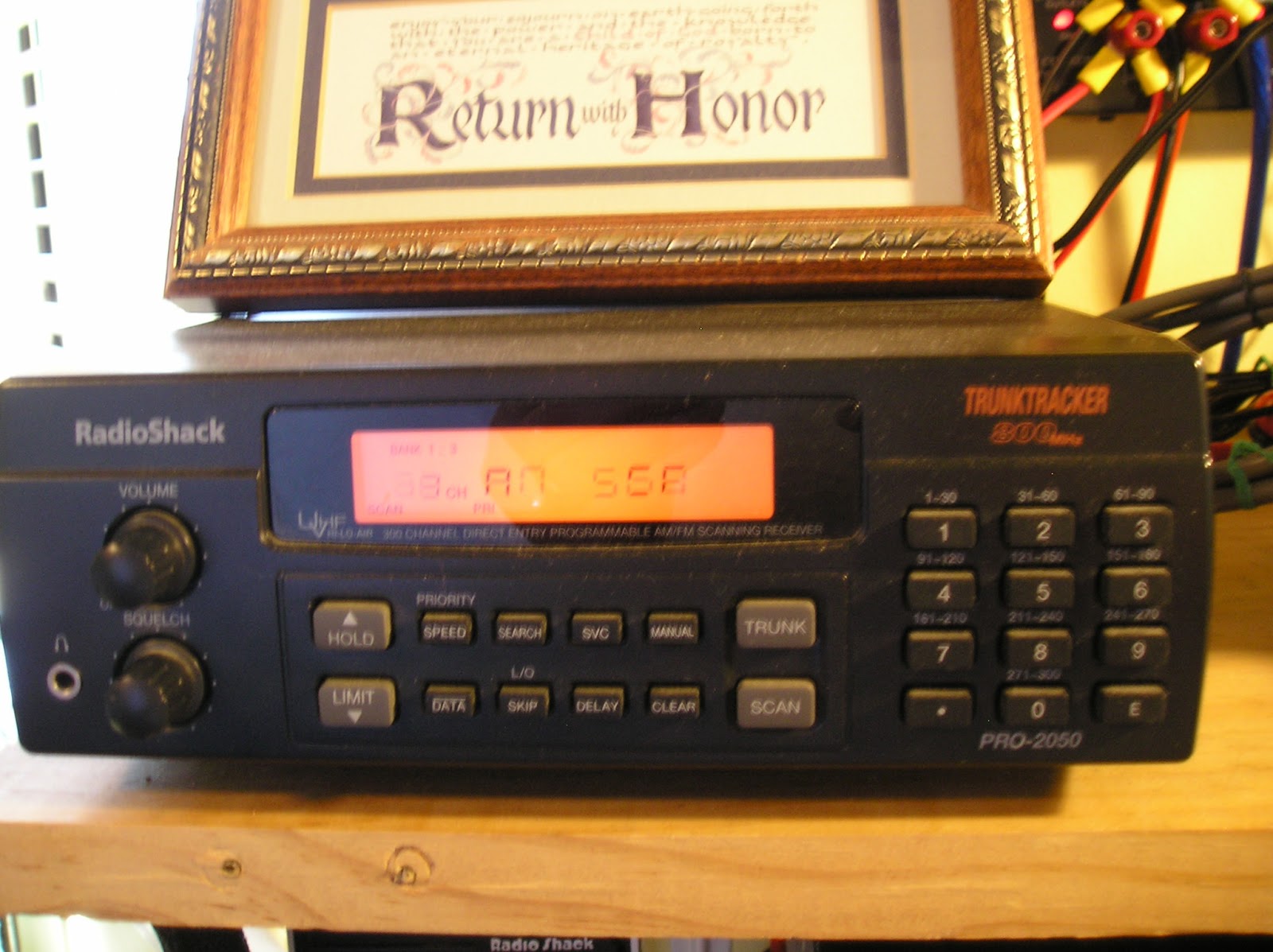
Next, is a Radio Shack scanner. It is a Radio Shack Pro-2050 and is also about 15 years old. It scans 300 channels in 10 different zones. It will do things that other scanners can't do, but I don't know how to get it to do them either. So it basically scans everything I want it to scan.

Going down the list, I have an RCI-2970N2 that is made by the
Ranger Corporation. It is a 10/12 meter radio that has an inserted chip that can also operate on 11 meters (CB). Most people would consider this to be a high dollar CB radio. It also works good on the 10/12 meter ham bands. And, yes, it has SSB.

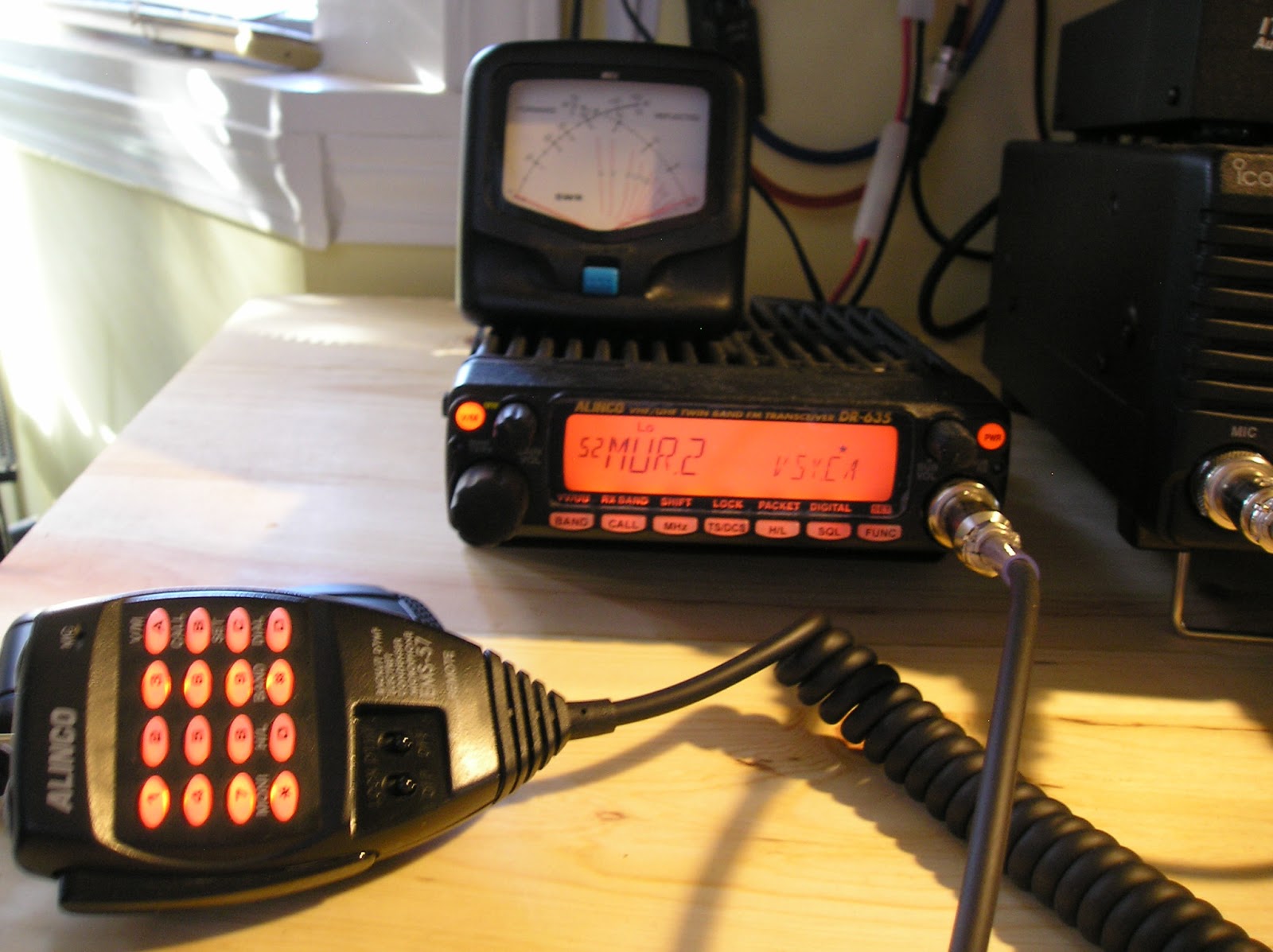
The radio I use the most is an Alinco DR-635T. It is a ham radio for the VHF/UHF frequencies. This radio can be easily modified to operate on extended frequencies, like GMRS, FRS, MURS and public service. Remember modifications to any radio mentioned in this post probably are illegal. Check your regulations. I use this radio for local ham use talking to repeaters, which is called duplex. I use it for simplex, talking directly to another ham operator. More on repeaters, duplex and simplex later. This is a nice radio, easy to use, easy to learn and is of respectable quality. And it is easy to modify. Also, more on that later.

These little handheld radios are used everyday at our house. They are commercial HT's (remember? handy talky), VHF/UHF, and computer
programmable. I use these for VHF ham radio, listening to public service and talking if need be (more on that later),monitoring the weather frequencies, listening and talking on GMRS, and the MURS frequencies. Where I use them most around the farm is on the MURS frequencies. They will communicate with the Alinco DR-635T on all of the frequencies I just mentioned. They have a legal power of four or five watts which will hit any ham repeater in our area. These radios cost 
a little more than some  other handheld commercial radios, but I have been using these for a few years around our little homestead. They go to the barn every day and milk, they work in the garden - they work. In the picture you will see what is a standard antenna and what is called a rubber ducky. The smaller one is very flexible, which allows for more bending and twisting and it won't break off. As Fern just mentioned, I would highly recommend these. Many radio companies sell them.

Next, is what some people in the ham world call the big dial. It is an HF, high frequency radio. This is what most people think of as ham radio. My model is an ICOM IC-718. It is considered to be an entry level radio or, more precisely, the bottom of the barrel. Some of this language is going to sound strange, but we'll talk more about it later. This radio I have will talk to and receive any station that the
much more expensive radios will. It has minimum bells and whistles, it costs about $700, when other HF radios cost $1000, $2000, $5000 and up. This radio meets my need. Now I added an antenna tuner to it and the antenna I chose to use is a dipole type antenna. More on antennas later. This little radio gets excellent reviews, it's easy to operate and inexpensive. I don't contest and I don't compete. Everything I do with radios is with the intent to communicate when the grid power goes down someday. 

I hope this helps some folks that are looking for basic answers to basic questions. We live in a complex world and when I want to communicate, I like for it to be simple. Other ham operators and CB operators will give you an entirely different opinion. This is just my opinion and this is the way that I like to do it. 

I took my HF radio down the road to a friend's house and we hooked up the same antenna. He has a real nice, first class TenTec radio. Any station he could hear, I could hear. He just heard it with a higher quality of sound. His radio is a much, much nicer radio and I am happy for him. Mine is a much lower quality, much lower cost, much easier to operate and it meets my need. While I was at his house, we cranked up his CB radio and on side band listened to a man talking in Ontario, Canada. His CB is a Galaxy 979 with no modifications with a 108 antenna.

Bill Clinton, not my most favorite president, had a plaque on his desk: KISS - Keep It Simple Stupid. I try to follow this every day of my life - keep it simple.

On a side note, we have not had internet for the last two or three days. I use DSL from my local hardline phone company. Last night we went to a friend's house so Fern could post about canning. Tonight, I am posting on a brand new Verizon Jetpack. What I realized today, if you want technical information from the sales people at the Verizon store, then you have come to the wrong place. But if you want a sales person that can match your new phone with your shoes, then you have come to the right place.

We'll talk more later. 73, Frank