My sinus dilation procedure went well yesterday and I am recovering nicely. I think. But since I am not quite up to speed, I thought I would share a post with you from about a year and a half ago.
The dramatic drop in the stock markets yesterday have made headlines around the globe. This is yet another example of the roller coaster ride that will eventually grind to a halt, or go out with a bang. It reminds me regularly of James Howard Kuntsler's book The Long Emergency. If you haven't read it, I would highly recommend it. Even though it is a novel, it is great food for thought and may give you some ideas of things you may want to acquire that you haven't thought of, or purchased yet.
The current state of the world economies continue to reinforce our decision to invest in tangibles instead of increasing our savings. There are still a number of things we are considering and weighing. Things that will not only increase our comfort, but the ease at which we can perform daily tasks that will be necessary for survival. Because once the final curtain closes and the end of life as we know it arrives, it will no longer be how to survive, but how to live. We talk often of surviving the coming collapse and that's exactly what we plan on doing. If we are blessed with the option then life will go on and become a new normal, a new kind of life.
Consider your life, when all else about you has changed. That's what it will continue to be. Life. There may be many things about that life that have changed dramatically, but it will still be your life. What you make of it will be up to you.
Until next time - Fern
~~~~~~~~~~~~~~~~~~~~~~~~~~~~~~~~~~~~~~~~~~~~~~~~~~~~~~~~
Originally published February 3, 2014
I was reading over the news and ran across a link from the Drudge Report that went to Alex Jones.
The gist of the article was the small scale rioting after the Super
Bowl, none of which was of much interest to me. At the very bottom of
the article was this quote.
"While
their entire country is being bankrupted, hollowed out, and flooded
with illegal immigrants as Obama announces that he will ignore Congress
and pursue his agenda via dictatorial executive fiat, Americans remain
unmoved.
The only things
that get them in the least bit animated are Black Friday sales and NFL
football games. When a civilization reaches this point of decadence, a
Roman Empire-style collapse is soon to follow."
As the day went on the Dow Jones Industrial Average fell over 300 points, today alone (February 3, 2014). This was after the "worst monthly loss since May 2012 on Friday."
I don't pretend to know much of anything about the stock market, but I
do know that is not the norm. Frank follows the markets very closely. I
have also read enough to know that the stock market is being propped up
in our fragile, artificial economy, somewhat like a house of cards.
When, not if, will a strong enough wind come along and blow this house
down? Remember the story of the Three Little Pigs? Is 'your house' built in such a way that the Big Bad Wolf will not be able to 'huff and puff and blow your house down'?
The events in the world comprise a complexity that is impossible to comprehend in it's entirety. "All that is necessary for the triumph of evil is that good men do nothing. Edmund Burke"
Is this where we are today? Is that why many people don't take notice
of the more significant events going on around them? Or is it an escape
of sorts? Or are people afraid to say or do anything due to retaliation
from our government? When things are too big to accept and
conceptualize, is it better to distract yourself with the fantasy world
presented on television or at the ballgame?
We
have read many people that talk about those they know who think
everything is fine. Prices may be higher, health insurance may be
changing or disappearing, but everything is fine. We've had these types
of things happen before and everything turned out fine, you'll see.
Really? I don't think so. But I only mention some things in passing to
some people because, otherwise, I will draw too much attention to
myself, which I do not want to do. I would rather be somewhat
un-memorable. Plain, simple. Do not talk, act, dress or live in a way
that draws attention. I definitely do not want to be part of the 'look
at me' crowd. I would rather be somewhat invisible.
There is a growing stress in the world. People on the
phone at a variety of businesses are becoming rude and condescending.
Why? Don't they need the business? Most businesses I frequent in person
are hurting. Does management want to say something to these rude employees, but feel
their
hands are tied? Are they afraid of being charged with some kind of a
hate crime in court? Or, does the person answering the phone think this
is normal behavior since that is the way it is on television? You know,
that big make believe screen that for the last 50 to 60 years has been
teaching Madison Avenue values and morality. For the life of me, I
cannot understand why anybody would want to watch television. I can find
no value in that big make believe screen. But everybody I listen to,
asks the same question, "Did you see ______ on television?" Just
unbelievable to me. Not to mention how hypnotizing it is. Just look at a
room with a television and see how everyone is drawn into staring at
it. You can't hardly keep from it. It's creepy.
The Roman Empire didn't collapse overnight. I'm sure
there were many, many people then that couldn't conceive the fall of
that mighty Empire. It was just TOO BIG TO FALL. Hmm...doesn't that
sound familiar? Too big to fail. What does that mean for us? It worries
me when I read that many of our government agencies have stocked up
on
millions of rounds of ammunition and weapons. It worries me when banks
start questioning why people want their money. It worries me when
executive orders become the standard way of running the government. It
worries me when lying and cheating and spying become the norms of our
day. It worries me that many police forces appear to be more concerned
with controlling and intimidating people instead of serving and
protecting them. It worries me when there are millions of people running
around singing 'All is well' when I know there is no chance of our
nation recovering and resuming our previous 'eat, drink and be merry'
way of life. It is impossible. It will never happen. We are in for a
major correction in the way we live. It is inevitable.
The almost instant availability of everything from donuts
to pedicures to brain surgery will soon be a thing of the past. We now live with a new
generation
of people that have never even considered living without cell phones,
computers and big screen TVs, not to mention refrigeration and air
conditioning. We live with a generation of people that have been taught
it's okay not to work, but don't worry, we'll feed you and house you and
make sure your standard of living is better than many who still choose
to work hard every day for the clothes on their backs and the food on
their tables. I cannot even begin to imagine what this generation will
think when there is no longer anyone there to 'take care of them'. This
worries me, too.
"When a civilization reaches this point of decadence, a Roman Empire-style collapse is soon to follow." How
soon? I don't know. I only know that God has given us the task to warn
our neighbors. Please heed this warning. Hold your family close. Try to
get them ready.
Until next time - Fern
Experiences from country living; self-sufficiency; Christian values; amateur-ham radio; a hard working good life; and Humor is the Essence of Survival.
The Road Home
There is no place like home.
Saturday, August 22, 2015
Thursday, August 20, 2015
Homestead News, Volume 9
Time continues to fly by and autumn will be with us before we know it. We are finally out of the 100+ temperatures. It was 59* here last night! I don't think it will last, though, we are supposed to be back up into the low 90's by early next week, and that is fine. It is much more manageable than the 100+ stuff with high humidity. With the cool weather this morning, we were able to use our new double hung windows to fill the house with cool, fresh air. They work great.
We want to send our thoughts and prayers to those that are being affected by the wildfires around the country. We have friends in the northwest that have had to evacuate their home, and we haven't heard from them since yesterday. It must be very difficult to leave your home not knowing what you may return to. There are many different types of challenges we are all given, but many times on the other side of it, we are stronger for having been tested and refined.
We continue to pen up the youngest kids and accumulate milk for cheese making. The last batch of cheddar is ready to wax, but I ran out of steam before I got to it today. Two more wheels of cheddar are now in the cheese press and will be ready to remove and start the drying process tomorrow evening. Since I won't be able to wax these two wheels until Saturday, I put them in a plastic storage bag in the refrigerator. I will be having a sinus dilation procedure tomorrow morning, so I don't expect to get much of anything done for the rest of the day.

We continue to eat our cheddar at room temperature, but have found that it gets too oily if we leave out the whole wheel. This time we cut it in half covered the open end with plastic wrap and put it back in the cheese frig until we are ready for it.

We also filled up the fermentation crock with four heads of cabbage today. The last batch of sauerkraut stayed in the crock for a month and it was the best tasting we have had so far. We still have three quarts of it in the refrigerator that we are eating, and wanted the next batch to have plenty of time to ferment. It's interesting how quickly things like making sauerkraut becomes routine.
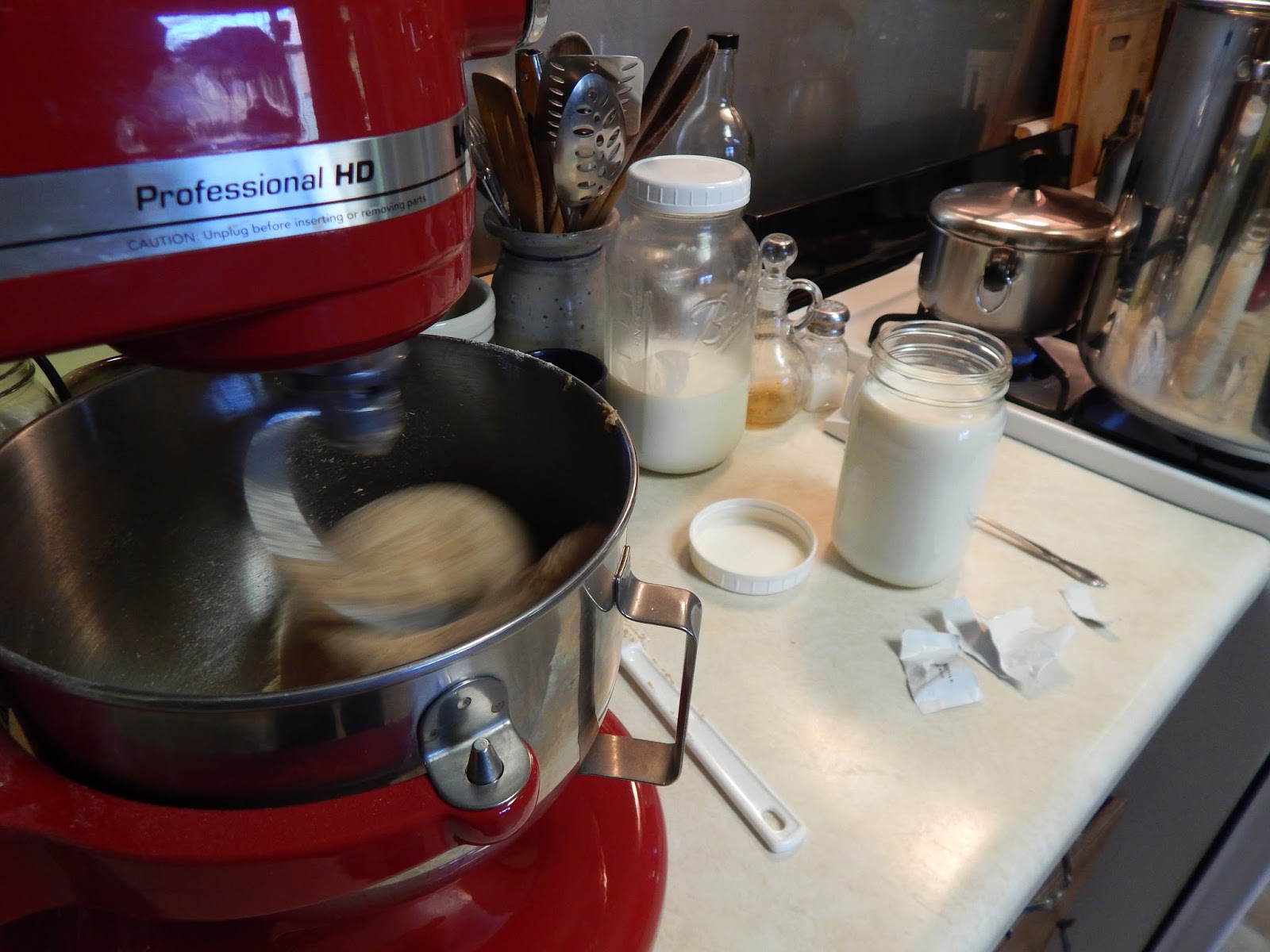
Today was also bread day. The sourdough was still doing it's thing and predigesting all those carbohydrates for us on top of the frig while I was writing this. We didn't get the dough mixed up until about 11:00 this morning, so I didn't bake the rolls until 8:30 this evening. I wanted to give it plenty of time to ferment and digest beforehand. They sure are good.


I've tried to make cottage cheese twice by leaving the milk on the counter. The first time it didn't really curdle, so I thought I hadn't left it long enough.
The second time I left it for about four days and it was definitely soured, but still didn't really make curds like it was supposed to. That's too bad, I was really hoping it would work. Now it will be back to the cheese book and making another stab at modifying the recipe so I can get good cottage cheese.
We still have roosters and wethers to butcher, and we hope next week after my sinuses clear up we can get a lot of butchering done. That and get some fall crops planted. My headaches and general feelings of sickness have put everything like that on hold for way too long. So I hope to have more to report in the butchering department very soon.
The pigs are doing much better in the behavior department. There are some folks at church that have raised pigs for years and Frank was quizzing them on 'normal' pig behavior last week. We are still learning, and they are still growing. It will be very interesting to see how they do in the long run. I'm also very interested to see how Lance and Liberty behave once we have butchered the barrows. I think the interaction will be different then. We pay a little more attention to them since they are our breeding pair and the barrows will end up on our dinner plates. I have a question for you. Does a pig's tail continue to grow longer and get more curly as they grow up?
The whey produced from making cheese goes to good use as pig food. They get upset with me if I take them a bucket of scraps without some kind of liquid in it. I can't help but laugh at them when they fuss at me. It's a funny little squeal.
By the time we got most of the day's activities completed, the kitchen was really a mess.
As the week has progressed we have watched more major fluctuations in the financial markets around the world. It is just another indicator of the instability of the underlying foundations of economies everywhere. We continue to discuss what tangible items we can invest in that we will be able to use in the future, come what may. An example of one of our acquisitions is a stainless steel water bath canner. We have two like the one pictured above that the whey is in. One of them, after three or four years of use, has chipped and has a place trying to rust on the inside of the bottom. Knowing they won't be durable for long term use, especially if we get to the point that we can't buy or trade for another one, we chose to invest in stainless steel. As you can tell, it's still in the box. We'll keep using the enameled version as long as we can.
We continue to pick peppers, tomatoes, cowpeas and carrots from the garden. I really hope to write another garden article before long with the things we have been able to plant for fall.
Thank you for all of the great comments. It's neat to be able to share. Frank and I have learned a great deal from other folks experiences. Please keep sharing.
Prepare for the fall of the year and the fall of the world. They will both be arriving soon.
Until next time - Fern
We want to send our thoughts and prayers to those that are being affected by the wildfires around the country. We have friends in the northwest that have had to evacuate their home, and we haven't heard from them since yesterday. It must be very difficult to leave your home not knowing what you may return to. There are many different types of challenges we are all given, but many times on the other side of it, we are stronger for having been tested and refined.
We continue to pen up the youngest kids and accumulate milk for cheese making. The last batch of cheddar is ready to wax, but I ran out of steam before I got to it today. Two more wheels of cheddar are now in the cheese press and will be ready to remove and start the drying process tomorrow evening. Since I won't be able to wax these two wheels until Saturday, I put them in a plastic storage bag in the refrigerator. I will be having a sinus dilation procedure tomorrow morning, so I don't expect to get much of anything done for the rest of the day.
We continue to eat our cheddar at room temperature, but have found that it gets too oily if we leave out the whole wheel. This time we cut it in half covered the open end with plastic wrap and put it back in the cheese frig until we are ready for it.
We also filled up the fermentation crock with four heads of cabbage today. The last batch of sauerkraut stayed in the crock for a month and it was the best tasting we have had so far. We still have three quarts of it in the refrigerator that we are eating, and wanted the next batch to have plenty of time to ferment. It's interesting how quickly things like making sauerkraut becomes routine.
Today was also bread day. The sourdough was still doing it's thing and predigesting all those carbohydrates for us on top of the frig while I was writing this. We didn't get the dough mixed up until about 11:00 this morning, so I didn't bake the rolls until 8:30 this evening. I wanted to give it plenty of time to ferment and digest beforehand. They sure are good.
I've tried to make cottage cheese twice by leaving the milk on the counter. The first time it didn't really curdle, so I thought I hadn't left it long enough.
The second time I left it for about four days and it was definitely soured, but still didn't really make curds like it was supposed to. That's too bad, I was really hoping it would work. Now it will be back to the cheese book and making another stab at modifying the recipe so I can get good cottage cheese.
We still have roosters and wethers to butcher, and we hope next week after my sinuses clear up we can get a lot of butchering done. That and get some fall crops planted. My headaches and general feelings of sickness have put everything like that on hold for way too long. So I hope to have more to report in the butchering department very soon.
The pigs are doing much better in the behavior department. There are some folks at church that have raised pigs for years and Frank was quizzing them on 'normal' pig behavior last week. We are still learning, and they are still growing. It will be very interesting to see how they do in the long run. I'm also very interested to see how Lance and Liberty behave once we have butchered the barrows. I think the interaction will be different then. We pay a little more attention to them since they are our breeding pair and the barrows will end up on our dinner plates. I have a question for you. Does a pig's tail continue to grow longer and get more curly as they grow up?
The whey produced from making cheese goes to good use as pig food. They get upset with me if I take them a bucket of scraps without some kind of liquid in it. I can't help but laugh at them when they fuss at me. It's a funny little squeal.
By the time we got most of the day's activities completed, the kitchen was really a mess.
As the week has progressed we have watched more major fluctuations in the financial markets around the world. It is just another indicator of the instability of the underlying foundations of economies everywhere. We continue to discuss what tangible items we can invest in that we will be able to use in the future, come what may. An example of one of our acquisitions is a stainless steel water bath canner. We have two like the one pictured above that the whey is in. One of them, after three or four years of use, has chipped and has a place trying to rust on the inside of the bottom. Knowing they won't be durable for long term use, especially if we get to the point that we can't buy or trade for another one, we chose to invest in stainless steel. As you can tell, it's still in the box. We'll keep using the enameled version as long as we can.
We continue to pick peppers, tomatoes, cowpeas and carrots from the garden. I really hope to write another garden article before long with the things we have been able to plant for fall.
Thank you for all of the great comments. It's neat to be able to share. Frank and I have learned a great deal from other folks experiences. Please keep sharing.
Prepare for the fall of the year and the fall of the world. They will both be arriving soon.
Until next time - Fern
Monday, August 17, 2015
A Simple Non-Electric Milking Machine
The time has arrived that I need to employ a milking machine instead of continuing to hand milk our goats. This time has arrived much sooner than I had hoped, but the arthritis in my hands have made that decision for me. I have a finger that will no longer straighten unless I work on it for a while. It is affecting my grip and I'm dropping a lot of things. Rats. One of the biggest draw backs for me is that I really enjoy milking my goats. I'm sure I still will, it will just be different. I can enjoy the still of the morning, watching the animals and listening to the birds, it will just be different. As the goats and I get used to this new routine, I'm sure there will be challenges and adjustments along the way, so later on, I'll do an update on my new milking routine and tell you what I've learned. For now, here is my very first experience with this machine.
I can't say our milking machine is new because I bought it several years ago. It's been in a storage building awaiting the time that I needed it. This is an example of storing things that will become useful in the times to come. If you have a future project that will make life easier and more productive after the SHTF, and you can afford it now, acquire what you think you will need now and store it away. It will wait for you, just like this milker.
Back when I researched and looked for a simple milking machine the Henry Milker out of Alaska was the only one I found, so I got one. Now there are several companies that have similar products like the one Patrice Lewis at Rural Revolution uses, the Udderly EZ Milker. Patrice did an article on how she uses one to milk her cow here. If there is anyone out there that uses or has experience with a non-electric milking machine, please share with us. I would really appreciate anything you can share. I wrote this part of the article before we went to the barn and tried out the machine. You'll realize why I said this later on.
The components of our milking kit included the vacuum pump, four tubes, two tube cleaning brushes, two wide mouth quart jars, two lids, a micro fiber cloth and a carrying case. The directions are simple and easy to follow.
Copper, our three year old doe, was the victim for the first trial of milking with this machine. This is the second year we have milked Copper and she is very easy going and a good milker. She looked at me a few times as I fumbled around trying to get the bucket, which we brought to protect and support the jar, and the syringe that goes over the teat in place to begin this process.
At first I couldn't get a good suction going so the pressure would build up a vacuum and begin withdrawing the milk. With Frank's help, we finally got things going and the milk flowing.
The pressure gauge has to be pumped much more often than I expected, and even though I had to squeeze it less often than if I had milked by hand, it really wasn't that different than milking by hand except I didn't have to squeeze as hard.
I had to restart the suction/vacuum process twice on each teat because the milk stopped flowing. The directions included this possibility, and directed to release the syringe from the teat and start over, which we did.
Even with restarting twice on each teat, we only withdrew about half of Copper's milk. The rest I ended up milking out by hand into the bucket. I'm glad Frank recommended we bring it.
I'm sure with practice this machine would withdraw more of the milk, and I would be get much more adept. Even with all of the commotion of trying to figure out this machine, Copper was very cooperative through it all, and I was grateful. Frank did end up feeding her quite a bit more than usual just to keep her occupied while I tried the milker and he took the pictures. Even the flash on the camera didn't bother her. She did a very good job.
The Henry Milker worked just as advertised. The instructions and videos found on their website were helpful since I did run into a few things that were mentioned. Because I had access to the information ahead of time, I knew what to do when these situations occurred.
Pros? The milk goes directly into the jar which prevents any hair or dust from getting into it like it does when you hand milk into a bucket. The milk doesn't have to be filtered. Just change out the lid for a regular plastic one and put the jar in a bucket of water to chill, then into the refrigerator it goes. Even inexperienced people could milk an animal using this machine.
Cons? I have read in other places and heard from an acquaintance that you still need to finish the milking by hand if you want to
make sure you get all of the milk and keep production to a maximum. The thing I noticed as we were increasing the pressure to create the vacuum and get the milk to flow, was that Copper's teat was pulled down and lengthened in the syringe. My first thought was that I didn't like that. What will that do to the tissue of her teat if this process is repeated over and over twice a day? Will it cause the teats to lengthen and stay that way? Will it cause them to loosen and lose their natural elasticity and break down the structure of the orifice? Will it cause them to leak over time because the tissues have been stretched so often?
I don't even know if these are questions that address a valid concern, but my first thought was I don't want that to happen to my does' udders. I have grown very particular about the udders my does have and we have bred them to have certain characteristics. Another thing that has caused this concern is a video about another company that makes non-electric goat milking machines that shows the
process compared to an electric milking machine. Some of the does in this video
have very large teats and the suctioning motion of the electric
milking machine rhythmically pulls on the teats. I think this process
over time has caused part of the shaping of the teats. I don't see how
it can keep from it. There are also some people that prefer a large
bulbous type of teat, even for hand milking, because you get more milk
per squeeze, therefore you don't have to squeeze as many times to get
the same amount of milk as a doe with smaller teats. Maybe I am just
backward in my choice of goat teats, but I don't think so. I think the
straight, smaller structure of this type of teat is much closer to what
is found in nature as opposed to what is found with structured breeding
practices.
So, what about my arthritis? I don't know. But for now I will continue milking by hand and doing the best I can. I may need to limit how many goats I have in milk at once, I don't know. It is very interesting to finally get to a place where I thought I would have to give in and quit milking by hand even though I didn't want to. Now that I have tried it, I really don't want to use a machine, not unless I really, really, really have to, and for now I don't have to, so I'm not. I thought about just deleting this article and not finishing it, but then again I thought maybe it would be of use to someone, so here it is. Food for thought.
Until next time - Fern
I can't say our milking machine is new because I bought it several years ago. It's been in a storage building awaiting the time that I needed it. This is an example of storing things that will become useful in the times to come. If you have a future project that will make life easier and more productive after the SHTF, and you can afford it now, acquire what you think you will need now and store it away. It will wait for you, just like this milker.
The components of our milking kit included the vacuum pump, four tubes, two tube cleaning brushes, two wide mouth quart jars, two lids, a micro fiber cloth and a carrying case. The directions are simple and easy to follow.
| Copper with her kids back in March |
At first I couldn't get a good suction going so the pressure would build up a vacuum and begin withdrawing the milk. With Frank's help, we finally got things going and the milk flowing.
| Yes, we always have our radios, even when we're together. |
The pressure gauge has to be pumped much more often than I expected, and even though I had to squeeze it less often than if I had milked by hand, it really wasn't that different than milking by hand except I didn't have to squeeze as hard.
I had to restart the suction/vacuum process twice on each teat because the milk stopped flowing. The directions included this possibility, and directed to release the syringe from the teat and start over, which we did.
Even with restarting twice on each teat, we only withdrew about half of Copper's milk. The rest I ended up milking out by hand into the bucket. I'm glad Frank recommended we bring it.
I'm sure with practice this machine would withdraw more of the milk, and I would be get much more adept. Even with all of the commotion of trying to figure out this machine, Copper was very cooperative through it all, and I was grateful. Frank did end up feeding her quite a bit more than usual just to keep her occupied while I tried the milker and he took the pictures. Even the flash on the camera didn't bother her. She did a very good job.
The Henry Milker worked just as advertised. The instructions and videos found on their website were helpful since I did run into a few things that were mentioned. Because I had access to the information ahead of time, I knew what to do when these situations occurred.
| No filtering necessary |
Cons? I have read in other places and heard from an acquaintance that you still need to finish the milking by hand if you want to
| Copper's udder |
| One Stripe's udder |
Until next time - Fern
Labels:
arthritis,
doe,
goats,
milk buckets,
milking,
milking machine,
storage,
teat,
udder
Saturday, August 15, 2015
The Versatility of Things
Frank ran across a very interesting article today at the Urban Survival Site called 32 Foods That Aren't Just for Eating. This is a very interesting list in and of itself. Better yet, each item in the list is a link to another site with more uses for that particular food. Take garlic for instance, it is linked to a site that has 20 unusual uses for garlic. It's a great article with lots of valuable resources.
When I came to baking soda on the list I had to smile. It reminded me of our choice to use only baking soda for toothpaste. I also quit using the popular scrubbing liquids for cleaning and now use a small amount of baking soda, a drop of Dawn dish washing liquid and a wet rag. It works great.
More than anything this list is an exercise in creatively thinking about how to extend the use of not only foods, but just about any item that comes in the door. Frank and I look at many empty containers and wonder what they can be used for instead of being thrown away. The scraps of lumber from building projects are kept for use in other projects that require smaller pieces of wood, or are put in the kindling pile. We use stock panels to stake our tomatoes on instead of cages. At the end of the season, we take down the panels so we can till the garden. The panels and t-posts are stacked nearby for use again the next year.
As prices get higher and higher, and in some instances, the availability of some things come into question, it's a good mental exercise to determine what we really need, not just want, but really need to perform our daily tasks, regardless of where we live. I was talking to a friend of ours yesterday about things we may need in the coming days, weeks and months. She said she used to buy things like shoes or clothes with her extra money, but now she buys things she knows she will need in her garden, for canning her food or for her chickens. Times have changed and our purchasing habits have definitely changed.
Not long ago we had a comment in which the person spoke of her family and friends and their purchasing choices. They told her they knew they needed to prepare, but didn't know how or where to start, so they just kept living like nothing was wrong or was going to happen. All the while this person has been scrimping and saving to obtain the things she will need should a disaster or collapse occur. There are many of us that have changed the way we look at the world and the value we place on a given item. There are many of us that no longer look at dust catchers as things we want to acquire. The appearance of things no longer determines it's value, the usefulness or functionality of the item is what puts it higher on our list of things to consider.
An example. Right now I am more interested in getting my outdoor kitchen constructed and in working order than I am in having a dishwasher. I have drawn out a preliminary plan for Frank to ponder. You see, I have many ideas that turn out to be unrealistic in the category of feasibility. But if I can explain or draw it out well enough and give it to Frank to think about, he can adjust it to the point that it will work. It might not even be close to the particular idea I started out with, but it still meets the need I had in the first place. To build this outdoor kitchen there aren't many things we will need to get because we have already obtained many of the items to complete it. Some of them we have had for a quite a while, not knowing exactly what we were going to do with them, but at the same time, knowing they would be useful should the SHTF. They have worked very well into this plan.
Versatility. That is what the Urban Survival Site reminded me of. Not only things, but many food items are versatile as well. Use your creativity and imagination, analyze your situation, your supplies and your needs, not necessarily wants, but needs. What are the things or food items you need to acquire before things get dicey or inflation gets worse or the dollar is devalued? What can you do right now to make your family more secure in their preparations?
Frank and I spend much of our time thinking just like this now days. We continue to hear and read many things that indicate the hour glass is quickly running out of sand. When that last grain falls with a resounding crash, will you be ready?
Until next time - Fern
Friday, August 14, 2015
Low Carb Pizza
I have been trying out different ways to make a low carb pizza using our whole wheat sourdough starter. Frank and I switched to eating low carb in December 2014, and plan to continue eating that way forever. We have both lost around 45 pounds since we changed our eating habits, and this has changed our lives for the better. Because of this change, I have been experimenting with different low carb meals. Some are a success, some aren't and some need a little more tweaking.
For the crust, I used whole wheat sourdough starter. I put olive oil on the plates, spread out some starter, then baked it for about 15 minutes while I got the toppings ready. I wanted it to be cooked before I added any sauce, so it wouldn't be too wet.
I used some of the tomato sauce we canned a few years ago. I'm trying to use up the last few jars. To the sauce I added salt, pepper, basil, oregano, parsley and some of the garlic we canned a few months back.
The garlic has worked out very well. We have already used one pint and opened a second. I'm thinking we may need to can another batch of 16 pints.
I layered tomato sauce, browned sausage, onions, sweet peppers from the garden and some of our shredded mozzarella.
After it was constructed, the pizza baked for another 10 minutes at 450*.
Our side dish this evening was a bowl of collard and beet greens picked from the garden. We think the turnip greens are better, but collard greens are just fine, too.
The olive oil didn't work very well, and the 'crust' stuck a little. It was also softer or moister than I prefer, but the flavor was good. I think I'll have to try making a dough for the crust sometime, but I'll need to make it in the morning for the evening meal. That will give time for the starter to digest the carbohydrates in the whole wheat flour, which not only reduces the carb load, but releases many useful vitamins and minerals.
Now the final version. What Frank thought. "You can live on it. Maybe after it's tweaked, you could live on it happily."
There are so many different ways to eat healthy. We try to find ways to grow or make our own with everything we eat. There are many, many low carb products on the market, but if it is feasible for us to make our own, we would much rather do so. It's part of choosing. As long as we still have the freedom to choose, we choose not to participate in the processed, prepackaged, chemicalized items corporate America puts on the grocery shelves and calls food. It takes time and effort to learn, produce, and prepare real food, but it is worth it.
Until next time - Fern
Subscribe to:
Posts (Atom)