

~~~~~~~~~~~~~~~~~~~~~~~~~~~~~~~~~~~~~~~~~~~~~~~~~~~~~~~~
Question #1
Hello Frank,
Hello Frank,
First, I want to thank both you and Fern for what you do
to help us and others. I know that just like the rest of us, you are busy
doing your best to prepare for whatever is coming our way, yet you
take precious time to extend a helping hand to anyone who will take
the time to read your blog. Please know that you are very much
appreciated!
Secondly, I want to apologize for the length of this email and thank you in advance for the time you spend reading and hopefully responding to it. A man's time is a precious commodity.
We are attempting to set up an emergency communication system between three family member locations. I am a total novice at this but I have been reading and researching for 2-3 months and based most of our plan on the information gleaned from your "Frank's Radio Communications" articles. I fully realize that I am stretching things to the limit here both technically and legally, and that it may not even be doable, but I have to try.
I'll describe our situation as best I can, then list my questions. We want to link the three family member locations, without relying on repeaters. Since this is for emergency use, we want the system to be free standing. We are located in hilly Southeastern Ohio, but fortunately all three locations are at or near the hill tops. No one is down in a valley or a low area.
Location A: This is my location. I am not licensed yet, but I am studying for my Technician license and will be taking the exam September 17 (that's the next exam date here). I am setting up a "basic" 2 meter base station at this location. I have a Yaesu FT-1900 (modified) for the base radio and have mast materials to put my antenna up 30-40' AGL. My mast will probably be okay close to 40' with a small antenna, but less with a large antenna. I'm using the military camouflage net support poles (heaviest aluminum type) and it is at the end of my house, supported firmly at 14', leaving 26' unsupported if I go to 40'. I don't want to use guy lines unless absolutely necessary, but I can if you think it's required. There are no power lines and if it came down it could only hit a metal roof. At this location I want to be able to use the 2 meter ham band and maintain contact with locations B & C.
Location B: This is my daughter. At home, she is about 8 miles from my location with no major obstructions between us. At work she is also about 8 miles away, but with some small building obstructions. Her plans are to use the system only for emergency contact with me, and it needs to be mobile so that she is covered at her work place. For convenience, and cost control, we hope to be able to meet her needs with a 5 watt HT and a good quality antenna.
Location C: This location is about 12 miles from me, with no major obstructions between us. This is a stay-at-home person, but would also like the ability to go mobile if necessary. I would still like to use the 5 watt HT if possible, but with a small mast if necessary. I was hoping that we could use an antenna that would work for both the mast and mobile if needed. The one I had in mind was the CA-2x4SR with a ground plane for the mast and a mag mount for mobile.
What I hope to do is use my base to access the 2 meter ham band and use the low MURS channels (151) to communicate with B & C. Certainly, we are testing the limits here, but this seems to me to be the most economical way for us to set up an emergency communication system. I realize that we are asking a lot for a 2 meter antenna to also be effective for the MURS channels at 151 MHz, but my hope is to use a wide band antenna that is tunable to be resonate at about 148-149 MHz. If I am correct, this should give me a usable range including the upper portion of the 2 meter band and the low MURS channels.
My plan is to finish setting up my base as soon as I make the antenna decisions, then use my 5 watt HT with a mobile mag mount antenna on my vehicle to test the "system" at locations B & C before we buy any more equipment.
First question, in your opinion, is it possible to do this with the HTs and mobile antennas as described above? If not, what would you suggest as minimum equipment requirements to get the job done?
Second question is which antennas would you recommend? I have read and researched until my eyes are crossed and I cannot come up with a definitive answer. For the mobiles, the CA-2x4SR looks good to me but I'm wide open to the voice of experience. For my base antenna, I'm really undecided. I currently have three on my "possibles list," the Hustler GC 144 (with the MKR-2 ground plane kit), the Hustler G6-144B (pricey & big), and the Diamond X50A. The X50A is described as "pre-tuned" so I haven't been able to find out if it is field tunable or not. But, from the reviews I've read it seems to generally be tuned toward the upper end of the 2 meter band, which is just what I need. One fellows review that I read said his was resonate at 149.5 out of the box. Again, I am wide open to the voice of experience.
Soooo, there you have our situation. Don't worry about hurting my feelings with your comments and suggestions. I've already been told by two Hams that I can't do this with less than 200 Watts at each location. I prefer efficiency to brute power, but if I am way off track here don't hesitate to say so, just please give me some direction as to how to get to where we want to go.
Thank you
*******************************************************************************
This is the first
of two emails. The second email will contain product recommendations and
significantly more detail, but I want to assure you that this is doable. This
is what I do.
Your CA2x4SR is an
excellent choice. I use it for mobile and base with a ground plane. I'll send
more detail later, but you don't need 200 watts. On a clear day 5 watts will
get you where you want to go. During a torrential rain storm, more power may
be needed, but not 200 watts.
I will send you a
second email. I talk to friends 30 miles away on MURS 1, 2, & 3 simplex,
or line of sight, on a handheld with a 2 inch stubby antenna. Does your tower
really need to be 40 feet?
We'll talk more
later,
Frank
*******************************************************************************
~~~~~~~~~~~~~~~~~~~~~~~~~~~~~~~~~~~~~~~~~~~~~~~~~~~~~~~~
Thank you so very much. After the response I
got from two different Hams (one was at Universal Radio) I was beginning to
doubt myself on this project. As far as the antenna height goes I was just
trying to make it as effective as possible. I would be thrilled if it
didn't have to go that high.
Thank you again and Please have a Blessed
Day.
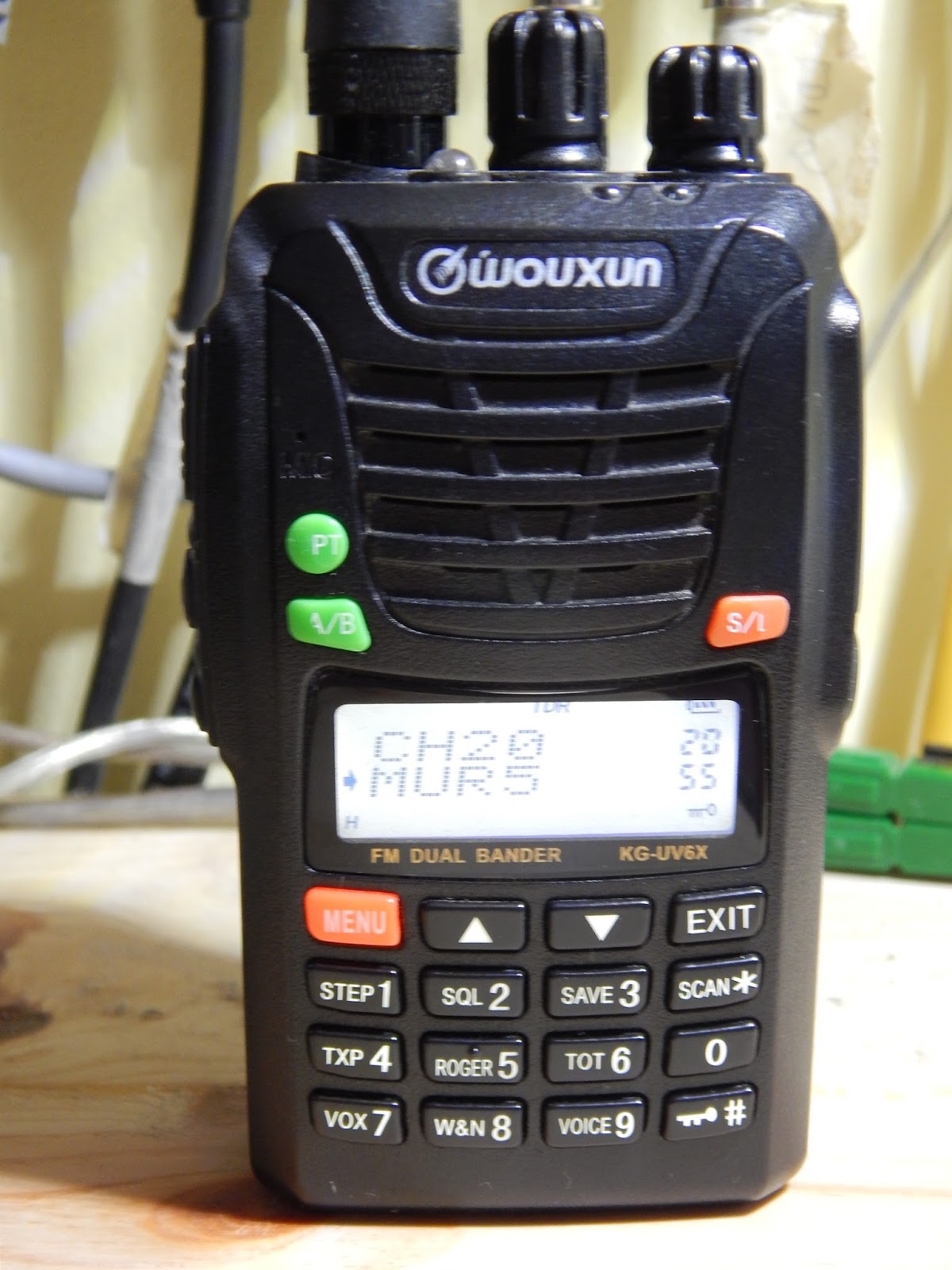

Your tower height may be a tad bit excessive. I take it 14 feet is close to your ridge. Unless you plan on putting up other antennas, if you don't need the extra height, then don't use it.

If you do use the battery eliminator and the external antenna, always keep the original antenna and battery handy in case you have to leave on foot quickly.
Yes, your idea is doable. The little Baofeng UV5R, is inexpensive and it works. For accessories check out Radioddity.com, because some use an SMA female and others use an SMA male type antenna connector. Buy two of the little handhelds, get your cell phone out and have somebody at

If it will work with two handy talkies, make sure you're both outside, not inside a structure. If somebody has to be inside a building, have them stand in a window facing the direction they want to talk. Give it a try, see if it will work. What you've invested at this stage is the cost of two handy talkies. On Amazon the UV5R sells for about $25.00 with free shipping. It is critical that you are facing each other just like you are having a conversation. If you get a poor signal, move two or three feet to the right or left and try again. If it works, then put up the outside antennas and you should be good to go. If you want to get a bit more sophisticated, then use a base station with a power supply. Always get a bigger power supply than you think you'll need.

Now the procedures described above are for emergency communications. You've read this before. Doing 36 MPH in a 35 MPH zone is illegal. Doing 96 MPH in a 35 MPH is also illegal. Nobody cares if you do 36 MPH, but they do care if you're doing 96 MPH. Always run the lowest power you can.
By the way, in reference to the 200 watt VHF radio? Some old time hams do not support any type of radio communication except ham radio. Many of the older hams see it as the ultimate hobby, and that's great. You probably are going to use radio for a different purpose, and that's great, too. It's a big playing field and there is lots of room for everybody. I would like to see a 200 watt VHF that anybody sells.

For you and everybody else out there, you might want to consider a scanner. Many ham radios will scan, but as a general rule, they are notoriously slow. Why a scanner? If you know an event is occurring, you can warn your loved ones ahead of time. It's much better to avoid a problem, than deal with one. A scanner can save your life. You want to know what is out there.

Try to buy products that operate off of 12 volts. That simplifies your charging. If you're using your car battery or you're using a home power supply, it just makes life easier. Think about it.
What we talked about up above with MURS and GMRS, I really hope this helps, but I know it works. I have used this technique, I still use it, and I use it everyday. Take care. Best of luck.
~~~~~~~~~~~~~~~~~~~~~~~~~~~~~~~~~~~~~~~~~~~~~~~~~~~~~~~
Question #2
Hello,
I am acquainted with you both from The Deliberate Agrarian, Herrick Kimball's blog.
I am very intrigued with your communications post. I too believe in the profound importance of readiness and an impending radical change to our civilization.
I must confess though, in conjunction with an overwhelming amount of ideas/projects/responsibilities and the thought of adding something that I know is crucial but for which I lack interest/affinity or skill, stops me cold. I haven't the resources (money, time and interest) to become a ham radio hobbyist but KNOW it is a necessity that should not be ignored because I am in over my head with other projects.
So my query is, how can I set up communications for a minimum investment in time and money? I am not talking about shortcuts but levels. It sounded as if there were some in your class that are at or were at, my level.
I know you are busy folk so I will be grateful for any information you are able to impart. I will, in the meantime, search your blog and glean what I can. Thank you for sharing with us.
***********************************************************************************

Best of luck.
***********************************************************************************
Start with a
Baofeng UV5R+, about $35.oo. Programming cable, about $10.00. Use the
Chirp programming system, it is free. Any frequencies you
need can be obtained at Radio Reference.com. An inexpensive supplier is Radioddity.com or Amazon. For ham radio assistance or advice contact
your local
ARRL club. You can find this information at ARRL.com.
Read the section called Frank's Radio Communications in the right hand column, and this will answer most of your questions. Pam, I do not use ham radio for a hobby, I use ham radio and other forms of radio for survival. An inexpensive analog scanner comes in very handy, if you live in an area that supports analog.
Read the section called Frank's Radio Communications in the right hand column, and this will answer most of your questions. Pam, I do not use ham radio for a hobby, I use ham radio and other forms of radio for survival. An inexpensive analog scanner comes in very handy, if you live in an area that supports analog.
When
you get in touch with ARRL, tell them what you just told me, see if
there are any classes being offered that are normally free, and ask for
an Elmer, which is a teacher. If you don't click with this one, ask for
another one. The shoe doesn't always fit the first time.
Frank
***********************************************************************************
Thank you Frank, very much, for your time and knowledge. I am deeply grateful and humble. Please know that I did not mean to be insulting when I used the word "hobbyist".
I
have read some of your articles and most of it goes over my head. I
have a innate ability with mechanics but electrical blows my mind (pun
intended!). For instance, I truly cannot comprehend the
difference between an ohm, a watt and an amp despite multiple attempts
and patient friends and family. Indeed, I will follow up on your
information or try to persuade my husband to become interested.
Today, I wish the collapse would just hurry up and be done. The waiting is interminable.
But
I would be forever saddened at losing contact with folks like you and
Mr. Kimball. (I would call you by your surname, but you've never shared
or I've never seen it. I am a firm believer in the use of Mr., Mrs.,
and Ms.. And "Mr. Frank" sounds like something a toddler uses with a
neighbor.)
Again, many thanks for your response.
~~~~~~~~~~~~~~~~~~~~~~~~~~~~~~~~~~~~~~~~~~~~~~~~~~~~~~~~
Thank you for your question. You are correct, there were people in the ham radio class that had no interest at all in getting an amateur radio license. They were interested in survival communications, which was actually part of the title of the class.

If you need two way communication, first on the list is CB radio. Some people don't like the trash talk, but it is a good means of communication and lots of people have CB radios.

If you want to talk around the world it gets sharply more complicated, but it can be done. If you want to just listen around the world, a decent shortwave radio with a good antenna will let you listen, plus you can also listen to all of the ham radio frequencies with a good shortwave radio. It's all in the antenna. Look for SSB when you're checking out radios. Single side band. Sometimes called upper side band and lower side band.
For more detailed information, read Frank's Radio Communications. Don't spend any time on getting a Technician or General license. Read the other articles first about CB, GMRS, scanners and that type of stuff. I hope this information helps. After you do a little bit more research, put some more questions together. It's really not that difficult. Take care.
~~~~~~~~~~~~~~~~~~~~~~~~~~~~~~~~~~~~~~~~~~~~~~~~~~~~~~~~
Question #3
Help, need com & antennas, handhelds, ect... Have read your site. Need to get com going as fast as we can.
***********************************************************************************
Start
with a Baofeng UV5R+. Use the Chirp programming system. Any frequencies
you need can be obtained at Radio Reference.com. An inexpensive
supplier is Radioddity.com. For ham radio assistance or advice contact
your local ARRL club. You can find this information at ARRL.com.
Read the section called Frank's Radio Communications in the right hand column, and this will answer most of your questions.
Read the section called Frank's Radio Communications in the right hand column, and this will answer most of your questions.
Best of luck.
***********************************************************************************
Dear Frank, Thank you for your reply. I like yours & Fern's site. I have been reading your Com page and decided to try the Hand held’s you recommended, Midland GXT 1050s. I would like to extend the range so I was looking @ the exterior antennas . I guess I must have missed the one in the article that you recommended for that set. Thanks again for all you both do. Good luck & stay vigilant & safe.
~~~~~~~~~~~~~~~~~~~~~~~~~~~~~~~~~~~~~~~~~~~~~~~~~~~~~~~

~~~~~~~~~~~~~~~~~~~~~~~~~~~~~~~~~~~~~~~~~~~~~~~~~~~~~~
Ladies and Gentlemen, above I've addressed three relevant and pertinent questions. All three of these folks have the same thing in common. They all believe that we're going to need communication beyond what we currently have available today. For whatever reason, if you are reading this blog, then you know that we have serious difficulties just over the horizon,

These three questions addressed above are folks that are worried, and you should be too. I know I am. Read the questions above again. Three different perspectives, but all three see an urgent need to be able to communicate beyond normal day to day communications. What are you going to do when things shut down and your kids are miles away? Or your wife is at the dentist? Or your husband is on a trip somewhere? What are you going to do? Dial 911? Those people are going to go home and take care of their families. You should be taking care of your family, too. Look around. I don't know how else to say it, but it is very, very near.
I hope you enjoy this read. Take care. May God be with you all.
We'll talk more later, Frank


